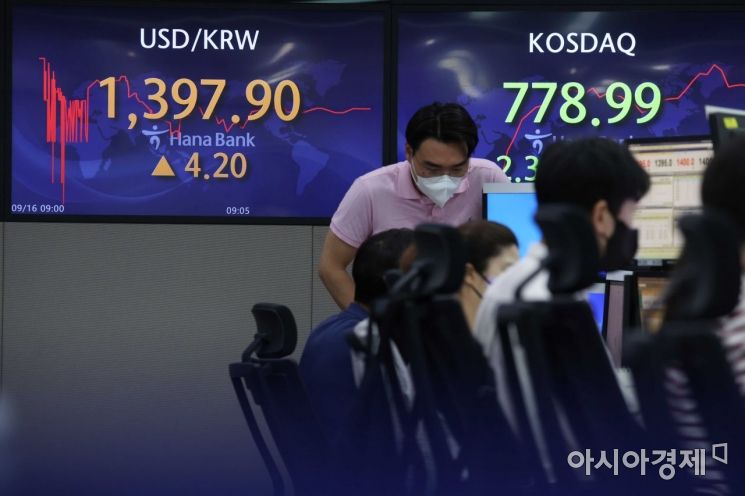
 On the 16th, when the won-dollar exchange rate started to rise, dealers were working in the dealing room of Hana Bank in Euljiro, Seoul. Photo by Moon Honam munonam@
[Asia Economy Reporter Kwon Jae-hee] As the 'King Dollar' continues, the market capitalization of stocks held by foreign investors in the domestic stock market has plummeted to the 30% range. This is the lowest level since July 2009.
With the strong dollar pressure pushing the won-dollar exchange rate to just below 1,400 won, it is interpreted that the foreign selling spree is continuing, putting pressure on stock market supply and demand.
According to the Korea Exchange on the 18th, as of the 15th, the total market capitalization of the KOSPI market was 1,892 trillion won, of which the market capitalization of stocks held by foreigners was 575 trillion won.
Based on market capitalization, the proportion of stocks held by foreigners is 30.39%. This is the lowest in about 13 years and 2 months since July 27, 2009, when it was 30.37%.
The foreign ownership ratio of KOSPI was close to 40% in early 2020. Since then, due to the COVID-19 pandemic and the surge in individual stock investment, it decreased to 36.50% at the end of 2020 and 33.55% at the end of 2021.
This year, it rose to 34.20% on January 25, ahead of the LG Energy Solution IPO, but gradually declined to the 30% range.
Considering the trend, there is a strong possibility that the foreign ownership ratio will soon fall below 30%. If the 30% range breaks, it will be the first time since July 13, 2009 (29.92%).
The reduction in foreign ownership ratio is largely due to foreign selling. Recently, as the won-dollar exchange rate's upward trend accelerated, the foreign selling pressure has intensified.
Despite unfavorable conditions such as won depreciation and the interest rate inversion between Korea and the U.S., foreigners who showed net buying in the KOSPI market in July and August eventually turned to net selling in September.
At the beginning of this month, the won-dollar exchange rate surpassed 1,360 won for the first time in 13 years and 4 months and continued its rapid rise, soaring to just below 1,400 won in about two weeks.
Since September, out of 10 trading days until the 16th, foreigners showed net buying in KOSPI only on the 13th (400.4 billion won). The cumulative net selling amount during this period was 1.5286 trillion won.
Amid high inflation pressures and concerns about tightening, global risk asset investment sentiment has weakened, and the deepening won depreciation is considered a factor that further accelerates foreign capital outflows.
The sharp rise in the won-dollar exchange rate acts as a negative factor for foreign supply and demand, pulling down stock prices and leading to a vicious cycle that causes further exchange rate hikes.
The KOSPI, which recovered to the 2,500 level in August, recently fell below the 2,400 level again due to foreign selling pressure, giving up the 'bear market rally' gains since early July.
Labor Gil, a researcher at Shinhan Financial Investment, explained, "The won-dollar exchange rate and KOSPI foreign supply and demand generally show a negative correlation coefficient," adding, "From the perspective of foreign investors, when the exchange rate rises, exchange losses can increase, accelerating capital outflows."
He also added, "If the exchange rate rise is seen as a result of export slowdown, it can induce foreign net selling from a fundamental perspective," and "Because the relationship between exchange rate, foreign supply and demand, and fundamentals is close, the strong dollar means a weakening of domestic stock market returns."
© The Asia Business Daily(www.asiae.co.kr). All rights reserved.

















