POSCO Holdings Expected to Decrease by 49.4% Compared to Same Period Last Year
Hyundai Steel and Dongkuk Steeldown by 35.1% and 45.8%, Respectively
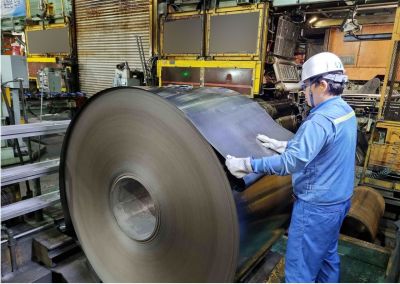 The first electrical steel sheet product produced on the 15th after the normalization of POSCO Pohang Steelworks 3rd Electrical Steel Sheet Plant. Photo by POSCO
[Asia Economy Reporter Choi Seoyoon] As Typhoon Hin Namno swept through the steel industry, the sector's third-quarter earnings are expected to worsen compared to last year. Weak demand and falling steel prices are cited as common causes of the poor performance.
According to financial information firm FnGuide on the 17th, POSCO Holdings' third-quarter operating profit is forecasted at 1.578 trillion KRW, a 49.4% decrease from the same period last year.
Hyundai Steel's third-quarter operating profit is expected to decline by 35.1% to 536.2 billion KRW, while Dongkuk Steel is projected to earn 161.8 billion KRW, down 45.8% from a year ago.
Among the three major domestic steel companies, the operating profit forecasts for POSCO Holdings and Hyundai Steel have decreased by 431.2 billion KRW (5.4%) and 100.5 billion KRW (3.7%), respectively, compared to three months ago.
The industry points to the decline in raw material and product steel prices as the cause of the third-quarter earnings deterioration for the three steel companies. Hyunsoo Lee, a researcher at Yuanta Securities, analyzed, "The thick plate segment, which improved profitability by raising shipbuilding-related sales prices in the second quarter, is expected to see a decline in profitability as further price increases become difficult in the second half. The cold-rolled segment has seen demand decrease this year, leading to reduced sales volume and spread compared to last year."
Hot-rolled steel sheet prices are also struggling. According to the industry, as of early this month, the domestic prices of hot-rolled steel sheets from POSCO and Hyundai Steel are 1.05 million KRW and 1.06 million KRW per ton, respectively. This is about a 17% drop from 1.26 million KRW per ton three months ago.
With demand falling, steel market conditions weakening, and inventories rising, POSCO has also considered reducing production by 20,000 tons of wire rods and 50,000 tons of stainless steel to defend prices. According to POSCO Holdings, steel inventory assets in the first half increased by about 17.2% from the end of last year to 14.0998 trillion KRW.
The sharp rise in exchange rates and increased import raw material costs are also negative factors for the steel industry, which relies on imported raw materials to produce steel products. Hyuntae Kim, a researcher at BNK Investment & Securities, evaluated, "With demand from downstream industries falling short of expectations and average rebar selling prices declining since June, an inventory reversal effect is expected. The second half will inevitably be affected by slower construction starts and rising interest rates."
Meanwhile, POSCO announced that sales are expected to decrease by 2.004 trillion KRW due to flooding damage at the Pohang Steelworks caused by Typhoon Hin Namno. The scale of production disruption is estimated at 1.7 million tons. The company explained that sales decline expanded as the normalization of the STS segment, including the STS cold-rolling plant adjacent to the cold stream, which suffered relatively severe damage, was delayed.
© The Asia Business Daily(www.asiae.co.kr). All rights reserved.
!["The Woman Who Threw Herself into the Water Clutching a Stolen Dior Bag"...A Grotesque Success Story That Shakes the Korean Psyche [Slate]](https://cwcontent.asiae.co.kr/asiaresize/183/2026021902243444107_1771435474.jpg)
















