Most Agenda Items Agreed Upon, Including Low Wage Increase and Forced Relocation to Provinces
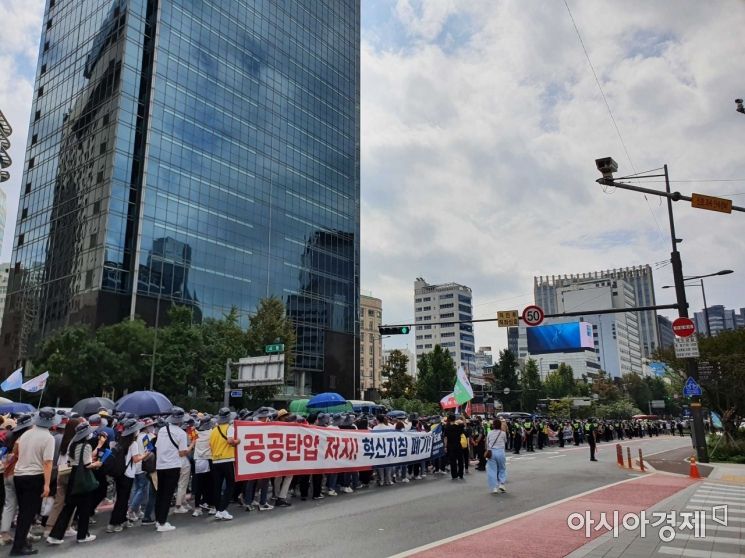 On the 16th, participants of the nationwide financial industry labor union (Geumyung Nojo) general strike held a street march around Sejong-daero, Jung-gu, Seoul.
[Asia Economy Reporter Minwoo Lee] The nationwide general strike by the Financial Industry Labor Union (Financial Union), held for the first time in six years, saw a large influx of the 2030 generation expressing strong dissatisfaction. While agreeing with issues such as wage increases below the inflation rate and the destruction of financial publicness, they also expressed fatigue with the 'noble union' frame.
On the morning of the 16th, the Financial Union held a rally with about 30,000 participants (estimated by the organizers) around the Sejong-daero intersection in Gwanghwamun, Seoul, and launched a general strike struggle. Afterwards, they marched on foot to the Samgak area in Yongsan-gu, Seoul, near President Yoon Seok-yeol's office, and then dispersed.
Notably, many employees in their 20s and 30s attended the event. A Financial Union official said, "I was surprised by the higher-than-expected participation rate of the younger generation," adding, "It seems they agreed with the various issues raised by the union, thinking of them as 'their own matters.'"
In fact, most of the 2030 generation met on site sympathized with the union's claims. Mr. A, a junior employee in his early 30s at a mutual finance institution, said, "I came up from the provinces to participate because I absolutely could not accept the wage increase rate proposed by the employer," and added, "I joined the strike for the first time because I couldn't understand the imposition of actual wage cuts on the private sector."
Mr. B, an 11-year employee at a regional bank, especially expressed frustration with the 'noble union frame.' He said, "I agree with issues such as low wage increase rates and unreasonable provincial relocations, but what angers me the most is being labeled as a noble union," and stated, "I participated in the general strike six years ago, and as long as this frame continues, I plan to actively participate in future general strikes."
Employees of policy banks strongly opposed the recent controversy over the transfer of prime clients. According to a document titled 'Prime and Mature Stage Loan Classification Scenario' from KDB Industrial Bank, obtained by Kim Ju-young, a member of the National Assembly's Planning and Finance Committee from the Democratic Party, the bank analyzed the effects of transferring about 18.3 trillion KRW in operating assets of 'prime' clients with the highest credit rating to private banks. Transferring prime clients and relocating to provinces is perceived as tantamount to dismantling a policy bank. Mr. C, a junior employee at IBK Industrial Bank, said, "I came to the rally because I strongly sympathize with adjusting the wage increase rate and blocking the forced relocation of KDB," and lamented, "At this rate, wages will effectively be cut, and I am worried that unjustified relocations of public institutions will accelerate in the future."
© The Asia Business Daily(www.asiae.co.kr). All rights reserved.

















