Ministry of Gender Equality's Budget for Rights Sector to Increase by 1.5% Next Year
Victim Protection Act Pending in National Assembly
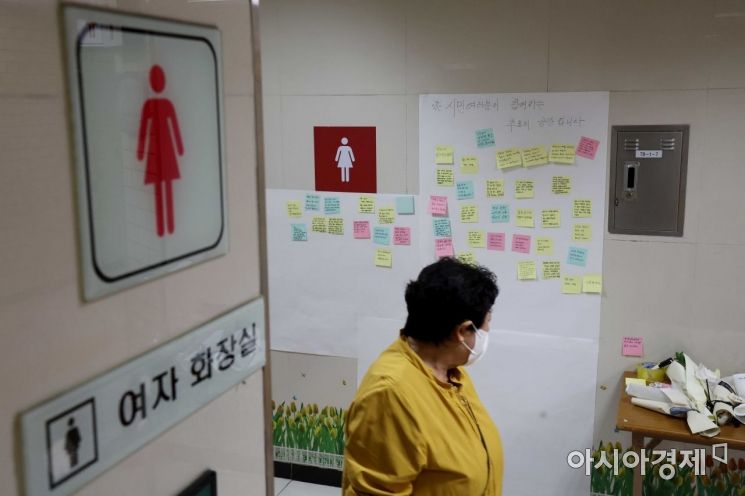 At the entrance of the women's restroom at Sindang Station on Seoul Subway Line 2, where a female attendant was killed by a coworker who had been stalking her, citizens continue to visit to pay their respects. Photo by Moon Honam munonam@
The murder of a station attendant at Sindang Station has highlighted the urgent need to strengthen legal and institutional measures to protect women. However, budget increases fall short of expectations, and laws to protect victims from stalking remain dormant in the National Assembly.
On the 16th, the Ministry of Gender Equality and Family (MOGEF) confirmed that it allocated 137.2 billion won for the "rights and interests" sector in 2023. This year's budget for the rights and interests sector is 135.2 billion won, a 1.5% increase from the previous year. MOGEF’s rights and interests sector develops policies to support women exposed to sexual violence, dating violence, and violent crimes. The ministry’s total budget for next year is 1.5505 trillion won, a 5.8% increase, but the budget related to this murder case has only slightly increased. This is interpreted as a reduction in investment in women’s protection projects due to debates over the possible abolition of MOGEF.
Investment in the police’s capacity to investigate crimes related to women is increasing, but concerns remain. Next year’s budget for police investigations into crimes against women is 4.7 billion won, about a 38% increase compared to this year. However, stalking crimes are rapidly increasing. According to data submitted by the National Police Agency to Lee Hyung-seok, a member of the National Assembly’s Public Administration and Security Committee from the Democratic Party, the number of 112 emergency calls related to stalking crimes last year was 14,509, a 3.2-fold increase from the previous year.
The Stalking Punishment Act was enacted in October last year, but the "Act on Prevention of Stalking and Protection of Victims" (Victim Protection Act) remains pending in the National Assembly’s Gender Equality and Family Committee. The government submitted the Victim Protection Act to the National Assembly in April, but discussions about abolishing MOGEF have pushed it to the back burner. According to this bill, the state and local governments would be required to operate systems and facilities to protect and support stalking victims. It also proposes establishing judicial police management to enable immediate response and action upon receiving stalking reports. The regret is that if the Victim Protection Act had been in place, the victim of the Sindang Station case, who endured stalking for three years, could have been more thoroughly protected.
While budget increases are insufficient and the passage of the bill is stalled, similar stalking murder cases continue. In June, in Seongnam City, Gyeonggi Province, a man in his 50s murdered his former cohabiting partner who was under personal protection. The perpetrator reportedly stalked the victim by visiting her workplace twice a day after assaulting her and being unable to meet her. Around the same time, in Ansan City, Gyeonggi Province, a woman under personal protection was killed by a man in his 60s wielding a weapon. The perpetrator in this case was also previously charged with stalking.
Heo Min-sook, a researcher at the National Assembly Legislative Research Office, said, "In stalking crimes, victims are in extremely dangerous situations until the perpetrator is punished. If active sanctions cannot be imposed on the perpetrator, at least victim protection should be strengthened, but even that is not happening."
© The Asia Business Daily(www.asiae.co.kr). All rights reserved.

















