Shock in US August Consumer Price Index (CPI)
Not Expected to Plunge as Much as US Stock Market
Future Stock Market Decline Seems Inevitable
Buying at Low Points More Promising Than Panic Selling
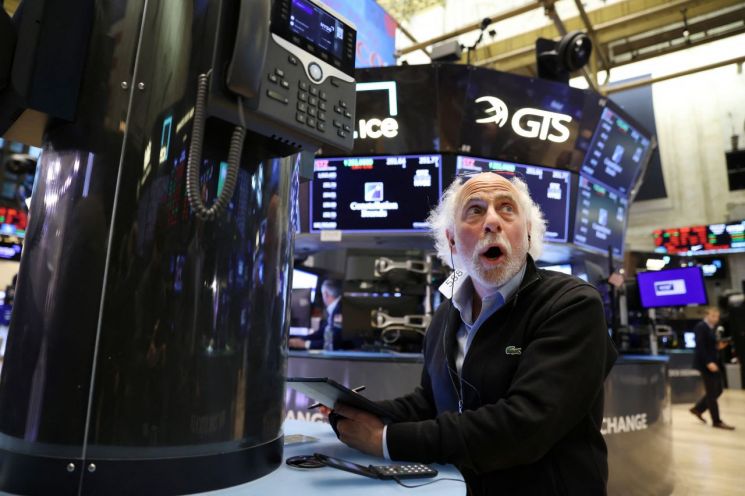
[Asia Economy Reporter Junho Hwang] Despite the strengthening of the US tightening stance, inflation has not subsided, causing growing concerns among retail investors. Heads of equity management departments at domestic asset management firms predict that the decline in the domestic stock market will be less severe than that of the US stock market, but they advise against excessive optimism like during the COVID-19 stock market boom. It is an analysis that now is the time to develop stock-specific response strategies rather than panic selling.
On the 14th, after a meeting on measures following the rise in the US Consumer Price Index, Sangjin Jeong, Head of Equity Management at Korea Investment Trust Management, said, "In the recent strong dollar phase, the rise in the US stock market despite the increase in energy prices was seen as a sign that the US tightening stance would change," adding, "This makes it difficult to easily change the US tightening stance even if inflation calms down."
Recently, the US S&P showed an upward trend between the 6th and 12th, while South Korea's KOSPI rose on the 8th and 13th. Due to the Chuseok holiday, a surge in demand on the 13th caused the KOSPI to rise by 2.74% in a single day. However, after the US Consumer Price Index was announced on the 13th (local time), the Nasdaq fell by 5.16% and the S&P 500 by 4.32%.
Yuk Jinsoo, Head of Global Operations at Mirae Asset Global Investments, analyzed, "Although the difference in inflation figures does not seem large, it should be viewed as a trend," adding, "Fear of further US tightening, inflation becoming entrenched contrary to market expectations, and other factors have caused panic."
With the possibility of a benchmark interest rate hike exceeding expectations (1%) emerging in the US, the prevailing view is that the stock market will face difficulties going forward.
Jeong said, "It is reasonable to see the stock market as difficult in the future," adding, "Although some of this has already been reflected in the market, the impact of the strong dollar will be significant," and predicted, "However, the impact on the domestic stock market is expected to be somewhat less than on the US stock market." Accordingly, he observed, "It is unlikely that institutions will sell off stocks; rather, they are likely to adopt a box-range strategy of buying when prices fall and selling when they rise."
Song Taewoo, Head of Equity Management at Hanwha Asset Management, said, "Since commodity prices that affected inflation in the first half of this year have somewhat stabilized, performance improvement factors are expected to appear in the first half of next year," adding, "We believe the effect of current stock selling is not significant, and we are considering market responses from a bottom-buying perspective in case of further declines."
Seobeomjin, Head of Growth at Samsung Active Asset Management, also said, "It has been confirmed that the problem is the market's premature expectations of inflation peaking and interest rate cuts," adding, "It seems advisable to confirm that inflation is easing for a while and consider bottom-buying and increasing weights." He continued, "We plan to maintain a low proportion of technology and growth stocks vulnerable to interest rate hikes and increase liquidity," adding, "However, since stock prices have already adjusted by more than 20% compared to the beginning of the year, it is a situation where stock-specific responses are needed rather than panic selling."
© The Asia Business Daily(www.asiae.co.kr). All rights reserved.

















