'Monster Monsoon' Hits Pakistan... Irregular Patterns and Increased Heavy Rainfall Due to Climate Change
Differences in Perspectives Between Developed and Developing Countries on the 'Climate Crisis'... Compensation for Damages Also Difficult
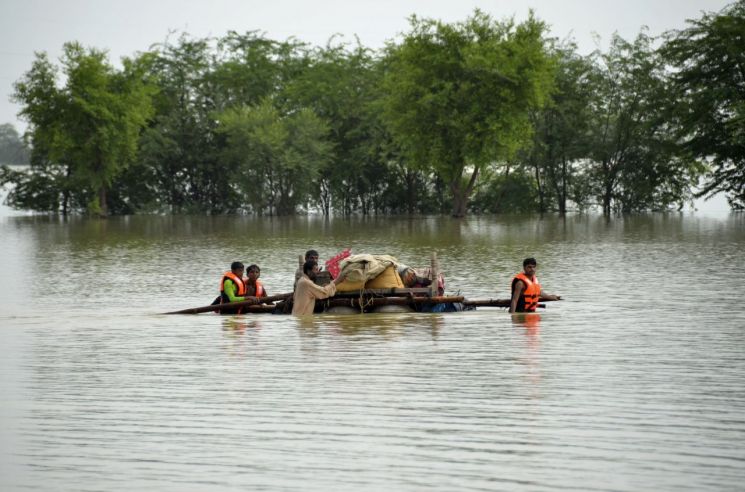 On the 28th of last month (local time), disaster victims in Zafarabad, Balochistan province, southwestern Pakistan, are loading household items onto rafts to escape the flood-affected area. [Image source=Yonhap News]
[Asia Economy Reporter Yoon Seul-gi] An analysis has revealed that the damage caused by the unprecedented 'Monster Monsoon' in Pakistan amounts to approximately 41 trillion won. This figure corresponds to about 74% of Pakistan's annual budget and is expected to place a significant burden on the country, which is already experiencing a severe economic crisis. As global warming accelerates, it is predicted that developing countries like Pakistan, which suffer from climate-related damages, will increase rapidly; however, discussions on compensation for these damages in the international community remain stagnant.
Last month, Pakistan suffered severe damage due to the worst monsoon floods triggered by the climate crisis. According to Pakistani authorities, 33 million people, or 15% of the population, were affected by the floods. The death toll reached approximately 1,400. Lakes overflowed, destroying 8,094 km² of farmland?equivalent to 13 times the area of Seoul?and 19 water supply systems. Additionally, houses, roads, railways, livestock, and crops were lost.
To make matters worse, there are signs of the spread of waterborne infectious diseases. The floods have paralyzed social infrastructure, disrupting the supply of clean drinking water, forcing displaced people to drink floodwater out of necessity.
The economic damage is also immense. On the 9th, United Nations Secretary-General Ant?nio Guterres stated at a press conference in Pakistan that the preliminary estimate of flood damage in Pakistan exceeds 30 billion dollars (about 41.6 trillion won). This amount corresponds to about 74% of Pakistan's annual budget; according to the Pakistani government, the 2022-23 budget is 9.52 trillion Pakistani rupees (about 55 trillion won). Compared to Pakistan's nominal GDP in 2021, as compiled by the World Bank, this is about 9% of the total.
This heavy rainfall is related to the South Asian monsoon, which occurs between June and September in Pakistan. The South Asian monsoon is a seasonal wind that brings moist air to the region during summer, causing heavy rains. The summer monsoon provides 65-75% of Pakistan's annual water supply and plays a crucial role in agriculture and the livelihoods of residents.
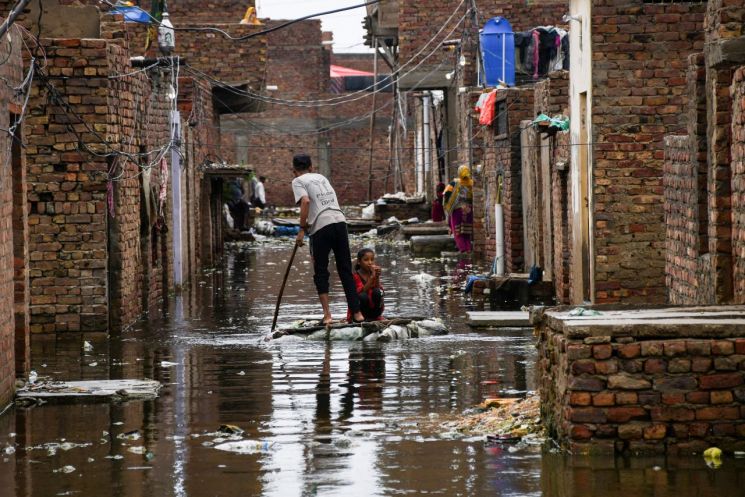 On the 24th of last month (local time), a man and a girl are riding a raft through flooded streets in Hyderabad, Sindh Province, southern Pakistan, where monsoon heavy rains poured.
 [Image source=Yonhap News]
The problem is that recent climate change has made monsoon patterns irregular and increased the frequency of heavy rainfall. According to the Washington Post (WP) on the 31st of last month, Pakistan received 190% of its average rainfall from June to August this year. In July, which saw the highest rainfall since 1961, the monsoon rainfall exceeded the usual amount by about 26%.
Record-breaking heavy rains during the monsoon period also caused frequent flooding. Although the soil was saturated and could no longer absorb rainwater due to earlier rains, precipitation peaked in August, resulting in severe damage.
Pakistan's Minister of Climate Change, Sherry Rehman, described this as a 'Monster Monsoon.' She said, "The monster monsoon is causing continuous chaos across the country," adding, "Many areas of this country have been submerged due to eight weeks of continuous heavy rain. Floods are pouring in from all directions."
The Pakistani government has labeled this situation a 'climate disaster' and pointed to the responsibility of developed countries for climate change. Minister Rehman told The Guardian on the 4th, "Global warming is an existential crisis facing the world, and Pakistan has become ground zero (the epicenter of the catastrophe). However, Pakistan accounts for less than 1% of global greenhouse gas emissions."
Voices in the international community have also called for holding wealthy countries accountable for the floods in Pakistan. On the 10th (local time), Secretary-General Guterres visited Karachi in southern Pakistan, which suffered severe flooding during the monsoon, stating that the G20 countries emit 80% of today's greenhouse gases and that "wealthy countries have a moral responsibility to help developing countries like Pakistan recover from such disasters." He added, "Today it is Pakistan, but tomorrow your country could be the victim. This is a global crisis and requires a global response."
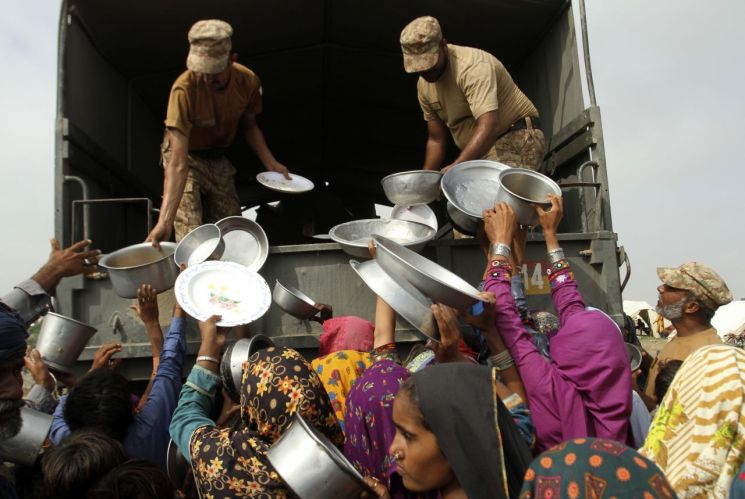 Pakistani soldiers are distributing food to flood victims in the flood-affected area of Rajanpur, Punjab Province, on the 27th of last month (local time). [Image source=AP Yonhap News]
◆ Differences in Perspectives Between Developed and Developing Countries on the 'Climate Crisis'... What About the Costs of the 'Climate Disaster'?
While countries agree on the need to reduce carbon emissions to slow the pace of global warming, opinions diverge on who is responsible for the climate crisis.
Developed countries argue that developing countries must actively reduce carbon emissions immediately to prevent the climate crisis, whereas developing countries claim that developed countries, which account for most of the accumulated carbon emissions, bear the responsibility. Due to these differing views on the main actors in the climate crisis, it is expected to be difficult to reach an agreement on the costs of climate damage.
There have already been calls for developed countries to pay compensation to countries affected by climate damage. At the 26th United Nations Climate Change Conference of the Parties (COP26) last November, AK Abdul Momen, Bangladesh's Foreign Minister, said, "Many have lost their lives and futures," adding, "Someone must take responsibility."
Mia Mottley, Prime Minister of the Central American island nation Barbados, also stated in her COP26 speech, "The tropical island countries most at risk emit less than 1% of global greenhouse gases, while Northern Hemisphere countries emit 70%," emphasizing, "It is unfair and immoral to make the victims pay."
However, developed countries have been avoiding the issue of compensation for climate crisis damages. Developed countries, including the Group of Seven (G7), previously pledged in 2008 to provide at least 100 billion dollars annually by 2020 to help developing countries overcome climate damage, but this commitment has not been fulfilled.
© The Asia Business Daily(www.asiae.co.kr). All rights reserved.



















