Early Holiday Period Saw Decline in Diagnostic Tests, But Numbers Rise Again Ahead of Return to Daily Life
This Fall's COVID-19 and Flu 'Twin-demic' Inevitable... Other Viruses Also Spreading
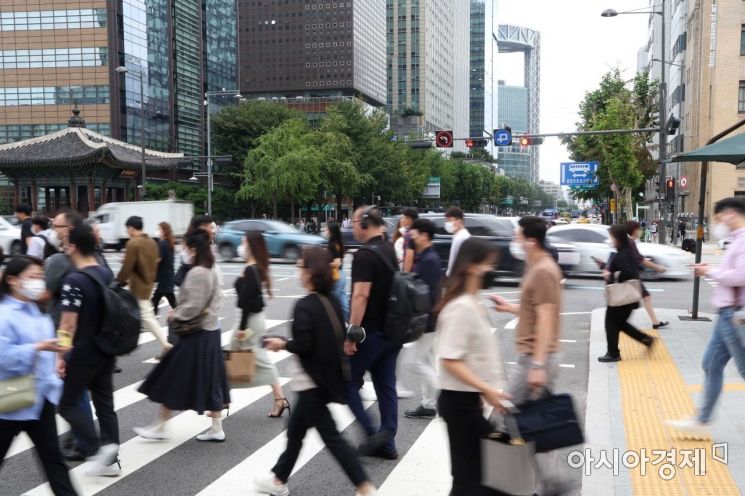 On the 13th, the first working day after the Chuseok holiday, office workers are hurrying their steps at Gwanghwamun Intersection in Seoul. Photo by Mun Ho-nam munonam@
[Asia Economy Reporter Jo In-kyung] Although the resurgence of COVID-19 has shifted to a declining trend, it is predicted that cases will increase again for a while after the holidays. The so-called 'twindemic,' where COVID-19 and seasonal influenza (flu) spread simultaneously, also appears unavoidable.
According to the Central Disease Control Headquarters on the 13th, as of midnight that day, the number of new COVID-19 cases increased by 57,309, bringing the total cumulative cases to 24,099,134.
The daily new cases had decreased from 72,646 on the 8th, to 69,410 on the 9th when the holiday began, then to 42,724 on the 10th, 28,214 on the 11th, and 36,938 on the 12th, but rose again to over 50,000 on this day. This is interpreted as the number of diagnostic tests, which had decreased in the early holiday period including the weekend, increasing again as people prepared to return to daily life in the latter part of the holiday.
Jung Ki-seok, chairman of the National Infectious Disease Crisis Response Advisory Committee, said in an interview with MBC Radio's 'Kim Jong-bae's Focus' on the same day, "The number of new cases (after the Chuseok holiday) will increase for a while," adding, "Although it dropped to the 60,000 range before the holiday, starting tomorrow (the 14th), it will increase significantly, surpassing 100,000, then maintain that level for a while before showing a decreasing trend again."
Influenza (seasonal flu) cases are also continuously rising during the summer. According to the Korea Disease Control and Prevention Agency, during the 36th week of this year (August 28 to September 3), the number of suspected seasonal flu patients per 1,000 outpatients was 4.7, an increase of 0.5 from 4.3 the previous week. Suspected flu patients are those showing symptoms such as high fever along with cough or sore throat, and the numbers have sharply increased for five consecutive weeks following 3.3 in the 32nd week (July 31 to August 6), 3.7 in the 33rd week, and 4.2 in the 34th week.
This level is high even compared to typical late summer flu patient occurrences. In the 36th week of 2018 and 2019, the number of suspected flu patients was 4.0 and 3.4 respectively, while in the same period in 2020 it was 1.7, and in 2021 it was only 1.0.
Seasonal flu mainly spreads in autumn and winter, but since the outbreak of COVID-19 in early 2020, mask-wearing became routine and social distancing reduced face-to-face activities, so flu did not spread for the past two years. However, this year, as outdoor activities have increased, the flu virus appears to be spreading again even before autumn arrives.
Other viral infectious diseases, which had been quiet until now, are also showing signs of an outbreak. Hospitalized patients with viral acute respiratory infections (adenovirus, bocavirus, parainfluenza, respiratory syncytial virus (RSV), rhino virus, metapneumovirus, coronavirus), which can be fatal to infants and the elderly, numbered 665 in the 36th week, about seven times higher than 94 during the same period last year.
Suspected hand, foot, and mouth disease patients, who mainly develop blistering rashes on the hands, feet, and lips of infants, also reached 37 per 1,000 outpatients, the highest since 2017.
Experts are concerned that if these viruses spread simultaneously while the COVID-19 pandemic continues, it will place a significant burden on the medical response system. Especially for seasonal flu, symptoms such as fever, sore throat, cough, chills, and muscle pain are similar to those of COVID-19, and if high-risk groups such as the elderly and those with underlying conditions become infected, the risk of severe illness is high, so they recommend getting an accurate diagnosis.
Chairman Jung said, "Since there were no many flu patients detected in early to mid-September, some level of flu outbreak this fall is inevitable," and urged, "If you have symptoms, do not hesitate and visit a nearby clinic to get tested for both flu and COVID-19 simultaneously."
© The Asia Business Daily(www.asiae.co.kr). All rights reserved.

















