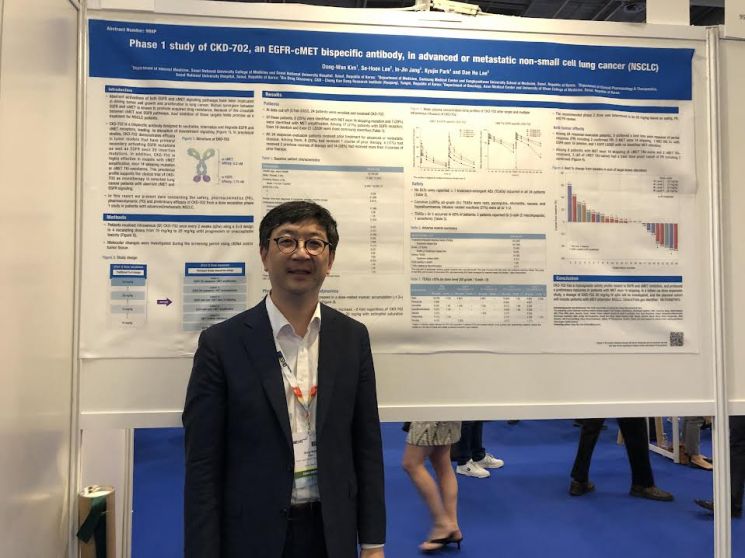
 Professor Dongwan Kim, Department of Oncology, Seoul National University Hospital, presenting the poster and presentation of the Phase 1 clinical trial results of Chong Kun Dang's bio new drug 'CKD-702' at the 2022 European Society for Medical Oncology (ESMO) Annual Congress
[Asia Economy Reporter Chunhee Lee] Chong Kun Dang announced on the 13th that it presented the Phase 1 clinical trial results of the anti-cancer bispecific antibody biopharmaceutical ‘CKD-702’ in a poster session at the ‘2022 European Society for Medical Oncology (ESMO)’ annual conference held in Paris, France.
ESMO, held from the 9th to the 13th of this month in Paris, is the largest cancer academic conference in Europe and is considered one of the world’s top three cancer societies alongside the American Society of Clinical Oncology (ASCO) and the American Association for Cancer Research (AACR). Being the last of these conferences, it is also regarded as a precursor to the following year’s JP Morgan Healthcare Conference, the world’s largest event for technology transfer and investment attraction.
Chong Kun Dang began the Phase 1 clinical trial of CKD-702 in 2020 to determine the recommended Phase 2 dose (RP2D) and to evaluate pharmacokinetic characteristics, safety, and anti-tumor efficacy in patients with advanced or metastatic non-small cell lung cancer (NSCLC) who failed standard therapy. The first part of Phase 1, dose escalation, has been completed, and the second part, dose expansion, is currently underway. The data presented this time are preliminary analysis results of 24 patients enrolled in the dose escalation part.
As a result, no dose-limiting toxicities (DLTs) were observed in any dosing group of CKD-702. Adverse events identified in the clinical trial, such as rash, paronychia, stomatitis, nausea, hypoalbuminemia, and infusion-related reactions, were mostly consistent with those seen in epidermal growth factor receptor (EGFR) and hepatocyte growth factor receptor (c-MET) inhibitors. Exposure to CKD-702 in the body increased proportionally with doses ranging from 10 to 25 mg/kg, and the recommended Phase 2 dose was determined to be 20 mg/kg.
The second part is being conducted at nine domestic institutions including Seoul National University Hospital to evaluate the anti-tumor efficacy of CKD-702 in patient groups with MET gene alterations such as MET exon 14 skipping mutation, MET gene amplification, and MET protein overexpression.
Professor Dongwan Kim of the Department of Oncology at Seoul National University Hospital, who presented the research results at ESMO, stated, “Based on the safety and preliminary responses observed in the first part, we confirmed the potential of CKD-702 as a new treatment option for cancer patients. Since there is currently no treatment for patients with MET gene amplification or MET protein overexpression, expectations for the results of the second part of CKD-702 are high.”
CKD-702 is an anti-cancer bispecific antibody that simultaneously targets EGFR and c-MET, which are essential for cancer cell growth and proliferation. By binding simultaneously to EGFR and c-MET, it induces degradation of both receptors and blocks signaling to inhibit cancer cell proliferation. Additionally, it induces antibody-dependent cellular cytotoxicity (ADCC), helping immune cells exert cytotoxic effects on cancer cells. This mechanism is expected to overcome resistance issues of targeted cancer therapies, making CKD-702 a promising biopharmaceutical.
© The Asia Business Daily(www.asiae.co.kr). All rights reserved.

















