Many Seasonal Workers Unauthorized Absences... Challenges in Implementing the System
Gangwon-do Promotes Rural '1+1 Hand Helping Challenge' Until November
Government Accelerates Expansion of 'Public Seasonal Worker System' by 3 Years
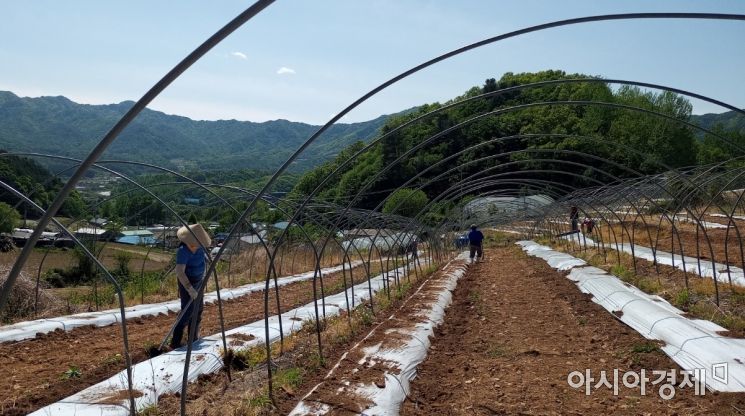
[Asia Economy Reporter Ra Young-cheol] To address the labor shortage in rural areas caused by the aging agricultural workforce, the government introduced the 'Foreign Seasonal Worker System,' but due to inadequate management systems for foreign workers, rural areas are still facing difficulties in securing labor.
In particular, a significant number of seasonal workers have absconded without permission, highlighting the need for fundamental countermeasures.
Introduced in 2015, the seasonal worker system is a policy that allows the short-term (up to 5 months) employment of foreigners to work in rural areas.
According to Gangwon Province, currently about 3,000 'foreign seasonal workers' are working in 14 cities and counties within the province.
However, many farms still struggle due to labor shortages, unable to carry out planned work.
Most farms either had to postpone planting new seedlings due to lack of labor or applied for foreign worker employment permits but were rejected for not meeting the required scores.
Cheorwon County, which faces severe labor shortages, introduced seasonal workers from Vietnam last year, but many absconded without permission, causing difficulties in implementing the seasonal worker program.
This year, the number of foreign seasonal workers who absconded in Gangwon Province totaled 98. This accounts for about 3.5% of the 2,759 foreign seasonal workers in the province during the first half of the year.
By region, Yanggu recorded the highest number with 52, followed by Inje with 34, Pyeongchang 5, Hoengseong 2, Samcheok 2, Chuncheon 2, and Yeongwol 1.
The number of absconders has been increasing annually. In 2019, 22 out of 1,464 absconded, and in 2021, when entry resumed after a temporary suspension due to COVID-19, 231 out of 382 absconded, accounting for about 60.4%.
Farmers unanimously state, "The labor shortage in rural areas can only be resolved by addressing fundamental rural issues such as hard labor, low income, and inconvenient living conditions."
Local governments also express that it is difficult to actively promote the seasonal worker program given the realities of rural areas.
Most regions requiring seasonal workers are small rural fishing and farming communities experiencing labor shortages due to aging populations and population decline.
Moreover, it is practically impossible for just 2 to 3 public officials responsible for the work to manage and supervise hundreds of seasonal workers scattered across various locations.
Accordingly, the province has decided to promote the '1+1 Helping Hands Challenge' for rural labor assistance involving all citizens until November, coinciding with the peak harvest season.
This is to stabilize agricultural labor supply through a 'helping hands relay' involving volunteer workers from provincial institutions, organizations, soldiers, and university students, as well as professional paid labor support such as rural labor brokerage centers and foreign seasonal workers.
The province plans to continue the labor assistance momentum in the second half of the year (harvest season) through the 'One More Time Challenge,' following the success of labor assistance by provincial government employees and 2,580 foreign seasonal workers during the first half (busy farming season).
To ensure stable rural labor supply, the province will improve accommodations for foreign seasonal workers and build 400 prefabricated houses by 2026 with a budget of 8 billion KRW starting next year.
Additionally, 20 public seasonal labor centers in the form of labor banks will be established with a budget of 3.2 billion KRW to support short-term workers employed for less than one month.
The government has also taken steps to secure foreign seasonal workers stably to solve the rural labor shortage problem.
On the 8th, the Ministry of Justice reviewed and finalized the 'Improvement Plan for Agricultural Seasonal Worker Management System' at the 6th National Policy Issues Ministerial Meeting chaired by Prime Minister Han Duck-soo.
It was decided to advance by three years the introduction of the 'Public Seasonal Worker System,' where local governments sign MOUs with foreign local governments and entrust specialized agencies to supply foreign workers.
In addition, the legal basis for operating the seasonal worker system will be established under the Immigration Control Act, and a seasonal worker network will be created to address grievances and complaints of foreign workers.
© The Asia Business Daily(www.asiae.co.kr). All rights reserved.
![Clutching a Stolen Dior Bag, Saying "I Hate Being Poor but Real"... The Grotesque Con of a "Human Knockoff" [Slate]](https://cwcontent.asiae.co.kr/asiaresize/183/2026021902243444107_1771435474.jpg)
















