Increase in Power Generation Share to 12.2%... Surpassing Wind Power (11.7%) and Hydropower (11%)
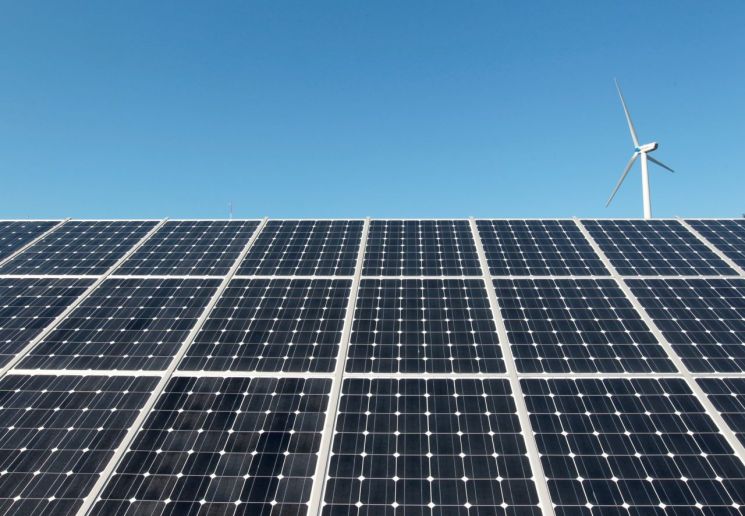
[Asia Economy Reporter Park Byung-hee] While the European continent is suffering from a heatwave this year, solar power generation has significantly increased.
According to Ember, a UK environmental think tank, major foreign media recently reported that solar power generation in the European Union (EU) this summer increased by 28% compared to the same period last year, marking an all-time high. This was due to the expansion of solar power facilities and prolonged periods of stronger sunlight than average this year.
Between May and August, the EU's solar power generation reached 99.4 terawatt-hours (TWh). Last year's solar power generation was 77.7 TWh. The share of solar power in total electricity production rose from 9.4% last year to 12.2% this year. Solar power generation surpassed wind power (11.7%) and hydropower (11%) shares.
According to Eurostat, the EU's statistical office, as of 2020, the share of electricity generation by source in the EU was 40.8% renewable energy, 30.5% nuclear energy, 14.6% coal, 7.2% natural gas, and 3.3% oil.
Ember estimated that solar power generation allowed the EU to reduce gas imports by 20 billion cubic meters, equivalent to four months' worth of gas imports. It also analyzed that this resulted in a reduction of fossil fuel import costs by 29 billion euros.
Pavel Cizak, a senior analyst and one of the report's authors, explained, "The fact that more than 10% of electricity can be obtained from the sun gives hope in terms of the transition to eco-friendly energy and energy security."
Since Russia's invasion of Ukraine on February 24, relations between the EU and Russia have deteriorated to their worst. The EU imposed sanctions on Russia, and Russia responded by halting natural gas exports to the EU. Russia was the EU's largest gas supplier, accounting for 40% of the EU's gas demand before the war broke out. The EU now faces the challenge of finding alternative energy sources to replace Russian gas.
Dolf Gielen, director of the International Renewable Energy Agency (IRENA), explained that the biggest reason for the record high solar power generation is the increase in solar power facilities across Europe. Gielen said, "Solar power facilities are increasing by about 15% annually," adding, "At minimum, solar power generation increases by 15%, and with improvements in solar panel efficiency, the actual increase in generation is more than 15%."
According to Ember, the EU's solar power facility capacity increased from 104 gigawatts (GW) in 2018 to 162 GW last year.
The severe drought caused by the heatwave also contributed to the increased share of solar power generation. The severe drought reduced hydropower capacity, and in France, nuclear power faced setbacks due to a shortage of cooling water.
By country, the Netherlands had the highest share of solar power generation at 22.7% among EU member states. This was followed by Germany (19.3%), Spain (16.7%), Greece (15.3%), Italy (15.0%), Hungary (14.7%), Estonia (13.9%), Cyprus (13.3%), Denmark (12.9%), and Belgium (12.8%). This year, with Belgium and Denmark surpassing 10% solar power share, the number of countries with solar power shares above 10% increased to 10.
The country with the largest increase in solar power generation was Poland. Poland's solar power generation increased 26-fold over the past five years. During the same period, Finland and Hungary's generation increased fivefold, and Lithuania and the Netherlands' generation increased fourfold.
© The Asia Business Daily(www.asiae.co.kr). All rights reserved.

















