Over 70,000 Cases of Fraudulent Benefits Detected in 3 Years and 6 Months
Assemblyman Min Hong-cheol: "We Must Prevent Errors and Fraudulent Claims"
The number and amount of fraudulent claims for housing benefits, which the government provides annually for housing-vulnerable individuals, have been increasing every year. In particular, although the number of cases of 'fake divorces' was small, a few individuals received a significant amount fraudulently.
According to data submitted by the Ministry of Land, Infrastructure and Transport to Min Hong-cheol, a member of the Democratic Party of Korea, over the past three and a half years, the amount the Ministry decided to recover from those who fraudulently received housing benefits reached 23.124 billion KRW.
Last year, the number of detected fraudulent housing benefit claims was 21,392 cases, an increase of more than 10% compared to 19,091 cases in 2019. This year, up to June, 11,862 cases of fraudulent claims have been detected.
The current criteria for 'fraudulent housing benefit claims' managed by the Ministry of Land, Infrastructure and Transport are divided into two categories: 'overpayments' caused by existing recipients failing to report or late reporting of changes in their income, assets, or residence, and 'intentional fraudulent claims' where benefits are received through other false or fraudulent methods such as common-law marriages or fake divorces.
Among the 72,224 detected fraudulent claims over the past three and a half years, 71,950 cases (99.6%) were overpayments. Intentional fraudulent claims accounted for only 274 cases.
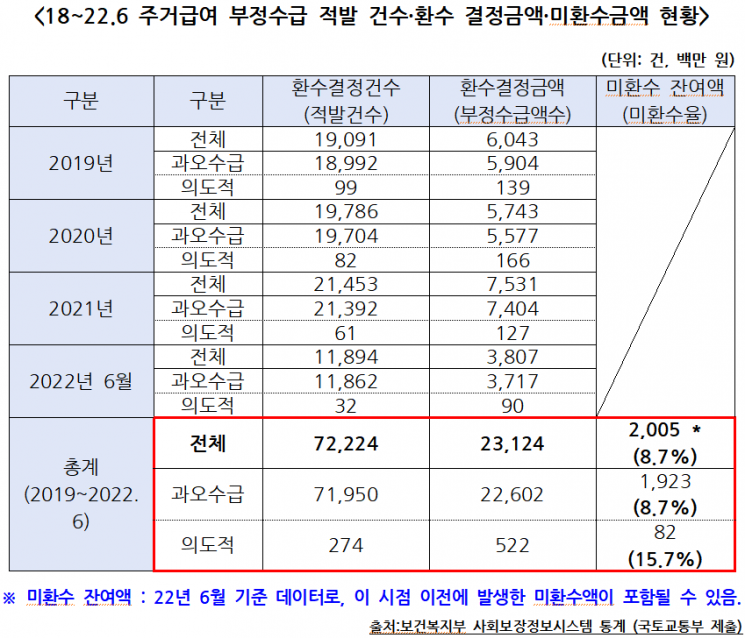
However, when looking at the average amount of fraudulent receipt per detected case by dividing the recovery decision amount by the number of detected cases, overpayments amounted to only 314,130 KRW, whereas intentional fraudulent claims reached 1,905,100 KRW. The amount received by those who intentionally committed fraud was more than six times higher.
Also, the non-recovery rate of housing benefit payments for which the government decided to take recovery measures over the past three and a half years was much higher among those who intentionally fraudulently claimed housing benefits.
Of the 22.06 billion KRW paid to those who overclaimed housing benefits over the past three and a half years, 1.923 billion KRW has yet to be recovered, resulting in a non-recovery rate of only 8.5%.
In contrast, for intentional fraudulent claimants, 82 million KRW remains unrecovered out of the total recovery decision amount of 522 million KRW, recording a non-recovery rate of 15.7%.
Min Hong-cheol said, "Housing benefits are the minimum welfare budget provided to ensure the quality of life for citizens with unstable housing," adding, "The government should establish measures to prevent both overpayments and fraudulent claims in advance and find ways to increase the recovery rate so that the budget can be more widely provided to citizens who truly need it."
© The Asia Business Daily(www.asiae.co.kr). All rights reserved.


















