August US CPI Release on the 13th
Fed Rate Hike Pace Gauge
Impact of US Giant Step↑
Pressure on BOK Rate Hike Likely to Increase
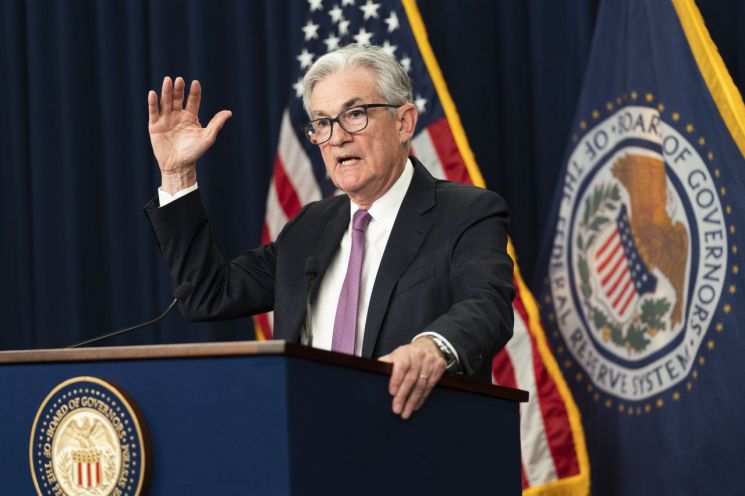 Jerome Powell, Chairman of the U.S. Federal Reserve (Fed), is speaking at a press conference held in Washington DC, USA, on July 27 (local time). [Image source=Yonhap News]
Amid growing concerns over domestic prices, exchange rates, and the stock market, attention is focused on how the market will move after the Chuseok holiday. Since the domestic market is heavily influenced by the dollar value and the pace of interest rate hikes by the U.S. Federal Reserve (Fed), the U.S. consumer price inflation rate, which significantly affects these factors, is expected to emerge as a key variable.
According to the financial market on the 11th, the U.S. Consumer Price Index (CPI) for August will be released on the 13th ahead of the Fed's Federal Open Market Committee (FOMC) meeting scheduled for the 20th-21st (local time). Previously, in June, the U.S. CPI surged to 9.1%, marking the highest level in 41 years since 1981, but in July, it slightly eased to 8.5% as international oil prices stabilized somewhat.
If the August CPI shows a clear slowdown, the Fed's pace of interest rate hikes may also slow down somewhat. According to Bloomberg consensus, the August CPI is expected to fall to 8.1% year-on-year, down from 8.5% in July. In this case, the preference for the dollar would stabilize, limiting the rise in the won-dollar exchange rate, and risk appetite in the stock market could improve, potentially triggering a rebound.
This week, the market showed instability due to Fed Chair Jerome Powell's strongly hawkish remarks. Expectations that U.S. interest rate hikes would accelerate caused the dollar value to rise, pushing the won-dollar exchange rate past 1,350 won, 1,360 won, 1,370 won, and 1,380 won sequentially, reaching the highest level since the financial crisis. The KOSPI also closed at 2,384.28, down 25.13 points (1.04%) compared to the previous week.
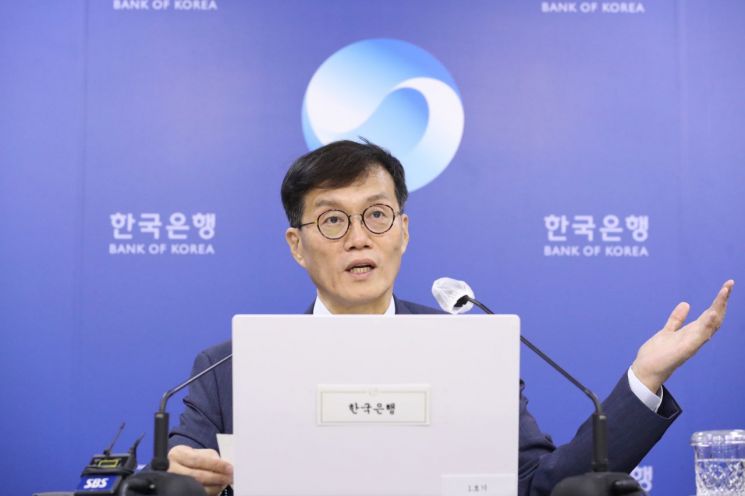 Bank of Korea Governor Lee Chang-yong is explaining the base interest rate hike at the monetary policy direction press conference held at the Bank of Korea in Jung-gu, Seoul, on the morning of the 25th of last month.
 [Image source=Yonhap News]
The outlook is not bright, although it may change depending on the U.S. August CPI. At last month's Jackson Hole meeting, Chair Powell said that "another exceptionally large rate hike may be appropriate" to respond to inflation, and at the recent monetary policy conference hosted by the Cato Institute in Washington D.C., he also stated that "history strongly warns against premature easing policies."
Accordingly, the market is increasingly predicting that the Fed will implement another 0.75% rate hike, a 'giant step,' at this month's FOMC. Even if inflation peaks, the Fed is likely to initially raise the benchmark interest rate sharply to enhance the effect of curbing inflation and then reduce the size of subsequent hikes.
In fact, on the 9th (local time), Fed Governor Christopher Waller said in a speech at the Institute for Advanced Studies (IAS) in Vienna, Austria, that he supports a large rate hike at the next meeting to bring the policy rate to a level that can suppress demand. Additionally, the robust U.S. employment figures in August also support the likelihood of a giant step at the FOMC.
If the Fed actually proceeds with three consecutive 'giant steps,' the ripple effects on the domestic market are expected to be significant. Although the Bank of Korea and the government have expressed confidence in economic stability, concerns over capital outflows and foreign exchange reserves may spread as the interest rate gap between Korea and the U.S. continues to widen. Furthermore, pressure for the Bank of Korea to raise rates will increase amid growing concerns about domestic and international economic slowdowns.
© The Asia Business Daily(www.asiae.co.kr). All rights reserved.


















