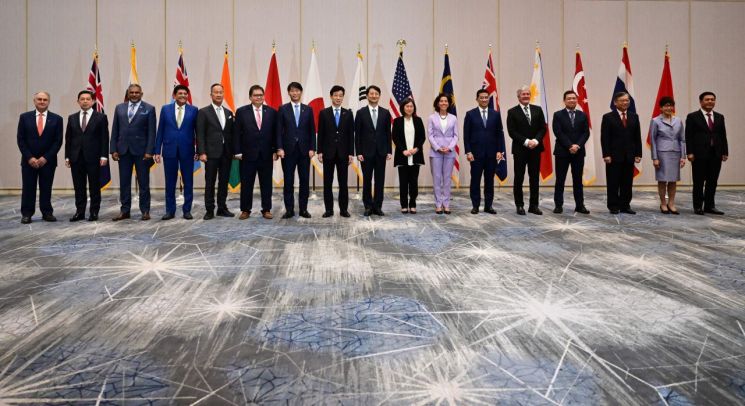
[Asia Economy Sejong=Reporter Kim Hyewon] The government, along with 14 participating countries including the United States and Japan, has declared the official commencement of negotiations for the Indo-Pacific Economic Framework (IPEF), a new economic and trade platform led by the United States.
According to the Ministry of Economy and Finance and the Ministry of Trade, Industry and Energy on the 10th, the IPEF participating countries agreed on ministerial declarations in four areas?trade, supply chains, clean economy, and fair economy?at the IPEF ministerial meeting held on the 8th and 9th (local time) in Los Angeles, USA, and announced the official start of negotiations.
The ministerial declarations announced this time are the result of intensive consultations since the launch of IPEF on May 23, outlining a new economic cooperation system covering digital, supply chains, climate change, and more. The participating countries?Korea, the United States, Japan, Australia, New Zealand, Vietnam, Brunei, India, Indonesia, Malaysia, the Philippines, Singapore, Thailand, and Fiji?held three ministerial-level meetings, dozens of senior representative-level and working-level consultations over about 100 days.
Looking at the main contents of the ministerial declarations by pillar, in the trade pillar, instead of market opening through tariff reductions under existing trade agreements, the countries agreed to cooperate to activate regional digital trade, promote eco-friendly and low-carbon trade and investment, innovate agricultural technology and ensure food security, and digitalize customs procedures.
In Pillar 2, the supply chain agenda, a crisis response mechanism will be established focusing on key sectors and items, and resilience of supply chains will be strengthened through investment.
For Pillar 3, the clean economy, the countries agreed to expand the dissemination, production, and trade of clean energy technologies, and for the fair economy, they agreed to enhance tax transparency and strengthen the implementation of anti-corruption agreements.
In Pillar 4, the fair economy sector, the 14 participating countries aim to create a fair economic environment that promotes regional economic activities such as trade and investment by enhancing tax transparency and strengthening anti-corruption agreement implementation. They also pledged to expand capacity building and technical support for developing countries to this end.
All 14 countries participate in the supply chain, clean economy, and fair economy agendas, while 13 countries except India participate in the trade agenda.
The Ministry of Trade, Industry and Energy explained that this agreement "will contribute to solving common challenges in the Indo-Pacific region by complementarily utilizing the characteristics and strengths of each participating country," and "especially, core mineral, clean energy, environment, and supply chain cooperation, which had been pursued bilaterally among participating countries, will be expanded in scope and level to 14 countries, creating greater synergy effects."
Based on the ministerial declarations, the participating countries will further specify the norms, cooperation details, and directions through agenda-specific negotiations in the future.
The Ministry of Economy and Finance stated, "Since IPEF is an economic cooperation platform aimed at addressing regional common challenges that have not been covered in previous trade negotiations, the participating countries agree on the need for rapid negotiation progress, and dense discussions are expected to produce concrete outcomes soon."
It added, "Our government will also participate in negotiations in the four areas to actively reflect our interests," and "plans to discover and propose intergovernmental cooperation projects in areas such as supply chain stabilization and clean energy, where concrete benefits can be felt early."
The government plans to cooperate as a 'one-team' with more than 20 related ministries and agencies including the Ministry of Trade, Industry and Energy, Ministry of Economy and Finance, Ministry of Foreign Affairs, Ministry of Agriculture, Food and Rural Affairs, Ministry of Oceans and Fisheries, Ministry of Science and ICT, Ministry of Justice, Ministry of Government Legislation, Anti-Corruption and Civil Rights Commission, as well as industry and experts.
© The Asia Business Daily(www.asiae.co.kr). All rights reserved.

















