KAIST, POSTECH, Sogang University, and Hanyang University to Admit New Students for Semiconductor Contract Departments
Contract Departments as a Quick Solution to Semiconductor Workforce Shortage... "Taiwan Also Promotes Contract Departments"
Tax Credit and Regulatory Improvement Plans for Semiconductor Contract Departments Proposed
"Multidisciplinary Approach Needed Due to Semiconductor Industry Characteristics"
[Asia Economy Reporter Kim Pyeonghwa] As talent development has emerged as a key issue in the semiconductor industry, the number of semiconductor contract departments in universities has doubled. This is evaluated as an effective measure to expand the workforce since graduates can be immediately deployed to the field. The government and the National Assembly have proposed regulatory improvements and tax credit plans to expand contract departments.
However, due to the characteristics of the semiconductor industry, opinions suggest that multidisciplinary considerations rather than focusing on specific departments are necessary. There are also claims that attention should be paid to securing talent outside the metropolitan area. Another challenge is securing sufficient faculty before expanding contract departments.
KAIST, POSTECH, Sogang University, and Hanyang University Establish New Semiconductor Contract Departments
According to the semiconductor industry on the 10th, the number of semiconductor contract departments linked with Samsung Electronics and SK Hynix will increase from three existing universities to four additional universities, resulting in more freshmen starting next year. Contract departments provide various support to enrolled students and guarantee employment at companies after graduation.
The Korea Advanced Institute of Science and Technology (KAIST) and Pohang University of Science and Technology (POSTECH) have established contract departments in cooperation with Samsung Electronics. KAIST has the Department of Semiconductor Systems Engineering, and POSTECH has the Department of Semiconductor Engineering. Both universities will admit freshmen to these departments starting next year. Sogang University and Hanyang University have introduced contract departments linked with SK Hynix. Sogang University has the Department of System Semiconductor Engineering, and Hanyang University has the Department of Semiconductor Engineering, each admitting freshmen next year.
Samsung Electronics is also discussing the establishment of a contract department with Kyungpook National University. Since a memorandum of understanding (MOU) has not yet been signed, the admission quota and establishment timing are undecided. If Kyungpook National University also establishes a contract department, the total number of semiconductor contract departments nationwide will increase to eight.
Samsung Electronics has previously recruited semiconductor talent through contract departments at Sungkyunkwan University and Yonsei University. The Semiconductor Systems Engineering Department at Sungkyunkwan University was established in 2006 and has been regarded as a representative case of contract departments in the semiconductor field. SK Hynix has had a contract department called the Department of Semiconductor Engineering in cooperation with Korea University since 2020.
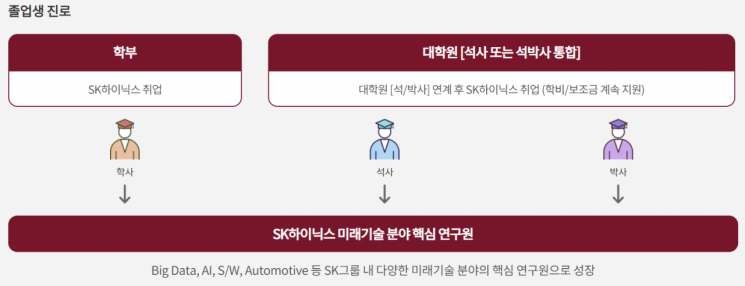 Infographic on Graduate Career Paths Introduced by the Department of Semiconductor Engineering at Korea University / Source: Department of Semiconductor Engineering, Korea University Website Screenshot
New Semiconductor Workforce Demand at 127,000... Expansion of Contract Departments Enables Rapid Field Deployment
The increase in semiconductor contract departments centered on Samsung Electronics and SK Hynix is due to a labor shortage. Although the semiconductor sector is growing in importance as a national core industry, there is a shortage of talent needed by the industry. According to the Ministry of Education and the Korea Semiconductor Industry Association, the total workforce in the semiconductor industry was 176,509 as of 2021. As the semiconductor industry expands over the next 10 years, the required workforce will increase to about 304,000. This means new demand alone is approximately 127,000.
The Ministry of Education warned that if the current workforce supply system is maintained, the labor shortage could worsen. Accordingly, it announced the 'Semiconductor Talent Development Plan' in July. This plan includes regulatory improvements for semiconductor contract departments, such as exempting existing regulations on admission quota limits and regional restrictions. Since graduates can be quickly deployed to the field, expanding contract departments is seen as a workforce expansion measure.
The People Power Party's Special Committee for Strengthening Semiconductor Industry Competitiveness (Semiconductor Special Committee) also emphasized the importance by choosing a contract department as its first field visit site. In July, the Semiconductor Special Committee visited Sogang University, which newly established the Department of System Semiconductor Engineering, to explore talent development plans with the education sector, academia, and industry. On that day, Park Jae-geun, president of the Korea Semiconductor Display Technology Society, attended the site and said, "Taiwan supplies 10,000 personnel annually by operating contract departments at major universities." In August, the Semiconductor Special Committee proposed the 'Semiconductor Industry Competitiveness Enhancement Act (draft),' which includes making university contract department operating expenses eligible for research and workforce development tax credits.
The Ministry of Science and ICT has announced plans to establish semiconductor contract departments at all four major science and technology institutes. In May, the ministry stated that besides KAIST, Gwangju Institute of Science and Technology (GIST), Daegu Gyeongbuk Institute of Science and Technology (DGIST), and Ulsan National Institute of Science and Technology (UNIST) will also have semiconductor contract departments, aiming to nurture more than 5,000 semiconductor talents over five years.
Need for Multidisciplinary Approach Rather Than Specific Departments... "Must Consider Utilizing Regional Talent"
However, there are evaluations that talent development centered on semiconductor contract departments is not a sufficient condition. It is argued that organizing specific departments centered on major companies alone cannot guarantee high-quality semiconductor talent.
The National Assembly Legislative Research Office, ahead of the national audit next month, stated in an August issue analysis report, "Semiconductors are products created by talents from various fields such as materials engineering, physics, chemistry, and electrical and electronic engineering," and added, "Simply expanding the quotas of existing major company-university semiconductor contract departments will not be a revolutionary solution, so a multidisciplinary approach is necessary."
The concentration of semiconductor contract departments in the metropolitan area and top-tier universities is also pointed out as a limitation. This could potentially widen the gap between metropolitan and non-metropolitan universities. Kim Yangpaeng, a senior researcher at the Korea Institute for Industrial Economics and Trade, said, "There may be excellent students in regional universities as well, so structural methods to utilize them are needed."
Securing faculty is also a challenge. Even if the quotas for semiconductor contract departments are expanded, it is useless if there are no instructors to teach. Regarding this, the Ministry of Science and ICT proposed hiring Ph.D. holders with abundant practical experience in semiconductor design and processes from companies as professors while expanding semiconductor contract departments at the four major science and technology institutes.
Meanwhile, to respond to industry workforce demands, the government plans to invest 449.8 billion KRW in the next year's budget, about 150% more than this year, in semiconductor talent development. It aims to nurture 150,000 semiconductor workers over 10 years, with a target of training 26,000 personnel next year alone.
© The Asia Business Daily(www.asiae.co.kr). All rights reserved.













