3% Interest Rate Parking Accounts Emerging One After Another
[Asia Economy Reporter Yoo Je-hoon] Kim Jong-heon (30), a third-year office worker, deposited a lump sum of 20 million won he had saved into a parking account at a certain savings bank. Although he does not currently need the money urgently, he keeps in mind the possibility of needing quick cash. Especially recently, the interest rate on parking accounts has risen to around 3%, easing his concerns.
With the high-interest rate trend and the drying up of low-cost deposits, known as 'core deposits,' in the banking sector, banks are competing fiercely in the 'parking account' market. In some cases, the annual interest rate exceeds 3%, reaching levels comparable to general savings and time deposit rates, intensifying the competition.
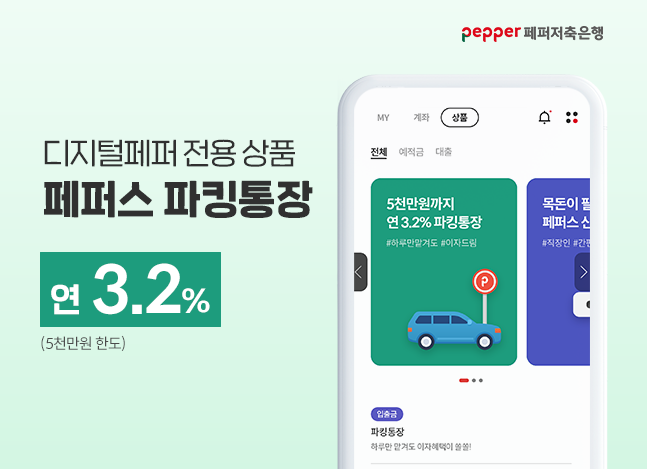
According to the financial sector on the 12th, Pepper Savings Bank's demand deposit account, 'Pepper Parking Account,' offers an annual interest rate of 3.2%. The deposit limit for the 3.2% interest rate is 50 million won, with no special preferential conditions attached.
Additionally, Welcome Savings Bank offers an annual interest rate of 3.0% within a 50 million won limit through its 'Welcome Office Worker Love Regular Deposit' account, provided certain preferential conditions (salary, automatic transfer) are met. OK Savings Bank goes a step further by raising the top interest rate of its 'e-Ut Account' to 3.3% (with preferential rates applied, 10 million won limit) starting next month. This rate is not low compared to the 3% level of regular time deposit rates at commercial banks.
Commercial banks are also joining the competition. Following KDB Industrial Bank's launch of a parking account offering 2.25% annual interest, SC First Bank recently introduced the 'First EZ Account,' a non-face-to-face demand deposit account, offering up to 2.5% annually (for first-time customers, for six months). This surpasses the interest rate of the original high-interest parking account, Toss Bank's Toss Bank Account (2.0% annually, under 100 million won).
Given this situation, switching between parking accounts has also emerged. Park Hee-young (36, female), an office worker who recently moved a lump sum from a bank parking account to a savings bank parking account, said, "I don't have an immediate investment plan, but the future is uncertain," adding, "With the interest rate gap between parking accounts widening to 1 percentage point (p), I judged it better to move to an institution offering higher rates, even temporarily."
The financial sector's competitive increase in parking account interest rates is partly due to customer lock-in effects, but also because low-cost deposits, which are the core of banks' net interest margins, are rapidly decreasing due to the impact of rising rates. According to the financial sector, as of the end of last month, the demand deposit balance of the five major domestic commercial banks (KB Kookmin, Shinhan, Hana, Woori, NH Nonghyup) was 659.68 trillion won, down 13.6794 trillion won from the previous month. The previous month also saw a decrease of 36 trillion won compared to the month before.
Industry experts expect this parking account interest rate competition to continue for the time being. The reduction of low-cost deposits is expected to persist due to rising interest rates, and bank bond yields are also gradually increasing. Seo Young-soo, director at Kiwoom Securities, stated in a recent report, "The speed of increase in deposit and loan interest rates and the decline in net interest margin are progressing faster than expected due to an excessive outflow of low-cost deposits," adding, "This is a matter to note as it indicates that financial stability risks are growing more than anticipated."
© The Asia Business Daily(www.asiae.co.kr). All rights reserved.

















