2nd Place 'Na Ttaeneun' 3rd Place 'Da Neo Jaldoerago...'
Asking About Interests or Using Positive Language Is Important
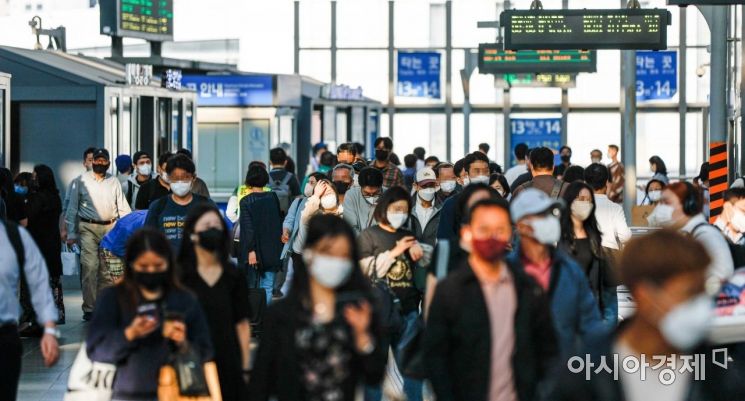 On the 8th, two days before Chuseok, the nation's biggest holiday, travelers are moving to board trains at Seoul Station. Photo by Jinhyung Kang aymsdream@
[Asia Economy Reporter Kim Jung-wan] With the Chuseok holiday just one day away, Professor Shin Ji-young of Korea University’s Department of Korean Language and Literature identified three types of phrases to be cautious about when families and relatives gather in one place for Chuseok.
On the 8th, on CBS Radio’s "Kim Hyun-jung’s News Show," Professor Shin said, "With social distancing eased and this being the first holiday where the whole family can gather, let’s break the vicious cycle of hurting each other with words," adding, "I will point out three types of phrases to be careful about during Chuseok."
Professor Shin named the most disliked phrase as "What are your plans for the future?" explaining, "It is a phrase that encompasses all words at the peak of interest," and "Questions like which school or company you will go to are also included in 'What are your plans?'"
She continued, "If you are truly curious about someone’s future plans and interested in them, you would already know everything," and "If you really worry about that person, you would speak carefully, and they understand that," adding, "But these kinds of questions are usually asked half-heartedly. It doesn’t really seem like they are curious."
Professor Shin pointed out, "A nephew wouldn’t ask his uncle, 'When will you get a job?', 'Have you prepared for retirement?', 'How much is your annual salary?', or 'Have you made all your plans for after retirement?'" and said, "(Asking about future plans) is a way adults express interest and try to soften and improve relationships, but it’s an unsophisticated method."
She ranked the second and third most disliked phrases as "Back in my day..." and "I’m saying this because I want what’s best for you." She explained, "These phrases show the density of interest toward family members you haven’t seen in a while, but the listener often reacts with 'Why are they like this?'"
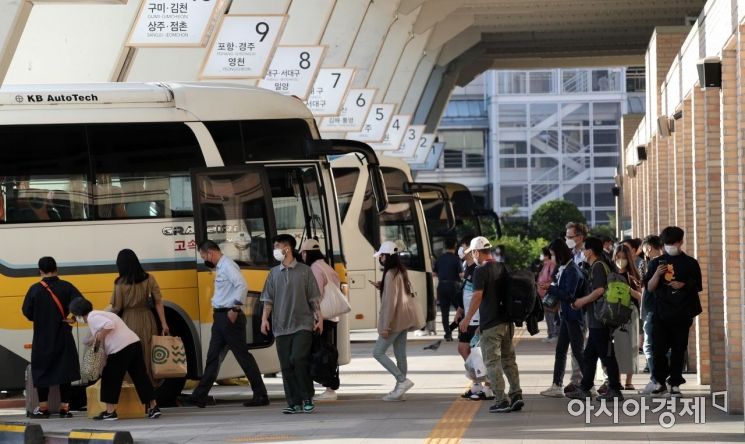 On the 8th, one day before the Chuseok holiday, travelers and visitors are boarding buses at the Express Bus Terminal in Seocho-gu, Seoul. Photo by Hyunmin Kim kimhyun81@
She also urged caution regarding comparisons or evaluations, including appearance. Professor Shin said, "Even words like 'You’re pretty' or 'You’ve lost weight' can be perceived as evaluations, which might make the person being addressed uncomfortable," but added, "However, saying 'You’ve grown a lot' to children in their growth phase is fine."
Furthermore, Professor Shin introduced appropriate topics for family conversations during Chuseok. She said, "There are many new slang words these days, but elders don’t know them well," and suggested, "'I think I’ve heard this word before, but I don’t know what it means or in what context it’s used. Please tell me.' Saying this naturally leads the conversation in that direction."
She also added that leading conversations with positive phrases like "That’s right, that could be true" instead of saying "No" can make conversations much smoother.
© The Asia Business Daily(www.asiae.co.kr). All rights reserved.


















