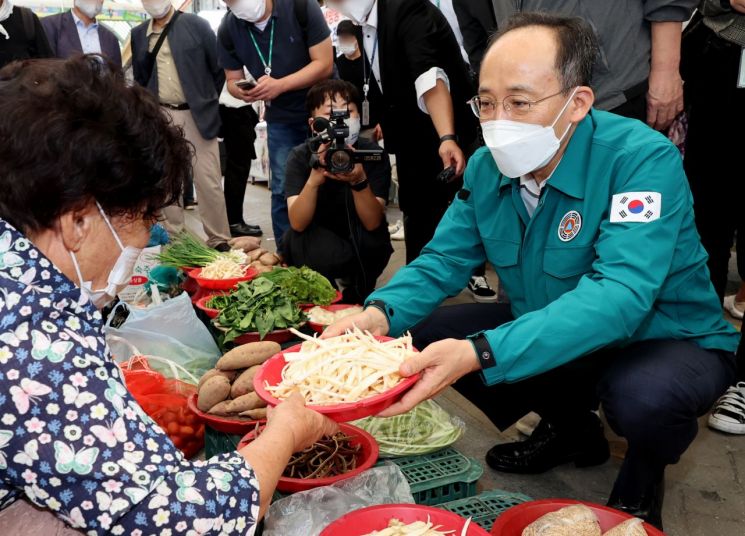
[Asia Economy Sejong=Reporters Kim Hyewon and Kwon Haeyoung] On the 8th, ahead of the Chuseok holiday, Deputy Prime Minister for Economy Choo Kyung-ho visited the Sejong traditional market to check the prices and supply trends of Chuseok seasonal products and encouraged merchants by purchasing goods with Onnuri gift certificates.
Deputy Prime Minister Choo announced that the government is supplying 230,000 tons of seasonal products, which is 1.4 times the usual amount and the largest scale ever, over three weeks (August 18 to September 8) to stabilize prices during Chuseok. He also explained that through the release of government stockpiles and contracted quantities, as well as support for slaughter fees for beef and pork, a cumulative total of 248,000 tons of 20 major seasonal products had been supplied as of the 6th, achieving 107.8% of the original plan of 230,000 tons.
Deputy Prime Minister Choo stated, "Regarding discount coupons for agricultural, livestock, and fishery products, we are providing the largest scale ever (65 billion KRW) and are working to further reduce the actual purchase price for consumers by expanding the per-person discount limit." He added, "We will maintain vigilance and respond with full effort until the end of the Chuseok period to stabilize the prices of seasonal products."
However, despite the government's efforts, concerns are growing that prices, especially for food items, will rise further due to already high inflation compounded by a typhoon just before Chuseok. Some items such as radish, napa cabbage, and hairtail fish have seen short-term price surges due to direct hits from the typhoon.
According to the Korea Agro-Fisheries & Food Trade Corporation on that day, the retail price of one radish was 3,919 KRW as of the previous day, a 28.1% increase in one week compared to the end of last month (3,059 KRW), just before Typhoon Hinnamnor occurred. Tomato prices rose 21.2% in one week to 7,481 KRW per kilogram, and prices of napa cabbage (14.7%), cabbage (14.7%), and oriental melon (6.8%) also increased consecutively. Hairtail fish prices rose 8.5% in one week (retail price basis) to 7,776 KRW per fish due to reduced fishing days caused by the typhoon.
Typhoon Hinnamnor caused significant damage mainly in the southern regions, disrupting the harvesting and fishing logistics of agricultural and marine products, further fueling the already soaring food prices centered on vegetables. Additionally, the demand for Chuseok seasonal products, which arrived earlier than usual, is pushing prices up.
To make matters worse, next month will have two substitute holidays, which may further stimulate the already high dining-out prices. Last month, dining-out prices rose 8.8%, the largest increase in about 30 years since October 1992 (8.8%). This is due to rising food material costs and labor expenses, and there are expectations that the rate could reach 9% within this year.
© The Asia Business Daily(www.asiae.co.kr). All rights reserved.
![Clutching a Stolen Dior Bag, Saying "I Hate Being Poor but Real"... The Grotesque Con of a "Human Knockoff" [Slate]](https://cwcontent.asiae.co.kr/asiaresize/183/2026021902243444107_1771435474.jpg)
















