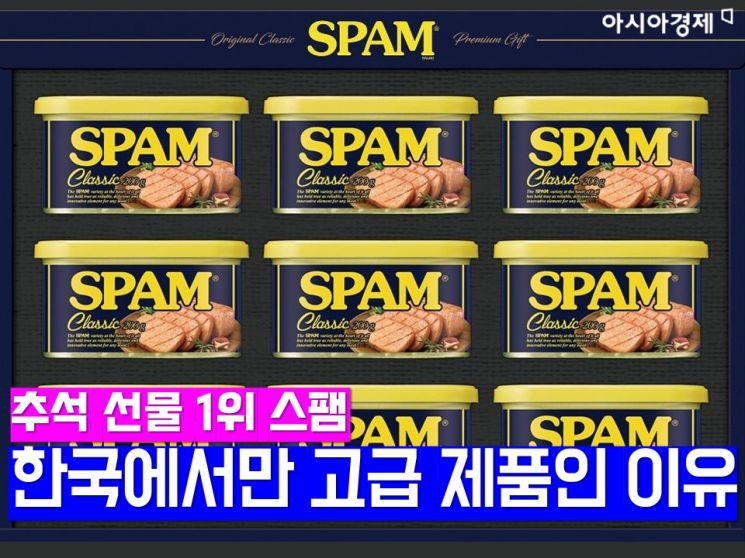
 Spam, which is very popular as a holiday gift for Chuseok, Seollal, and other holidays, holds the number one market share in the domestic processed meat market. / Photo by Song Hyundo, Asia Economy intern reporter
[Asia Economy Reporter Lim Juhyung, Intern Reporter Song Hyundo] Spam, the number one processed meat product in the domestic market, is also a staple gift during holidays every year. Overseas, where people are well aware of what kind of food Spam is, some view it as a very peculiar phenomenon and have published related articles. How did Spam, widely perceived as a "cheap ham eaten only during wartime," become such a popular product in Korea?
According to CJ CheilJedang, the domestic producer of Spam, the product recorded sales of 450 billion KRW in 2020 alone. In terms of quantity, 1.2 billion cans (based on 200g each) were sold, meaning that each Korean consumed 24 cans annually. Spam holds a dominant 60% market share in the domestic processed meat market, securing its undisputed number one position.
The cumulative sales of Spam have exceeded 4 trillion KRW. The steadfast "Spam love" of Koreans has also become a topic of interest overseas. In 2014, the New York Times (NYT) published an article titled "Koreans in Love with Spam." The British public broadcaster BBC also expressed surprise, stating, "In Korea, Spam carries the image of a premium product."
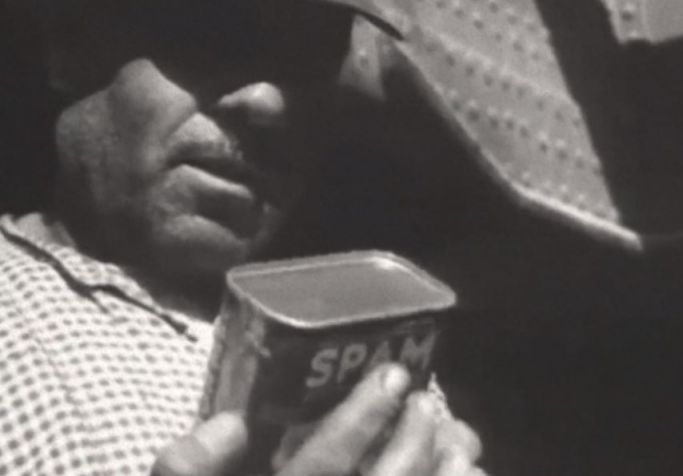 Spam, which was produced as military supplies during World War II, was considered low-quality ration food in the UK and Europe. / Photo by Internet Community Capture
The history of Spam, made by the American company Hormel, began in 1891. Spam was adopted as a military supply to feed U.S. soldiers during World War II and was distributed worldwide. In other words, it was first introduced as "wartime food." Its quality was not particularly outstanding. For U.S. soldiers who ate Spam and Europeans who received it as relief supplies or wartime rations, Spam was inevitably considered a "cheap product."
The way Spam spread in Korea was different from Western countries. According to the BBC, "Spam, sausages, and bacon that leaked out from U.S. military bases became precious food ingredients, and cooking them in spicy broth became the origin of today's Korean 'Budae-jjigae' (army stew)." In postwar Korea, where the industrial base was completely devastated, Spam was treated as a premium ingredient consumed by soldiers from advanced countries.
Spam, which could only be accessed through U.S. military bases, began to be widely consumed in earnest in 1987 when CheilJedang (now CJ CheilJedang) formed a technical partnership with Hormel and started producing it domestically through technology transfer.
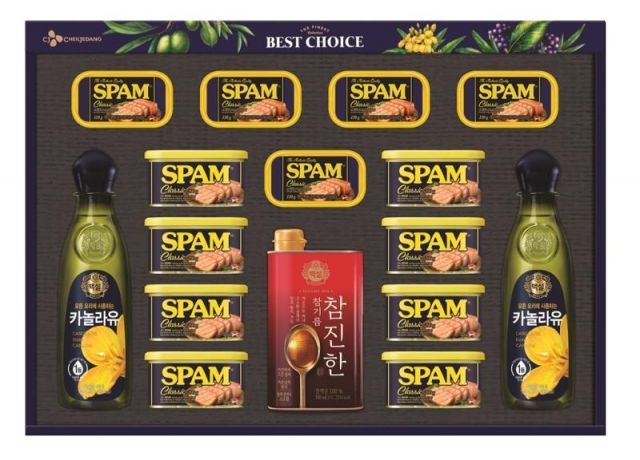
CheilJedang's "premium marketing" also played a role. They increased brand awareness by hiring famous celebrities as advertising models and positioned Spam as a high-priced gift exchanged during holidays such as Lunar New Year and Chuseok by packaging it in luxury boxes.
The "premiumization" of Korean Spam is not just a marketing element. The production process itself incorporates differentiated methods compared to overseas Spam products. For example, Hormel's Spam grinds meat into 4mm pieces and mixes it with sugar, salt, and other seasonings to create its distinctive flavor. However, the CJ CheilJedang Spam factory in Jincheon, Chungbuk, uses much finer 3mm ground meat to enhance texture.
Additionally, it undergoes a unique one-day "low-temperature aging" process to improve flavor, which is not found in other Spam factories. While Hormel's original Spam includes starch in its manufacturing process, Korean Spam excludes starch to dispel the perception of being a "cheap ham."
Launching specialized products tailored to Korean tastes and leading the premium market is also a key factor. For example, "Spam Lite," which reduces sodium compared to the original Spam, was launched in 2020 as Korea's original Spam product. Recently, a long-shaped product called "Spam Gimbap Ham," suitable for use as ham in gimbap (Korean rice rolls), was also introduced.
© The Asia Business Daily(www.asiae.co.kr). All rights reserved.
![Clutching a Stolen Dior Bag, Saying "I Hate Being Poor but Real"... The Grotesque Con of a "Human Knockoff" [Slate]](https://cwcontent.asiae.co.kr/asiaresize/183/2026021902243444107_1771435474.jpg)


















