POSCO Halts Steel Mill Operations for the First Time in 49 Years
Concerns Over Impact on Automotive and Other Industries

[Asia Economy Reporter Oh Hyung-gil] The steel industry, already struggling with sluggish business conditions due to declining demand and accumulating inventory, has been hit by Typhoon 'Hinnamnor.' Normal production processes have been halted, raising concerns about poor performance in the second half of the year.
According to industry sources on the 9th, POSCO plans to sequentially restart the three blast furnaces at its Pohang Steelworks, which are currently on a temporary shutdown, starting from the 10th.
The Seongang Substation, which suffered flood damage, was restored to normal operation on the 7th, and the dam water treatment facilities and LNG power generation will be gradually normalized from the 9th to supply the steam and nitrogen oxide necessary for the early operation of the blast furnaces. The rolling substation is also expected to be restored by the 10th, completing the power recovery at the steelworks.
Although the three blast furnaces, key facilities at the steelworks, were not directly damaged by the typhoon, their operation was temporarily suspended.
The Pohang Steelworks, which halted operations, experienced flooding in much of the steelworks area due to the overflow of Naengcheon, a nearby stream, caused by record-breaking heavy rains in the Pohang region. To prevent secondary damage from power outages, POSCO Pohang Steelworks implemented emergency measures such as venting by-product gases.
POSCO Holdings stated, "During the Chuseok holiday period, not only employees of Pohang Steelworks but also those at Gwangyang Steelworks will adjust their operation plans, and both direct and partner personnel will participate in recovery support," adding, "Environmental cleanup within the steelworks is planned to be completed during the holiday."
POSCO Group Chairman Choi Jeong-woo canceled other schedules immediately after the typhoon damage occurred and visited Pohang Steelworks to inspect the damage sites and employee safety, urging prompt recovery efforts. Chairman Choi said, "We will mobilize all possible methods, including switching production to Gwangyang Steelworks, to ensure rapid equipment restoration and prevent damage to our customers."
However, if the shutdown at Pohang Steelworks is prolonged, there are concerns about a domino effect of damage to downstream demand industries such as automotive, shipbuilding, and home appliances. The industry views that the automotive sector could face intensified production disruptions due to semiconductor shortages and steel supply issues, and the shipbuilding industry, which recently experienced a boom in orders, will inevitably suffer production setbacks.
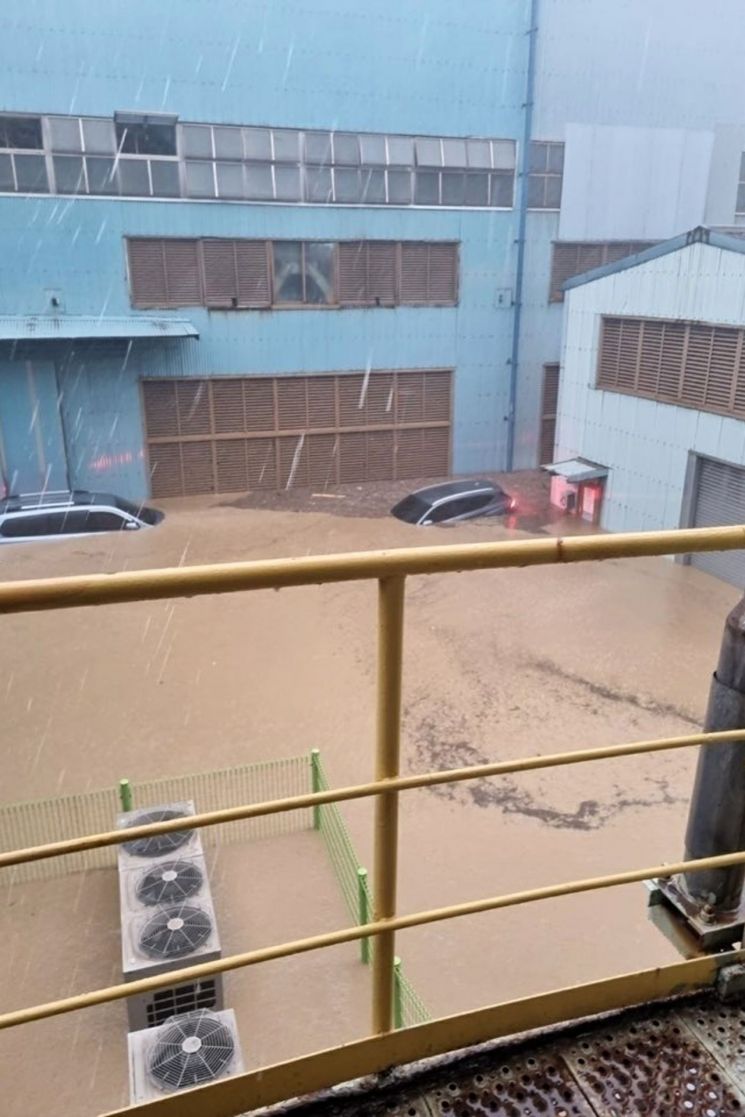
Hyundai Steel's Pohang plant also halted operations due to flooding damage caused by Typhoon 'Hinnamnor.' Hyundai Steel announced that it will temporarily suspend the production of long products and medium products at the Pohang plant and begin repairing the damaged facilities. This is due to flooding in some areas of the plant caused by the heavy rains accompanying Hinnamnor.
However, Hyundai Steel expects no significant disruption in product supply. Hyundai Steel stated, "We are currently repairing the damaged facilities," and added, "We anticipate no sales loss impact due to increased inventory and operating rates at the Incheon and Dangjin plants."
Steel companies are experiencing a rapid increase in inventory due to weak demand.
According to the Korea Iron & Steel Association, as of the end of June, hot-rolled steel inventory stood at 4.076 million tons, a 53.2% increase compared to 2.66 million tons in the same period last year. Hot-rolled steel inventory has been continuously rising since the spread of COVID-19, heading toward 'overproduction.'
From 2.952 million tons at the end of 2020, it increased to 3.523 million tons by the end of last year, and the upward trend has continued this year. Although production was reduced by 3.8% to 33.834 million tons this year compared to 35.198 million tons in the same period last year, it did not prevent inventory growth.
Except for steel pipes (0.3%), inventory increased significantly across most product categories.
Inventory of hot-rolled steel sheets reached 1.728 million tons, a 92% increase compared to the same period last year. Despite producing 18.66 million tons in the first half of the year, down from 19.09 million tons the previous year, domestic sales and exports decreased by 2.7% and 15.2% respectively to 4.94 million tons and 2.84 million tons, leading to a substantial inventory buildup.
As inventory accumulates, product prices are falling. Domestic hot-rolled steel sheet distribution prices dropped from 1.38 million KRW per ton in May to 1.02 million KRW this month. Rebar prices fell from 1.11 million KRW to 925,000 KRW, and H-beam prices decreased from 1.4 million KRW to 1.23 million KRW during the same period.
Demand industries for steel products, such as automotive and construction, are sluggish, and global economic recession is becoming a reality due to tightening policies in various countries. In particular, China's COVID-19 lockdown policies have significantly delayed infrastructure investments, including real estate, which has had a major impact.
© The Asia Business Daily(www.asiae.co.kr). All rights reserved.


















