Food Prices See 'Highest Increase' in 13 Years and 4 Months
MZ Generation Increasingly 'Reselling' New Products Bought from Secondhand Markets
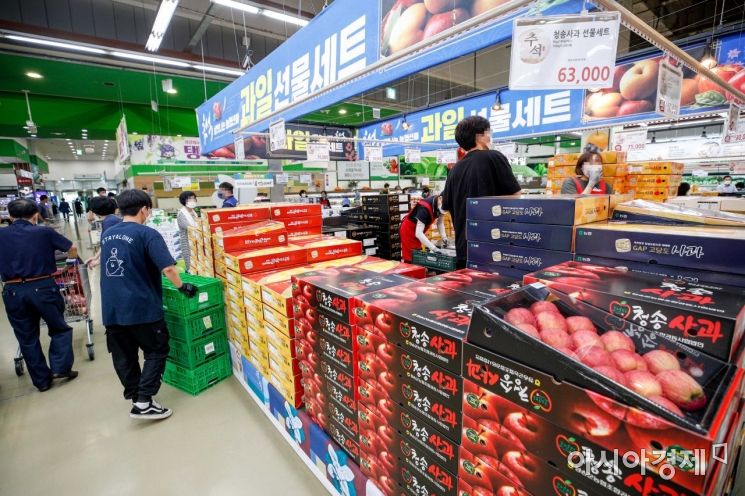 On the 29th, when the government announced that it would manage the prices of major goods before Chuseok at the level of one year ago and provide up to 4 million won to small business owners, citizens visited the Nonghyup Distribution Hanaro Mart Yangjae branch in Seocho-gu, Seoul, to do their shopping. Photo by Jinhyung Kang aymsdream@
[Asia Economy Reporter Jang Sehee] The number of MZ generation consumers (born from the early 1980s to the early 2000s) looking for cost-effective Chuseok gifts amid high inflation is increasing. The MZ generation is purchasing Chuseok gifts through group buying and various secondhand trading platforms.
Jung Aram (34), a housewife living in Yongin, Gyeonggi Province, said, "The price of fruit gift sets rose by about 20,000 to 30,000 KRW compared to usual, which was a financial burden," adding, "Although it was cumbersome, I received a 15,000 KRW discount through a group purchase among apartment residents." Lee Seunghyun (27), living in Eunpyeong-gu, Seoul, said, "I bought five Spam sets per person with my coworkers," and added, "The gift set priced in the 30,000 KRW range was sold for 26,500 KRW, so I decided to buy it immediately. It felt rewarding as I saved the price of four cups of coffee."
Fruit gift sets and Korean beef for soup, which were originally available for 10,000 to 50,000 KRW, have recently doubled in price to 50,000 to 100,000 KRW. In fact, food prices continue to soar. According to Statistics Korea, food prices last month rose 8.4% compared to a year ago, marking the highest increase in 13 years and 4 months since April 2009 (8.5%). Prices of seafood, meat, fruit, vegetables, and frozen foods all rose simultaneously.
Given this situation, more people are changing the type of gifts they give. With increased interest in health-related products due to COVID-19, some are gifting hand creams, hand sanitizers, and deodorants. Jang Kyungjin, a person in their 20s living in Gangnam, Seoul, said, "When fruit prices go down, the quality feels significantly worse," and added, "I purchased hand creams and hand sanitizers on discount at Olive Young for a total of 20,000 KRW."
Some also buy new products on online secondhand trading platforms. Lee Seokwon (36), living in Cheonan, said, "I directly traded for a tuna can gift set on a secondhand market that was unopened and sold for 13,000 KRW cheaper than offline prices." Choi Jungwon (29), who works in Yeouido, Yeongdeungpo-gu, Seoul, recently purchased red ginseng and vitamin gift sets on a secondhand market. Choi said, "If you hurry a bit and browse online secondhand markets, you can find quite decent products," adding, "Spending about an hour looking around secondhand markets can save you money."
It is also easy to find people in their 20s and 30s 'reselling' on secondhand markets. Young people who value practicality put items they do not use themselves on the market as new. Kim Hana (34), an office worker in Suwon, Gyeonggi Province, said, "I resold a body shower and body lotion set I received as a gift at work on a secondhand market. I think I can contribute even just 20,000 KRW to buy my parents’ Chuseok gifts."
© The Asia Business Daily(www.asiae.co.kr). All rights reserved.

















