Possibility of Additional North Korea Aid Approval
Kim Sung-han: "If North Korea Negotiates with Genuine Denuclearization Intent, Economic Support and Mutual Trust Will Be Actively Considered"
Past Governments' Peace Atmosphere Led to Increased Civilian Support
Experts: "Need to Boldly Increase Aid"
[Asia Economy Reporter Ki-min Lee] As the government approved civilian aid to North Korea for the first time, the possibility of additional export applications and government approvals from North Korean aid organizations has increased. However, since the annual number of civilian aid approvals to North Korea varies widely from 1 to 78 depending on inter-Korean relations, it is analyzed that a stable support atmosphere must be established.
In particular, it is analyzed that for President Yoon Seok-yeol to open negotiations with North Korea and build peace, civilian aid must be provided more than in past administrations, along with efforts to ease military tensions. The Yoon Seok-yeol administration has repeatedly stated that if North Korea sincerely engages in denuclearization talks, it will not hesitate to provide support from the early stages of negotiations.
On the 7th, Kim Sung-han, Director of the National Security Office at the Presidential Office, said in a keynote speech at the 2022 Seoul Security Dialogue hosted by the Ministry of National Defense, "Our government aims for principled inter-Korean relations based on a strong deterrent force grounded in the ROK-U.S. alliance for North Korea's complete denuclearization," adding, "If North Korea sincerely comes to denuclearization negotiations, we will actively consider economic support measures and confidence-building measures in the early stages of the negotiation process."
President Yoon also revealed a bold plan in his Liberation Day speech last month, stating that if North Korea opens the door to dialogue regarding nuclear issues, economic support measures will be actively considered from the early stages of negotiations.
According to data from the Ministry of Unification, aid to North Korea has fluctuated significantly depending on inter-Korean relations. According to data submitted by the Ministry of Unification to the office of Kim Seok-ki, a member of the People Power Party, civilian aid to North Korea during the Park Geun-hye administration from 2013 to March 10, 2017, amounted to 134 cases totaling 30.88 billion KRW, while during the Moon Jae-in administration from March 11, 2017 (including the period of Park Geun-hye’s impeachment) to May 9, 2022, 124 cases totaling 74.85 billion KRW were approved.
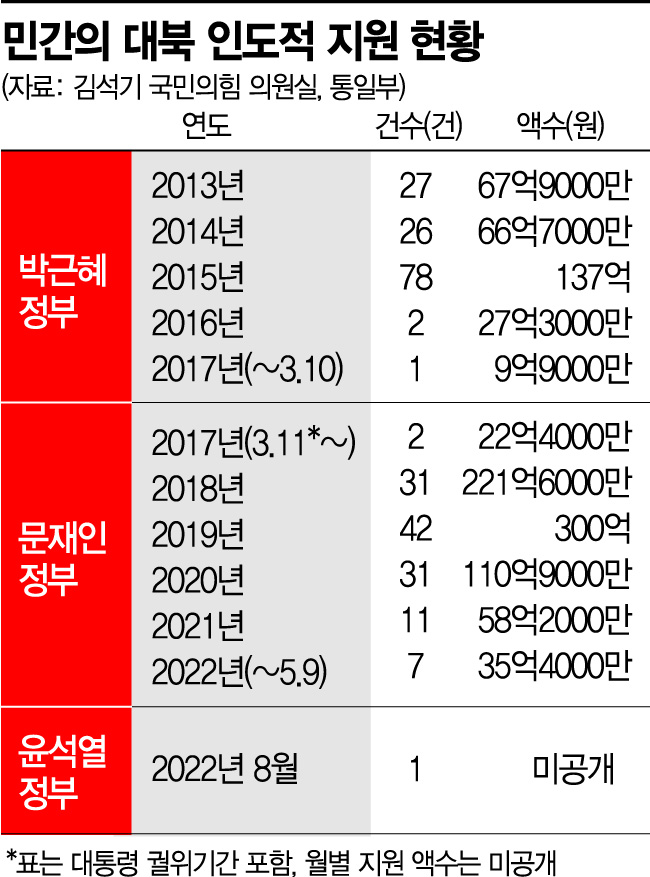
In 2013, when the Park Geun-hye administration began, 27 civilian aid approvals to North Korea were made, totaling 6.79 billion KRW, but in 2015, the number peaked at 78 cases worth 13.7 billion KRW. However, in 2016 there were only 2 cases, and until March 10, 2017, only 1 case worth 990 million KRW was approved. This was the result of an extremely tense situation following the landmine incident, the resumption of loudspeaker broadcasts to North Korea, and North Korea’s artillery shelling after the 2015 aid. Nevertheless, the Park Geun-hye administration strengthened calls for dialogue and support on the occasion of the 70th anniversary of Liberation Day and eventually produced the inter-Korean August 25 agreement.
During the Moon Jae-in administration, which had good relations with North Korea at the beginning of its term, civilian aid to North Korea was 2 cases in 2017, increasing to 31 cases in 2018 and 42 cases in 2019. However, relations deteriorated afterward, and the number decreased to 7 cases from January to May in the final year of the administration.
Considering this government stance, it seems likely that additional export applications and government approvals from North Korean aid organizations will continue. A Ministry of Unification official said, "If applications come in the future, each case will be individually reviewed and approval procedures will be followed."
However, experts analyze that given the current inter-Korean atmosphere and North Korea’s nuclear development situation, to open a peaceful atmosphere with North Korea, South Korea should actively consider increasing civilian aid more than past administrations.
A ruling party lawmaker from the National Assembly Foreign Affairs and Unification Committee said, "Since President Yoon announced a ‘bold’ plan for North Korea’s denuclearization, there is a need to boldly increase humanitarian aid to North Korea compared to the past."
Yang Moo-jin, President of the University of North Korean Studies, also said, "It is very meaningful that President Yoon announced a bold plan and resumed approval of inter-Korean civilian aid," adding, "To lead North Korea to the negotiation table, it is necessary to increase civilian aid to North Korea while actively working to ease military tensions."
© The Asia Business Daily(www.asiae.co.kr). All rights reserved.

















