[Seoul District News] Following the completion of the demolition of Sampyo factory facilities last month, the closure procedure was finalized with the submission of the business closure report on the 6th, marking a true end to a decades-long wish of Seongdong residents and raising expectations for its rise as a representative tourist attraction of Seoul... Gangdong-gu completes 'Gangdong Sports Taste Street' created to revitalize the street commercial area near Dunchon Jugong... Guro-gu allocates 53.2 billion won in the first supplementary budget of the 8th administration
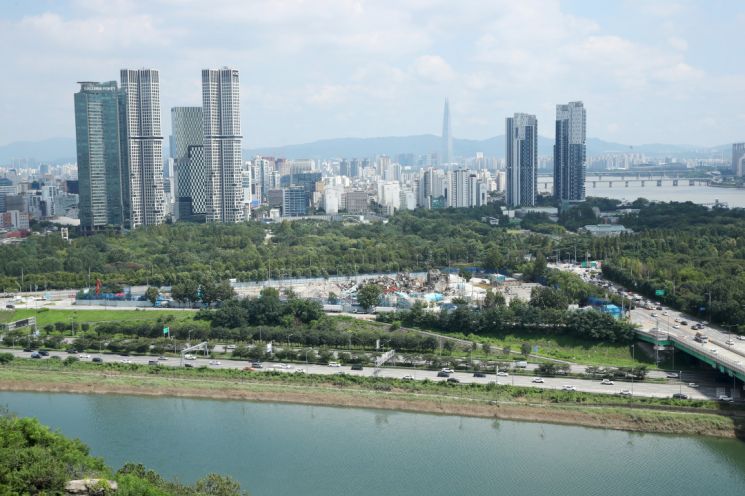
[Asia Economy Reporter Park Jong-il] Sampyo Remicon Seongsu Plant has completed the official closure process by submitting a closure report.
Seongdong-gu (District Mayor Jung Won-oh) announced that Sampyo Industrial Co., Ltd.'s Seongsu Plant submitted the factory closure report to the district office on the morning of the 6th, officially completing the closure process on paper as well.
This marks 45 years since the factory began operations.
The greatest wish of Seongdong residents: Relocation of the only remicon factory in downtown Seoul
Operating since 1977, Sampyo Remicon Seongsu Plant supplied remicon to major construction sites, playing a key role in Seoul's construction scene during the industrialization era. However, with large residential complexes built nearby and the creation of Seoul Forest, concerns arose over environmental pollution caused by noise and dust, as well as traffic congestion due to large remicon vehicle operations.
In response, Seongdong-gu residents voluntarily formed the 'Factory Relocation Promotion Committee' in 2015, urging the relocation of the factory through various efforts including a signature campaign with over 152,000 participants, public hearings, and a district-wide resolution rally.
Based on these residents' wishes, Seongdong-gu led a four-party agreement in 2017 with Seoul City, Sampyo Construction, and the landowner Hyundai Steel, agreeing to complete the relocation and demolition of the Sampyo Remicon Seongsu Plant by June 30, 2022.
Complete demolition process finished after five years of strenuous efforts
Over the next five years, about 100 practical meetings were held to discuss detailed implementation plans. On March 28 of this year, the deadline for the agreement, a groundbreaking ceremony for the demolition of the Seongsu Plant was held with the attendance of Seoul Mayor Oh Se-hoon, Seongdong-gu Mayor Jung Won-oh, Sampyo Industrial CEO Yoon In-gon, and Hyundai Steel Management Support Headquarters Director Seo Sang-won, marking the start of the demolition process.
Starting with the demolition of Batch Plant No. 5 at the end of May, Batch Plant No. 4 was demolished at the end of July, followed by Nos. 1, 2, and 3 on August 12, and the large outdoor storage yard on August 16, completing the dismantling of all major manufacturing facilities.
With the official receipt of the factory closure report by the district office on September 6, the demolition of Sampyo Remicon Seongsu Plant, a major wish of Seongdong residents, has come to a complete close.
Promising future development of the factory site... poised to become a representative landmark of Seoul
The site of Sampyo Remicon Seongsu Plant covers approximately 28,000 square meters, equivalent to four soccer fields. Located at the confluence of the Han River and Jungnangcheon Stream, adjacent to the trendy Seongsu-dong and the urban green space Seoul Forest, the site holds great future potential.
Seongdong-gu Mayor Jung Won-oh pledged during the June 1 local elections to build a cultural facility akin to an opera house and develop the area into a cultural tourism town.
Seoul Mayor Oh Se-hoon also expressed his ambition to secure Seoul's growth engine by creating a cutting-edge cultural complex full of youthful energy.
With the demolition of facilities completed last month and the closure report submitted, the de facto closure process of Sampyo Plant has ended, drawing increased attention to the future use of the site.
Mayor Jung Won-oh said, “I am pleased to mark a true conclusion with the processing of the Sampyo Plant closure report and to resolve a long-standing wish of Seongdong residents. Going forward, we will work with Seoul City to develop the Sampyo Plant site into a representative tourist attraction of Seoul that harmonizes with the waterside areas such as Seoul Forest, the Han River, and Jungnangcheon Stream.”
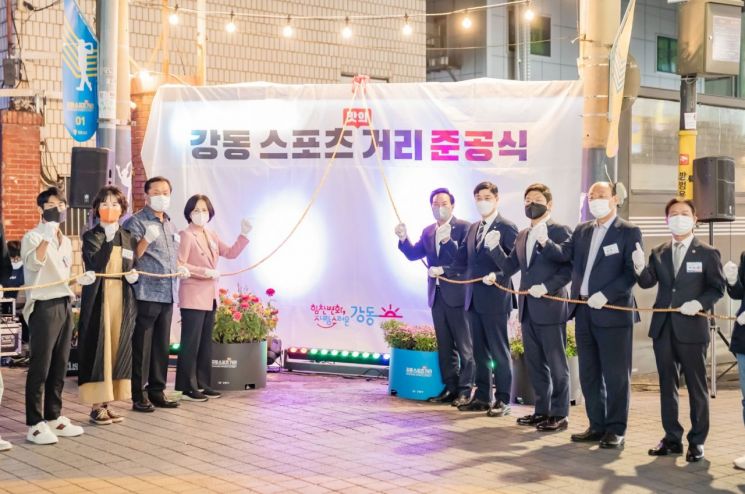
Gangdong-gu (District Mayor Lee Soo-hee) held a completion ceremony on the 6th for the 'Gangdong Sports Taste Street,' created to revitalize the street commercial district near Dunchon Jugong.
The 'Gangdong Sports Taste Street' was established along Yangjaedaero 89ga-gil and the side streets of Yangjaedaero near Dunchon-dong Station, where about 300 diverse stores are located. This area was one of the most severely depressed commercial districts due to the relocation caused by the 2017 reconstruction of Dunchon Jugong Apartments and the COVID-19 pandemic.
After exploring various measures to revitalize the commercial district, the district decided to create a themed street linked with the nearby Korea National Sport University and launched the project in 2020.
Gangdong-gu, the merchants' council composed of merchants near Dunchon Jugong, and Korea National Sport University established a public-private-academic governance to promote the Gangdong Sports Taste Street, characterized by a unique sports-related theme and specialized spaces utilizing leftover areas.
Using old fences and store windows, a unified pattern and color scheme inspired by the strong and vigorous image of athletes was applied to create an integrated street landscape, with sports-specialized designs also featured on pavements and various signage.
In particular, three LED media walls created using old fences broadcast sports content videos and various public-purpose videos, diversifying the visual attractions.
Additionally, the landmark wall installed at the street entrance is decorated with handprints of Olympic medalists from Korea National Sport University, further highlighting the street's unique character.
The ceremony was attended by Korea National Sport University President Ahn Yong-gyu, 1984 LA Olympic archery bronze medalist and current Korea National Sport University professor Kim Jin-ho, 2012 London Olympic gymnastics gold medalist Yang Hak-seon, 2021 Tokyo Olympic women's sabre team bronze medalist Seo Ji-yeon, and 2022 Modern Pentathlon World Championships double champion Jeon Woong-tae, among others.
Gangdong-gu Mayor Lee Soo-hee said, “I sincerely thank the merchants' council and Korea National Sport University for their participation in the creation of Gangdong Sports Taste Street. Besides the distinctive sports-themed landscape, we plan to hold alley festivals and street cheering events where many people can enjoy sports together.” He added, “We invite many visitors to Gangdong Sports Taste Street, which offers diverse attractions, food, and entertainment.”
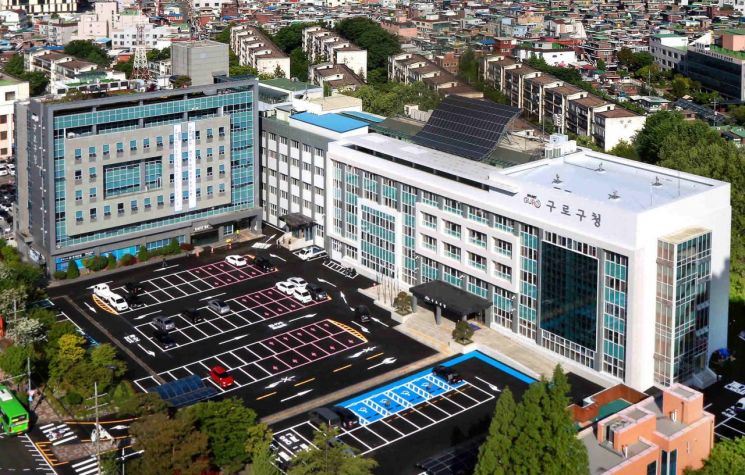
Guro-gu (District Mayor Moon Heon-il) is urgently preparing a supplementary budget of 53.2 billion KRW for the first additional budget of the 8th local government term.
Guro-gu stated, “The supplementary budget was prepared and submitted to the district council focusing on urgent projects that need to be promoted to support small business owners struggling due to the COVID-19 resurgence, revitalize the local economy, reinforce disaster prevention infrastructure, and realize key tasks of the 8th local government term.”
First, to overcome the COVID-19 crisis and revitalize the local economy, the budget includes ▲15.1 billion KRW for small business support funds, ▲1.9 billion KRW for issuing Guro Love gift certificates, and ▲400 million KRW for job support.
Additionally, 2.7 billion KRW was urgently allocated for disaster prevention and residents' safety, including ▲2.3 billion KRW for road and sidewalk maintenance and ▲400 million KRW for river and sewage facility maintenance.
For local projects, the budget includes ▲4.9 billion KRW for creating the Guro-dong village square, ▲1.1 billion KRW for undergrounding overhead distribution lines on school commuting routes as part of the Green New Deal, and ▲800 million KRW for establishing a public library in the correctional facility relocation site.
To secure supplementary budget resources, Guro-gu raised 13.7 billion KRW through budget cuts on various projects difficult to execute within the year, domestic and overseas travel expenses, as well as national and city subsidies and unappropriated surplus funds.
The supplementary budget will be finalized after review at the regular session of the Guro District Council held this month.
District Mayor Moon Heon-il said, “The supplementary budget was prepared prioritizing the stabilization of small business owners facing economic difficulties due to COVID-19, local economic recovery, and disaster prevention. We will thoroughly prepare in advance to ensure that essential projects are executed promptly and do our best to stabilize residents' lives and revitalize the local economy.”
© The Asia Business Daily(www.asiae.co.kr). All rights reserved.
![Clutching a Stolen Dior Bag, Saying "I Hate Being Poor but Real"... The Grotesque Con of a "Human Knockoff" [Slate]](https://cwcontent.asiae.co.kr/asiaresize/183/2026021902243444107_1771435474.jpg)


















