Opened Borders After 2 Years... Low Demand for Overseas Travel
Starting Tomorrow, 'Guide-Free Package Tours'... Conditional COVID-19 Test Exemption
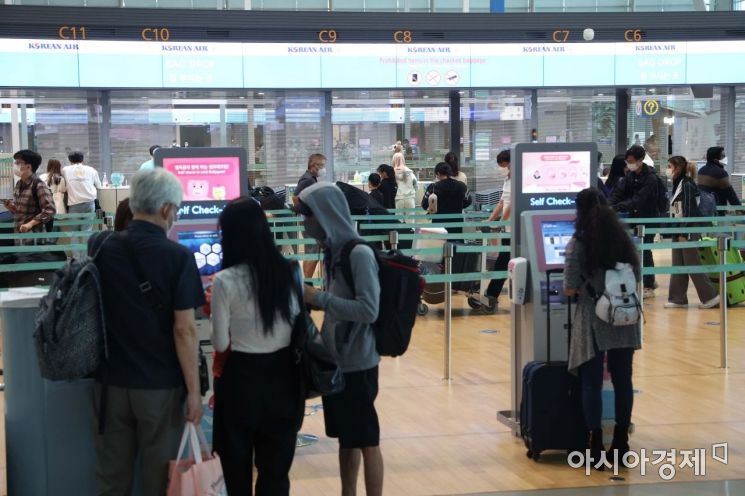 On the 29th of last month, the departure hall of Terminal 2 at Incheon International Airport was crowded with passengers. The photo is not related to the specific content of the article. Photo by Moon Honam munonam@
[Asia Economy Reporter Yoon Seul-gi] Japan will increase the daily entry limit to 50,000 people starting from the 7th and allow some forms of independent travel. Earlier, the Japanese government reopened its borders in June this year but did not permit individual independent travel, which resulted in minimal impact on tourism recovery. It appears they have now significantly eased restrictions.
According to the Japan Tourism Agency, a "package tour without a guide (escort)" will be implemented from the 7th. This "guide-less package tour" is similar to independent travel in that there are no restrictions on travel routes or schedules. However, travelers must still book flights and accommodations through travel agencies or other intermediaries.
Previously, even after Japan raised the entry cap to 20,000 people in June and reopened its borders, the number of foreign tourists did not increase significantly, causing concern. According to preliminary data from the Japan Immigration Services Agency, about 178,000 foreigners entered Japan in July, but only 7,903 entered for tourism purposes.
Despite the weak yen and low inflation, foreign travelers were scarce because the Japanese government prohibited not only individual independent travel but also group tours without escorts. Additionally, unlike in the past when visa-free tourism was possible, the current visa issuance process takes 2 to 3 weeks, and strict COVID-19 prevention measures are in place, which have been burdensome for tourists.
CNN reported on the 2nd in an article titled "Japan travel has resumed, so why aren't tourists returning?" that "Western travelers from the US and Europe tend to be spontaneous and dislike following fixed schedules, which is why they do not prefer Japan tourism."
Melissa Musicer, who lives in New York, told CNN, "I have visited Japan about six times in the past. I planned to visit again now that travel has resumed, but I gave up due to the restrictive measures and decided to go to Korea instead."
As foreign tourist numbers did not increase significantly even after reopening borders, the Japanese government drastically eased entry restrictions. Prime Minister Kishida announced on the 31st of last month, "Tourists will be able to visit Japan through package tours without guides starting next week, and the daily entry limit, currently set at 20,000, will be increased to 50,000."
He added, "Airport entry procedures will also be streamlined," and said, "As international exchanges become more active worldwide, Japan will join this trend by leveraging the cheap yen." Furthermore, the requirement to submit a negative COVID-19 test certificate taken within 72 hours before departure upon entry has been waived for those who have received a third dose of the COVID-19 vaccine.
With partial independent travel now possible and COVID-19 prevention measures relaxed, Japan's travel recovery is expected to gain momentum. Already, Japan travel bookings have more than doubled compared to August. According to Hanatour, from August 29 to September 4, the average daily Japan travel bookings surged by 413.9% compared to the previous two weeks (August 15?28), and the share of Japan bookings among all overseas travel product reservations increased from 8.3% to 26.1% during the same period.
© The Asia Business Daily(www.asiae.co.kr). All rights reserved.

















