Total Project Cost of 1.8 Trillion KRW... Full Underground Conversion of Over 11 Stations
Distance-Based Fare System... Supply of Youth Housing with Building-Type Entrances
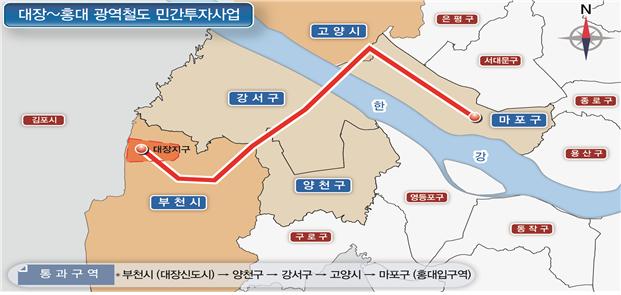
The metropolitan railway project connecting Bucheon Daejang New Town and Hongdae Entrance Station (Daejang-Hongdae Line) is being actively promoted with the goal of opening in 2031.
The Ministry of Land, Infrastructure and Transport announced on the 6th that the third-party proposal announcement (RFP) for selecting the operator of the Daejang-Hongdae Line passed the Private Investment Project Deliberation Committee (2nd Vice Minister of the Ministry of Economy and Finance) and that it will begin recruiting operators by the end of the year.
The Daejang-Hongdae Line is a metropolitan railway project that starts from Bucheon Daejang New Town and connects Bucheon City in Gyeonggi Province, Yangcheon-gu and Gangseo-gu in Seoul, Deogeun-gu in Goyang City, Gyeonggi Province, Mapo-gu in Seoul, and Hongdae Entrance Station.
This project applies a mixed BTO+BTL business model for the first time in a private investment project, and once opened, it is expected to take about 20 minutes to travel from Bucheon Daejang New Town to Hongdae Entrance Station. This reduces travel time by 30 minutes compared to the existing bus (51 minutes) and by 24 minutes compared to a private car (45 minutes).
The total project cost is approximately 1.8 trillion KRW. The government, which will own the railway facilities, will support land compensation costs (about 67 billion KRW) and construction subsidies (about 865.9 billion KRW), which is about 50% of the construction cost, but will not provide separate operational subsidies.
The RFP for recruiting operators focuses on reducing user burdens through reasonable adjustment of the fare system and fare reductions by recovering excess revenue, as well as promoting a compact city through simultaneous development of the railway and station areas, the Ministry of Land, Infrastructure and Transport explained.
◆ More than 11 stations... Entire section underground without shared lines
The number of stations proposed must be at least 11 or more as initially suggested by the proposer, and all sections, including the vehicle depot, must be constructed underground. The operation plan should propose independent operation without shared lines.
Additionally, the Daejang-Hongdae Line will introduce the 'distance-proportional' fare system for the first time in a private railway project. Considering the characteristics of this line with high transfer demand, passengers traveling short distances will be able to use the service at a lower fare than the existing fare.
Private operators may apply fare discount programs to reduce user burdens and increase operator profits, taking into account user travel patterns on weekends, weekdays, or during commuting hours.
If excess revenue occurs compared to the agreed income during operation, the government and the operator will share it according to the BTL and BTO ratio, and the government plans to use the excess revenue to reduce fares to lessen the burden on users.
◆ Building-type entrances + mandatory youth housing supply... Simultaneous railway and housing development
To promote simultaneous development of railway and housing, the government has mandated the construction of building-type entrances and the supply of youth housing utilizing the upper parts of these entrances. Private operators must present detailed implementation plans for this.
Excess profits generated from housing supply will be reinvested in fare reductions to keep user fares as low as possible.
The Ministry of Land, Infrastructure and Transport plans to select a preferred negotiation partner in the first quarter of next year after evaluating project applications and immediately begin negotiations.
The scenario is to conduct negotiations and sign the implementation agreement in the second quarter of 2024, approve the implementation plan and start construction in the first quarter of 2025, and open in early 2031.
Lee Yoon-sang, Director of the Railway Bureau at the Ministry of Land, Infrastructure and Transport, said, "This will contribute to alleviating road traffic congestion in the southwestern metropolitan area and help citizens enjoy more convenient commuting times."
He added, "As the first mixed BTO+BTL project and the first private investment railway project to introduce a distance-proportional fare system and mandatory subsidiary projects, it is a meaningful project, and we expect much interest and participation from private operators."
© The Asia Business Daily(www.asiae.co.kr). All rights reserved.

















