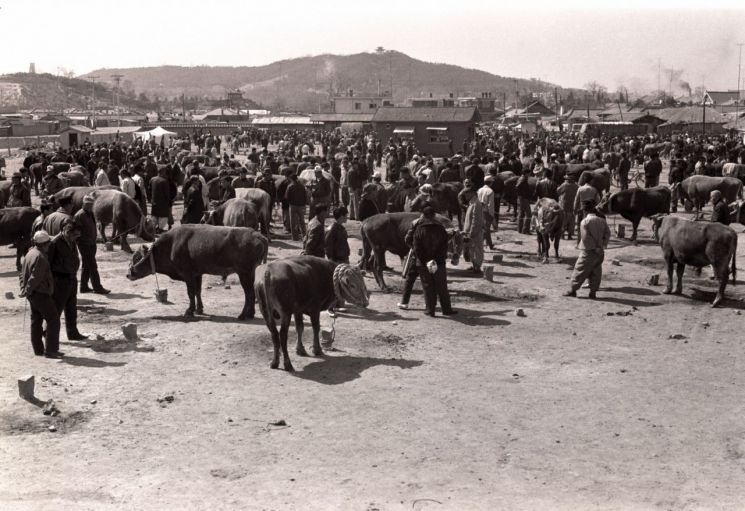
[Asia Economy (Suwon) = Reporter Lee Young-gyu] An exhibition showcasing the history of the 'Suwon Cattle Market,' once considered one of the three major cattle markets nationwide, will be held.
The city of Suwon, Gyeonggi Province, announced that it will hold a small exhibition titled 'Suwon Cattle Market' at the old Bugukwon (130 Hyanggyo-ro, Paldal-gu, Suwon) from the 6th of this month until December 27.
The history of the Suwon Cattle Market dates back to the Jeongjo era (1776?1800).
After building Hwaseong Fortress and establishing the new town center in Suwon, King Jeongjo created military farmlands (dunjeon) to promote Suwon's growth and distributed cattle to farmers. As the number of cattle increased, calves began to be traded at the Suwon market, naturally forming the cattle market.
With the opening of the Gyeongbu Line in 1905, people from the southern regions who wanted to sell cattle flocked to the Suwon Cattle Market, which was close to Seoul and offered good prices for cattle.
The Buksudo-dong Cattle Market (currently across from Maehyang Girls' Middle School) moved to Yeonghwa-dong after liberation. The Suwon Cattle Market reached its heyday during the Yeonghwa-dong period.
The Suwon Cattle Market had a strong character as a 'brokerage market' where 'meat cattle' destined for Seoul were gathered. It grew significantly due to its proximity to Seoul, the largest meat consumption market in Korea.
In the late 1970s, as Suwon's city center expanded, the Yeonghwa-dong Cattle Market was pushed to Gokbanjeong-dong. The Gokbanjeong-dong Suwon Cattle Market was reborn as a modern facility, but with changes in the livestock distribution structure, it declined after the 1980s. The Gokbanjeong-dong market was closed in 1996, and the Suwon Cattle Market disappeared into history.
The Suwon Cattle Market was renowned nationwide as one of the 'three major cattle markets.' On market days, hundreds of cattle and people gathered. Cattle arriving at Suwon Station were taken to the cattle inn called 'Mabangchon.' Since cattle needed to catch the eye of merchants to sell well, they were groomed and rested at Mabangchon before heading to the market the next morning.
Cattle transactions were conducted through several rounds of negotiation between brokers called 'geogan' and cattle owners. Multiple participants were involved in the transactions, including brokers, cattle drivers, merchants, and 'assistants.' On market days, the Suwon Cattle Market was crowded with people from all over the country.
The Suwon Cattle Market exhibition consists of sections on ▲the history of the Suwon Cattle Market ▲the people buying and selling cattle at the market ▲and Suwon's Mabangchon. Visitors can also take photos at a photo zone recreating the 'National Korean Cattle Champion Competition.'
The Suwon Cultural Center systematically researched and organized materials related to the Suwon Cattle Market and published a book on it; the research results will be unveiled at this exhibition.
A city official said, "Suwon is focusing on researching the local history of areas lost to urban development," adding, "We hope many citizens will visit the 'Suwon Cattle Market' exhibition and reminisce about old Suwon."
The exhibition is open from Tuesday to Sunday, 9:30 a.m. to 6 p.m. It is closed every Monday and on legal holidays. Admission is free.
© The Asia Business Daily(www.asiae.co.kr). All rights reserved.

















