"The Heart of Honoring Ancestors Is Not in the Number of Dishes"
4 out of 10 Koreans Say "Charyesang Should Be Simplified"
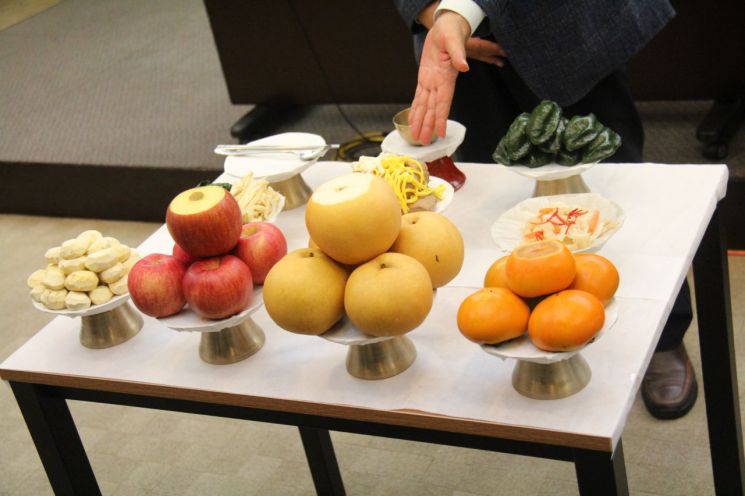 The Sungkyunkwan Ritual Establishment Committee announced the 'Simplification of Ancestral Rites' plan on the 5th at the Korea Press Center in Jung-gu, Seoul. The photo shows an ancestral rite table set with nine types of food according to the simplification plan. [Image source=Yonhap News]
[Asia Economy Reporter Hyunju Park] Ahead of the Chuseok holiday, Sungkyunkwan has proposed a simplified plan for the ancestral rite table. The key point is that foods fried or pan-fried in oil are not traditional, and the number of dishes should be limited to a maximum of nine.
On the 5th, the Sungkyunkwan Ritual Establishment Committee announced the 'Standard Ancestral Rite Table Plan' containing these details at a press conference held at the Korea Press Center in Jung-gu, Seoul.
Choi Young-gap, Chairman of the Sungkyunkwan Confucian Association Headquarters and the Ritual Establishment Committee, stated in the press release, "The ancestral rite is a ceremony filled with the sincerity of descendants honoring their ancestors, but if it causes suffering or discord within families, it is certainly undesirable." He added, "We hope that the announcement of this Chuseok ancestral rite table standard will serve as a starting point to resolve economic burdens, gender conflicts, and generational conflicts related to family rites, and to perform meaningful ancestral rites."
According to the standard plan, the basic simplified Chuseok ancestral rite table includes six types of food: songpyeon (rice cakes), namul (seasoned vegetables), grilled dishes, kimchi, fruits, and alcohol. Additionally, meat, fish, and rice cakes can be added. There is no longer a need to prepare jeon (pan-fried pancakes). According to Sungkyunkwan, in Volume 41 of the 'Complete Works of Sage Kim Jang-saeng,' it is stated that "using oily foods such as wheat or fried dishes for ancestral rites is not proper etiquette."
Traditional etiquette practices such as 'Hongdongbaekseo' (placing red fruits on the east side and white fruits on the west side) and 'Joyul-ishi' (jujube, chestnut, pear, persimmon) are not found in etiquette literature. Sungkyunkwan explained, "No literature dealing with etiquette mentions the terms 'Joyul-ishi' or 'Hongdongbaekseo'; they only refer to 'fruit' (菓). The order of placing items on the table is not important."
Sungkyunkwan also stated that other table settings can be decided by family consensus. Furthermore, besides the traditional ancestral tablet indicating the ancestor's position or relationship, a photo of the ancestor may be placed during the rite, and the order of the ancestral rite and grave visit can be arranged through family discussion.
Sungkyunkwan said, "According to the 'Yegi' (Book of Rites), a Confucian classic dealing with the fundamental spirit of etiquette, in the 'Yueji' (Record of Music), major rites should be simple. The heart honoring ancestors is not measured by the number of dishes, so there is no need to strive to prepare many dishes."
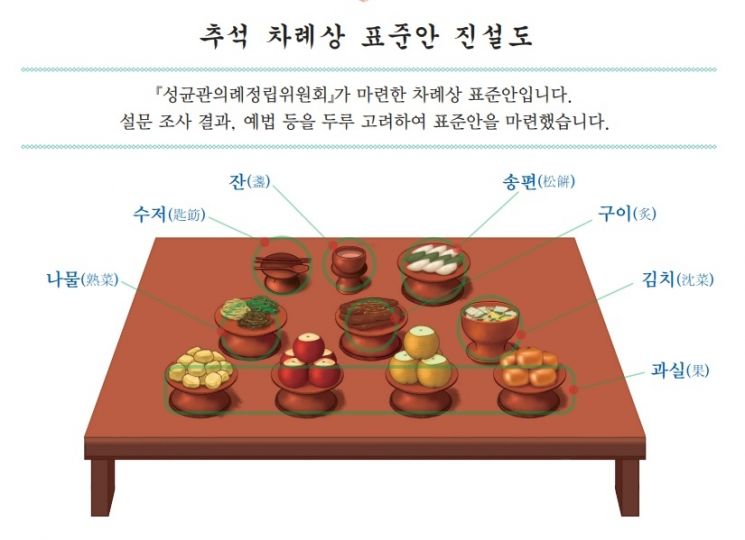 The standard proposal for Chuseok ancestral rites table announced by the Sungkyunkwan Ritual Establishment Committee. Photo by Sungkyunkwan
Sungkyunkwan stated that the standard plan was prepared after considering nationwide survey results and etiquette. According to surveys conducted from July 28 to 31 among 1,000 general citizens aged 20 and over and 700 Confucian scholars, both the general public (40.7%) and Confucian scholars (41.8%) identified 'simplification' of the ancestral rite table as the most necessary improvement when performing the rites.
Also, one in two citizens (49.8%) considered 5 to 10 dishes an appropriate number of foods to use during the rites. Meanwhile, 24.7% of citizens chose 11 to 15 dishes. Among Confucian scholars, 35.0% viewed 11 to 15 dishes as appropriate, and 26.6% chose 5 to 10 dishes.
When asked "Up to how many generations of ancestors do you perform the rites?" both citizens and Confucian scholars most frequently answered grandparents (second generation rites) at 32.7% and 39.8%, respectively. Regarding appropriate costs for the rites, citizens mostly chose the 100,000 won range (37.1%), while Confucian scholars favored the 200,000 won range (41.0%).
© The Asia Business Daily(www.asiae.co.kr). All rights reserved.


















