The government recommended remote work in the private sector,
but most office workers still have to go to work
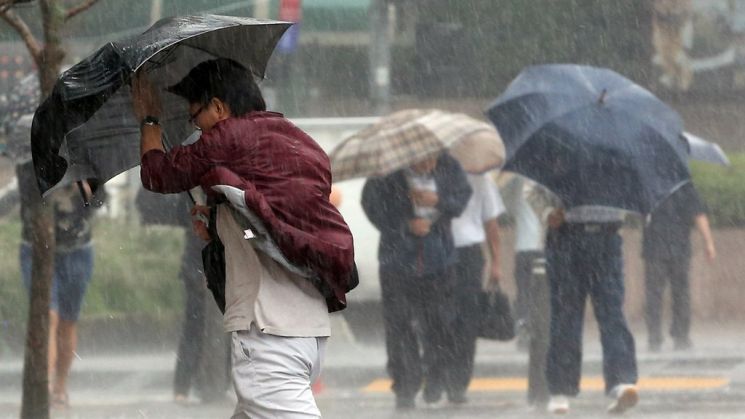 In September 2012, under the influence of Typhoon Sanba, strong winds and heavy rain swept through the Gwanghwamun area in Seoul, where citizens holding umbrellas struggled to move forward. [Image source=Yonhap News]
[Asia Economy Reporter Kang Juhee] On the 6th, Typhoon 'Hinnamnor' No. 11 is expected to make landfall on the Korean Peninsula while maintaining unprecedented strength, causing office workers to express concerns. Although the government requested adjustments to commuting hours or telecommuting in the private sector, it was only a 'recommendation,' and most office workers still had to commute as usual.
This typhoon Hinnamnor is predicted to make landfall in South Korea with strength comparable to the past devastating typhoons 'Rusa' and 'Maemi.' According to the Korea Meteorological Administration, as of 1 PM on the 5th, Hinnamnor is moving northeast at 23 km/h about 330 km south-southwest of Seogwipo. The central pressure of the typhoon is 935 hPa, the maximum wind speed is 50 m/s (180 km/h), and the radius of strong winds is 430 km, classified as 'very strong.'
The Ministry of the Interior and Safety announced on the 4th at 4:30 PM that the Central Disaster and Safety Countermeasures Headquarters (CDSCH) would be elevated directly from Level 1 to Level 3, and the typhoon and heavy rain crisis alert level would be raised from 'caution' to 'serious.' The CDSCH explained that this measure was taken to fully respond to the nationwide damage expected from the typhoon.
However, despite the forecast of a powerful typhoon, whether commuting hours will be adjusted in the private sector seems to depend on each workplace's discretion. On the morning of the 6th, when the typhoon is expected to make landfall, the CDSCH recommended telecommuting, flexible work hours, or adjusted commuting times to private companies. They also requested schools at all levels to decide autonomously whether to close or conduct remote classes. Many schools in Jeju Island, Busan, Gyeongnam, and Ulsan, which are within the influence zone of Hinnamnor, are reportedly conducting remote classes, closures, or shortened classes.
However, since adjusting commuting hours is not mandatory, many office workers in private companies had to commute as usual. Some have already expressed concerns about the morning commute tomorrow. Posts on social networking services (SNS) such as Twitter show netizens reacting with comments like, "It's almost quitting time, but the company hasn't said anything yet," "Is it really true that I have to commute in the rain and wind tomorrow morning?" and "They say they'll decide based on the situation tomorrow, but I'm scared the typhoon will worsen while commuting."
Meanwhile, the Korea Meteorological Administration forecasted that Hinnamnor will be closest to Jeju at around 1 AM on the 6th and will reach the coast of Gyeongnam around 7 AM. It is expected to pass near Ulsan or Gyeongju, Gyeongbuk, around noon and then move out to the East Sea. In a briefing that day, the KMA stated, "Hinnamnor is a very large typhoon with a strong wind radius of up to 400 km, bringing strong winds and heavy rain to most regions nationwide," and urged people to "prepare to prevent casualties."
© The Asia Business Daily(www.asiae.co.kr). All rights reserved.

















