Average 229.8 KRW per kWh from 1st to 5th
13.7%↑ from April's 202.11 KRW
Surge in LNG heat unit price to blame
This month's 144,634 KRW is double June's
KEPCO's financial burden nearing limit
Projected deficit this year 28.8423 trillion KRW
The wholesale electricity purchase price of Korea Electric Power Corporation (KEPCO) has once again broken the record high this month, raising concerns that deficit management has reached a critical level. There are urgent calls for practical measures such as tariff hikes to prepare for the full-scale rise in energy prices during the winter heating season.
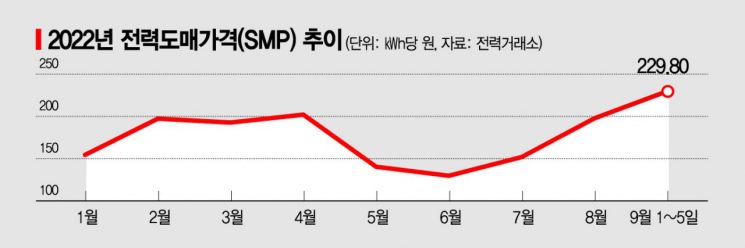
According to the Korea Power Exchange on the 5th, the land-based wholesale electricity price (SMP, System Marginal Price) for this month (1st to 5th) averaged 229.8 KRW per kWh, setting a new monthly record high. This is a 13.7% increase from the previous record SMP of 202.11 KRW set in April. Notably, on the 2nd, the land-based SMP reached 245.2 KRW per kWh, the highest ever since the establishment of the Korea Power Exchange in 2001. The previous day, the SMP was 228.96 KRW per kWh, surpassing the previous record of 225.42 KRW set on February 8, 2012, marking a new high in 10 years.
The recent sharp rise in SMP after a lull since April is attributed to the continuously record-breaking LNG calorific unit price. According to the Korea Power Exchange, the calorific unit price from Korea Gas Corporation this month is 144,634 KRW, up 13.8% from last month’s 127,069 KRW. Compared to June’s 77,662 KRW, it has nearly doubled, rising by 86.3%.
The concern is that SMP may rise further if heating demand increases significantly this winter. Due to the prolonged Russia-Ukraine war, global LNG prices have surged, causing Korea Gas Corporation’s natural gas spot (short-term contract) prices to rise as well.
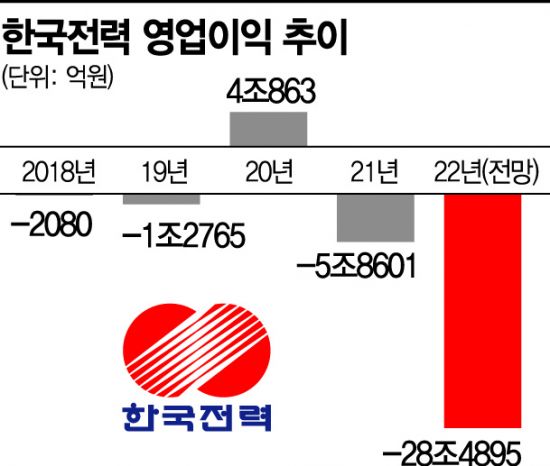
The surge in SMP is also pushing KEPCO’s financial burden to its limits. Financial information firm FnGuide forecasts KEPCO’s annual operating deficit consensus for this year at 28.8423 trillion KRW, with the debt ratio expected to rise from 223.2% last year to 397.4% this year. Some warn that if SMP remains at the current level, KEPCO’s operating deficit could exceed 30 trillion KRW by the end of this year.
Deficit management through borrowing is rapidly worsening KEPCO’s financial structure. As of last month, KEPCO’s corporate bond issuance stood at 19.32 trillion KRW, averaging 2.4 trillion KRW issued monthly. Although KEPCO’s total corporate bond issuance balance this year is about 55.565 trillion KRW, the balance is decreasing by the amount of the monthly deficit, which could lead to a halt in bond issuance early next year.
The government and KEPCO are considering revising the Korea Electric Power Corporation Act through legislation to increase the corporate bond issuance limit, but experts say this is only a temporary fix. The urgent priority is to improve the distorted structure where KEPCO buys electricity at 169.3 KRW per kWh in the first half of this year but sells it at an average of 110.4 KRW, incurring an average loss of 50 KRW per kWh.
Experts emphasize that although a 4.9 KRW per kWh increase in the standard fuel cost is scheduled for October, additional hikes should be considered as KEPCO’s real management normalization is possible. Professor Yoo Seung-hoon of Seoul National University of Science and Technology, chair of the Power Supply and Demand Basic Plan General Subcommittee, said, "To normalize KEPCO’s management, electricity rates must be raised and the price of power generation natural gas supplied by Korea Gas Corporation should be regulated to lower the SMP."
© The Asia Business Daily(www.asiae.co.kr). All rights reserved.
![Clutching a Stolen Dior Bag, Saying "I Hate Being Poor but Real"... The Grotesque Con of a "Human Knockoff" [Slate]](https://cwcontent.asiae.co.kr/asiaresize/183/2026021902243444107_1771435474.jpg)


















