Hanwha Q CELLS and Energy Agency Hold Agrivoltaic Solar Power Briefing
Double Benefits: Agricultural Income Plus Power Generation Revenue
"Related Laws Must Be Revised for Activation"
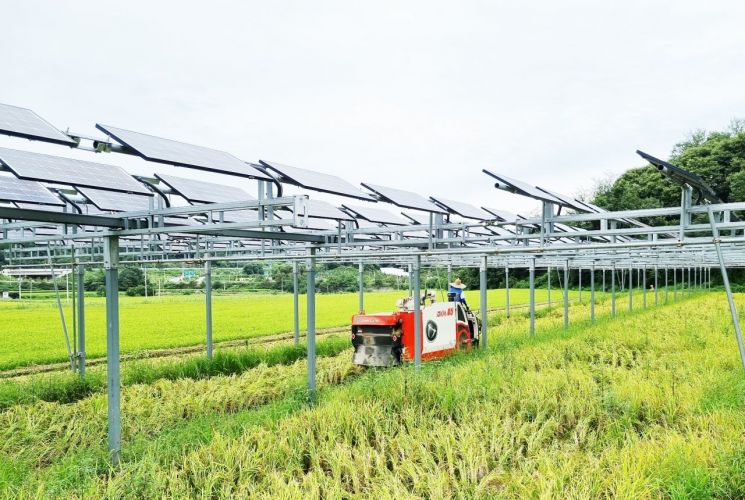 A farmer is harvesting with agricultural machinery (combine) at the agricultural solar power plant in Gidong Village.
[Asia Economy (Hamyang) = Reporter Jeong Dong-hoon] On the 1st, at the Hamyang-eup Gidong Village power plant in Hamyang-gun, Gyeongnam, solar panels are installed 4 to 5 meters high above a 3,068㎡ (approximately 923 pyeong) rice paddy. This is an 'agriculture-friendly solar power' model that is gaining attention as a way to create new income from farmland and promote the spread of renewable energy, thereby enhancing the sustainability of rural areas. To harvest the early-maturing rice variety, a combine harvester moved under the solar panels to begin harvesting.
This site is where the 'Gidong Village Social Cooperative,' composed of local residents, leased farmland from elderly farmers who find it difficult to farm and installed about 100 kW of dedicated agriculture-friendly solar power modules. It produces electricity sufficient for about 150 people annually. This power plant was completed in April 2019 with the Rural-Coexistence Cooperation Fund donated by Korea South-East Power Co., Ltd. The revenue from electricity sales is used as a village communal fund for repairing the village hall, installing shared CCTV, and other community projects.
Hanwha Solutions Q CELLS Division (hereinafter Hanwha Q CELLS) and the Korea Energy Agency held an agriculture-friendly solar power briefing at this site on the 1st. Attendees included Korea South-East Power, which established the Rural-Coexistence Cooperation Fund to support power generation projects; the Gidong Village Social Cooperative operating the power plant; representatives from the construction partner KLES; and Professor Jeong Jae-hak’s research team from Yeungnam University, who are researching the national project for standardizing agriculture-friendly solar power.
Gidong Village Social Cooperative Head: "High Resident Satisfaction through Administrative Support and Welfare Enhancement"
Currently, in South Korea, demonstration research related to agriculture-friendly solar power is actively underway, centered on the government, public enterprises, and research institutions to promote its activation. The Ministry of Agriculture, Food and Rural Affairs has been conducting large-scale research projects from last year through this year to improve the system for agriculture-friendly solar power. Hanwha Q CELLS was selected as a research institution for the national project to develop a standard model for agriculture-friendly solar power conducted by the Korea Institute of Planning and Evaluation for Technology in Food, Agriculture, and Forestry under the Ministry of Agriculture, Food and Rural Affairs, and is conducting joint research with domestic academia and small and medium-sized enterprises.
Institutional support for agriculture-friendly solar power is already in place in countries such as Japan and Europe. In France, since 2017, agriculture-friendly solar power plants have been defined as crop protection facilities, with an annual installation target of 15 MW supported. Italy has decided to provide subsidies for agriculture-friendly solar power projects as part of its COVID-19 recovery and restoration plan. Meanwhile, in Japan, where agriculture-friendly solar power is most actively distributed, power generation projects can proceed for up to 20 years only when farming continues under the solar modules.
In South Korea, agriculture-friendly solar power has not yet been fully activated. The main reason is that related systems such as the Farmland Act have not yet been established. Under the current enforcement decree of the Farmland Act, the maximum temporary use permit period for farmland for other purposes is only eight years, and after this period, power plants with a lifespan of about 25 years or more must be dismantled. This causes economic inefficiency in agriculture-friendly solar power projects, raising the levelized cost of electricity (LCOE) and potentially negatively affecting the transition to renewable energy.
Currently, related laws and amendments to promote agriculture-friendly solar power are under discussion in the National Assembly. In November 2021, Kim Seung-nam, a member of the Democratic Party of Korea (representing Jeonnam Goheung, Boseong, Jangheung, Gangjin), introduced the 'Act on Support for Agriculture-Friendly Solar Power Generation Projects,' which extends the temporary use permit period for other purposes to 20 years. In June 2020, Park Jung, a member of the Democratic Party of Korea (representing Gyeonggi Paju-si Eul), submitted a similar amendment to the Farmland Act to the National Assembly. Additionally, in March 2021, Wi Seong-gon, a member of the Democratic Party of Korea (representing Jeju Seogwipo City), introduced the 'Act on Support for Farmers Engaged in Agriculture-Friendly Solar Power Generation Projects' to guarantee income for farmers involved in such projects.
Meanwhile, Lee Tae-sik, head of the Gidong Village Social Cooperative, which manages and operates the Gidong Village power plant, said, "The revenue from the power plant supplements the village's administrative tasks and increases welfare benefits, resulting in high resident satisfaction," adding, "I hope that financial support measures for agriculture-friendly solar power projects will be further expanded so that rural renewable energy transition can be achieved in a way that benefits residents' convenience and interests."
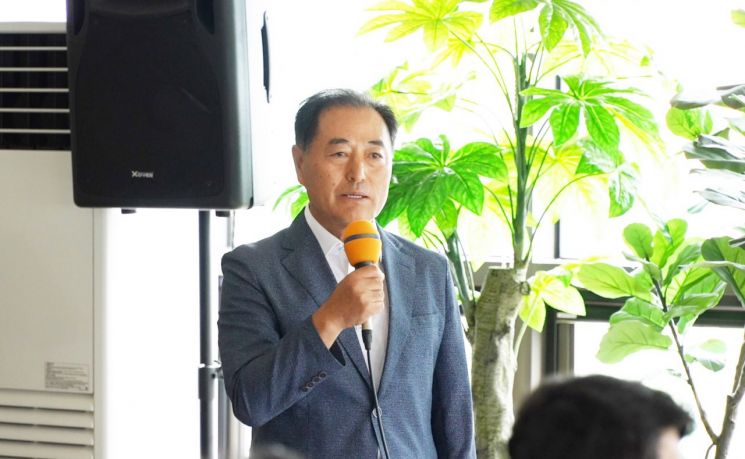 Lee Tae-sik, head of the Gidong Village Social Cooperative, explaining the status of the Gidong Village power plant
Producing Eco-Friendly Energy and Increasing Farmers' Income by Using Solar Power Unnecessary for Crop Growth
Unlike general rural solar power, which stops farming and only generates electricity on farmland, agriculture-friendly solar power produces electricity using light unnecessary for crop growth, allowing farming?the ultimate goal of farmland?to continue. For example, the light saturation point of rice is 50 klux (kilolux), and sunlight exceeding this does not affect rice photosynthesis. Agriculture-friendly solar power adjusts the size, arrangement, and angle of modules to supply appropriate sunlight for crop cultivation while generating electricity from the surplus sunlight.
Additionally, agriculture-friendly solar power is designed and constructed so as not to interfere with farming activities under the solar panels. It uses structures that do not affect soil quality and are easy to dismantle, and modules are installed at heights of 3 to 5 meters to allow agricultural machinery such as rice transplanters and combines to pass underneath.
The environmental stability of agriculture-friendly solar power and its impact on the farming environment have already been proven through research. According to data accumulated from a demonstration project conducted since 2017 by Korea South-East Power and the Gyeongnam National University of Science and Technology, no heavy metals such as cadmium and mercury were detected in soil where agriculture-friendly solar power was installed. Other soil substances were observed at levels similar to those in comparison sites without solar power installations. Crop yields under agriculture-friendly solar power farmland were found to be at least 80% of those on conventional farmland.
Moreover, agriculture-friendly solar power has a 'shadow effect' that reduces crop damage caused by extreme weather such as heatwaves, heavy rain, and cold damage. Professor Jeong Jae-hak from Yeungnam University, who visited the Gidong Village power plant that day, explained that agriculture-friendly solar power can prevent drought by blocking water evaporation and maintaining soil moisture, and reduce cold damage in winter by blocking the flow of cold air.
In a demonstration survey conducted since 2018 by the Agricultural Technology Center and domestic power companies, the harvest rate of green tea increased by 11%, and that of grapes by 2%. According to a demonstration survey conducted by the Green Energy Research Institute since 2019, the harvest rate of green tea increased by 5 to 21%. Additionally, a demonstration project conducted over two years from 2016 at the University of Massachusetts in the United States showed that while crop production at agriculture-friendly solar power plants was generally lower than in open fields, during the severe heatwave in 2016, crop production was higher than in open fields.
Improving Farmland Efficiency and Productivity, Noted as a Solution to Crises Such as Declining and Aging Agricultural Population
Agriculture-friendly solar power enables efficient use of farmland, serving as an incentive for farmland owners to continue farming without changing the land category. Currently, the domestic agricultural population is continuously decreasing and aging, and farmland area is steadily declining. According to the Ministry of Agriculture, Food and Rural Affairs, the total farmland area nationwide decreased by about 8% from 1,698,000 hectares in 2011 to 1,565,000 hectares in 2020. Especially, farmland area within agricultural promotion zones is decreasing by about 2,000 hectares annually. According to Statistics Korea, the farming population decreased by about 12% from approximately 2.5 million in 2016 to about 2.2 million in 2021 over five years.
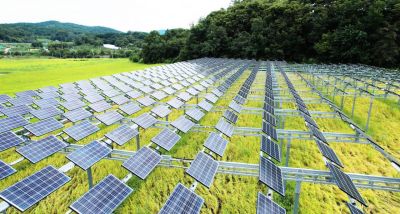 Aerial view of the agricultural solar power complex in Gidong Village, Hamyang-gun, Gyeongsangnam-do
Agriculture-friendly solar power can be utilized as a new income model for rural areas in crisis. According to calculations by Professor Jeong Jae-hak’s research team at Yeungnam University last year based on domestic electricity prices, a 100 kW scale power plant is expected to generate an annual income of 7.87 million to 13.22 million KRW. This is more than three to five times the expected annual farming income of about 2.4 million KRW from rice farming on the same area of farmland (approximately 700 pyeong).
Furthermore, the activation of agriculture-friendly solar power is expected to greatly contribute to the domestic renewable energy transition and the achievement of national carbon neutrality goals. According to a policy report released by the Korea Environment Institute in May 2021, installing agriculture-friendly solar power on just 5% of the total farmland area of 15,760 km2 (about 1.6 million hectares) as of 2019 could build about 34 GW of power plants. This is enough to produce electricity for about 48 million people?over 90% of the domestic population?to use at home for one year. Compared to last year’s new solar power installations of 4.4 GW in South Korea, this corresponds to about eight years’ worth of new installations.
Meanwhile, Hanwha Q CELLS manufactures modules optimized for agriculture-friendly solar power and supplies them to domestic pilot sites. In December last year, it launched a new agriculture-friendly solar power module product that was the first in the industry to obtain additional KS certification for eco-friendly high durability. It has also completed the supply and installation of agriculture-friendly solar power modules at various domestic demonstration sites, including the Hamyang-gun Agricultural Technology Center, Ulsan Metropolitan City Ulju-gun demonstration site, and Namhae-gun Gwandang Village demonstration site.
Yoo Jae-yeol, Executive Director of Hanwha Q CELLS Korea Business Division, said, "The activation of agriculture-friendly solar power is a measure that catches two birds with one stone by enhancing the sustainability of rural areas and efficiently expanding renewable energy," adding, "Hanwha Q CELLS will lead market activation by manufacturing and supplying modules suitable for agriculture-friendly solar power and actively contribute to achieving the NDC (Nationally Determined Contributions) and responding to the climate crisis."
© The Asia Business Daily(www.asiae.co.kr). All rights reserved.



















