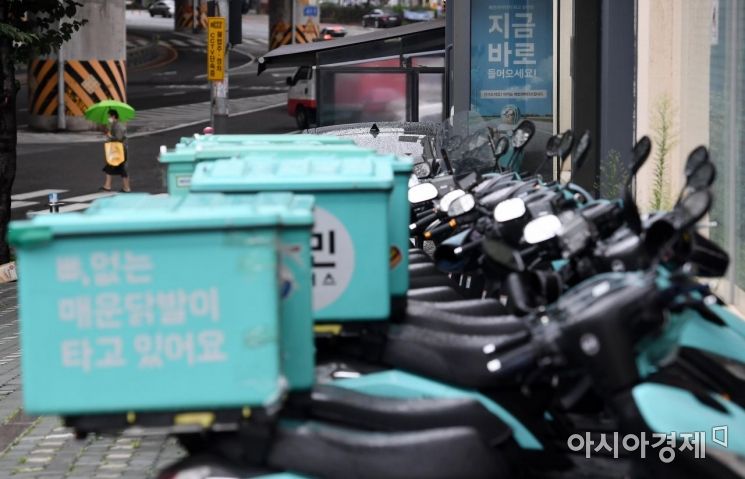
 On the 2nd, delivery motorcycles were lined up at a local center of a delivery agency in downtown Seoul. As the novel coronavirus disease (COVID-19) resurges, the volume of delivery orders has surged, causing ongoing difficulties in securing delivery personnel. According to Baedal Minjok, the total number of orders during the week of August 24-30, when COVID-19 spread was severe, increased by 26.5% compared to the last week of July (July 20-26). Photo by Kim Hyun-min kimhyun81@
[Asia Economy Sejong=Reporter Dongwoo Lee] From now on, major domestic delivery platform operators will no longer be able to unilaterally demand contract termination from food business owners.
The Fair Trade Commission announced on the 4th that it reviewed the terms of use for food business owners signed between three delivery app platform operators?Baedal Minjok, Yogiyo, and Coupang Eats?and corrected four types of unfair contract terms.
The types of unfair contract terms found in the terms of these three companies include ▲unfair contract termination and usage restriction clauses (2 companies) ▲unfair exemption clauses for the operator’s negligence (3 companies) ▲unfair usage clauses regarding members’ posts (2 companies) ▲and clauses where the operator’s notification method is unfairly disadvantageous to sellers (1 company).
The existing terms of Baedal Minjok and Coupang Eats allowed contract termination or sanctions against sellers due to property attachment or provisional injunctions unrelated to contract performance, or frequent complaints without confirming the seller’s fault. Accordingly, the operators revised the terms to allow immediate contract termination only in cases involving attachment or provisional injunctions on key assets necessary for contract performance and to specify the reasons for contract termination.
When imposing sanctions such as contract termination on food business owners, the terms were revised to provide opportunities for objection or correction, preventing unilateral sanctions by the company.
The unfair exemption type regarding operator negligence included provisions that limited liability to cases of “intentional or gross negligence” even if damages occurred to members due to service interruptions caused by repair or replacement of information and communication facilities. In response to criticism that it was unfair for operators not to be responsible for minor negligence, the operators voluntarily revised the terms to assume responsibility when the company is at fault or negligent.
The unfair usage type regarding member posts included provisions allowing the company to delete members’ posts even after contract termination while not allowing members to delete their own posts, or arbitrarily determining the scope of use of members’ posts. Due to concerns about copyright infringement, the terms were revised to allow food business owners to delete their posts themselves after contract termination.
The terms that required platform operators to post notifications on their website regardless of importance when notifying food business owners were also revised to require individual notifications for content that is disadvantageous to food business owners or has significant impact.
Hwang Yun-hwan, head of the Fair Trade Commission’s Terms Review Division, said, “The revision of terms by the top three delivery app platform operators is expected to improve unfair contract practices in the industry and prevent damages to food business owners who are platform tenants.”
© The Asia Business Daily(www.asiae.co.kr). All rights reserved.
![User Who Sold Erroneously Deposited Bitcoins to Repay Debt and Fund Entertainment... What Did the Supreme Court Decide in 2021? [Legal Issue Check]](https://cwcontent.asiae.co.kr/asiaresize/183/2026020910431234020_1770601391.png)
















