62% Have No Plans for New Hiring in the Second Half
FKCCI: "Hiring Market Shrinks Due to Domestic and Global Risks Like Global Supply Chain Deterioration"
Half of Companies with Ongoing Hiring Plans Have Over 50% of Positions as Ongoing Hiring
7 out of 10 Hires in the Second Half Are STEM Majors, 4 out of 10 Are Experienced Professionals
[Asia Economy Reporter Kim Pyeonghwa] With global supply chain instability alongside domestic and international uncertainties such as high inflation, high interest rates, and high exchange rates, the hiring market in the second half of the year is expected to be uncertain. Six out of ten companies have either not established or do not have plans for new hiring. The trend of expanding on-demand hiring and recruiting experienced professionals and STEM talents is expected to become more pronounced in the second half. Companies identified government deregulation as the top priority task for improving the employment market, including expanding hiring.
Corporate Survey Results Show 'Cloudy' Hiring Market in Second Half... Federation of Korean Industries (FKI) Warns "It May Contract Even More Than This Survey"
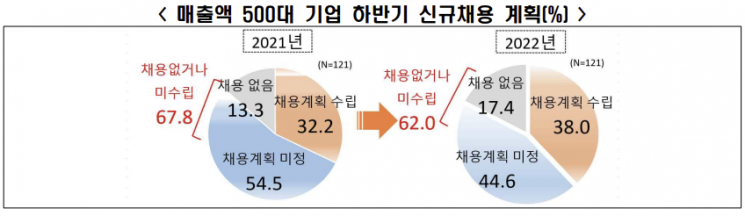
On the 4th, the Federation of Korean Industries (FKI) commissioned Research & Research, a public opinion research firm, to survey the ‘2022 Second Half New Hiring Plans’ targeting the top 500 companies by sales. The results showed that 62.0% of large companies, or six out of ten, had not established or did not have plans for new hiring. Among them, 44.6% had no new hiring plans, which is a decrease from 54.5% in the same period last year, but the percentage of companies that decided not to hire increased to 17.4% from 13.3% in the same period last year.
The FKI stated, “The decrease in the proportion of companies that have not decided on second-half hiring plans or decided not to hire compared to 67.8% in the same period last year reflects the increased labor demand due to the recovery of daily life after the spread of COVID-19.” However, they expressed concern that “recent global supply chain deterioration, high inflation, and high interest rates are increasing domestic and international risks, which may lead to a contraction in the hiring market in the second half.”
The proportion of large companies that established new hiring plans for the second half this year was 38.0%, an increase of 5.8 percentage points from 32.2% in the same period last year. Among them, 37.0% planned to increase hiring compared to last year, 50.0% planned to maintain similar hiring levels, and 13.0% planned to reduce hiring. The FKI explained that despite the difficult business environment, companies with the capacity to hire are actively creating jobs.
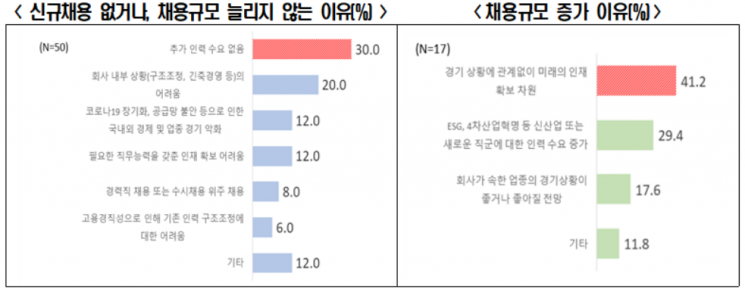
Companies that decided not to hire or not to increase hiring cited reasons such as ▲no additional workforce demand (30.0%) ▲difficulties due to company circumstances (restructuring, austerity management, etc.) (20.0%) ▲deterioration of domestic and international economy and industry conditions due to prolonged COVID-19 and supply chain instability (12.0%) ▲difficulty in securing talents with necessary job skills (12.0%) among others.
Conversely, companies that responded they would increase new hiring cited reasons such as ▲securing future talents regardless of economic conditions (41.2%) ▲increased workforce demand in new industries or new job categories (29.4%) ▲good or improving industry conditions in their sector (17.6%).
The FKI noted that the triple-high phenomenon this year?rising inflation, interest rates, and exchange rates?has increased uncertainty in corporate management, negatively impacting second-half hiring plans. Three out of ten large companies (32.2%) reported changes in second-half hiring due to the triple-high phenomenon, such as suspending or postponing hiring. Specifically, ▲reconsidering hiring (14.0%) ▲reducing hiring scale (12.4%) ▲suspending hiring (3.3%) ▲postponing hiring schedule (2.5%) were reported in order.
The FKI stated, “Due to worsening domestic and international conditions such as high inflation, high interest rates, high exchange rates, and concerns about global economic slowdown, corporate performance and investment are expected to be sluggish in the second half,” adding, “It cannot be ruled out that the employment market may contract even more than indicated by this survey.”
In the Second Half, On-Demand Hiring and Preference for Experienced and STEM Professionals Become More Prominent
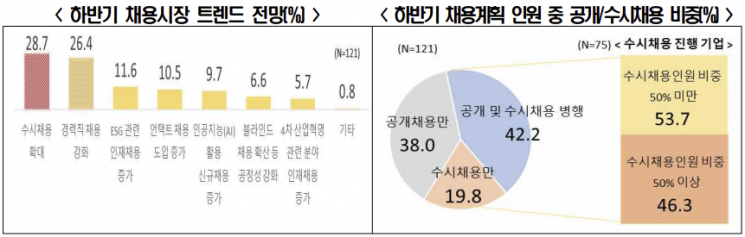
On-demand hiring is expected to be actively conducted in the second half. Regarding trends in the second-half hiring market, companies most frequently selected ▲expansion of on-demand hiring (28.7%). Other trends included ▲strengthening recruitment of experienced professionals (26.4%) ▲increased hiring of ESG-related talents (11.6%) ▲increased adoption of non-face-to-face hiring (10.5%) ▲increased use of artificial intelligence (AI) (9.7%) ▲spread of blind hiring and other fairness enhancements (6.6%) ▲increased hiring in the Fourth Industrial Revolution fields (5.7%).
Reflecting these trends, 62.0% of companies responded that they would use on-demand hiring for new recruitment. Companies conducting only on-demand hiring accounted for 19.8%, those combining open and on-demand hiring were 42.2%, and those conducting only open hiring were 38.0%. Among companies conducting on-demand hiring, nearly half (46.3%) recruit more than 50% of their total planned hires through on-demand hiring.
The preference for practical talents who can quickly respond to rapidly changing business environments is also prominent. Companies most frequently cited job-related work experience (19.2%) as the most important factor when evaluating talents. This preference for practical talents leads to a preference for experienced professionals. Companies responded that 35.8% of new college graduate hires in the second half would be experienced professionals, an increase of 6.1 percentage points from 29.7% in the first half.
In the second-half college graduate hiring market, the preference for STEM talents is expected to deepen. Among the planned new college graduate hires in the second half, 67.9% are expected to be STEM graduates, an increase of 6.9 percentage points from 61.0% in the first half. Following are humanities majors (30.8%) and other majors such as medical, arts, and physical education (1.3%).
The FKI emphasized, “Due to industrial structure advancement and the growing importance of science and technology, companies are focusing on securing talents in natural and engineering fields,” adding, “To nurture talents aligned with industrial demand, it is necessary to enhance higher education competitiveness by relaxing department enrollment regulations and strengthening industry-academia cooperation.”
Top Priority Task for Improving Employment Market is 'Deregulation of Companies'
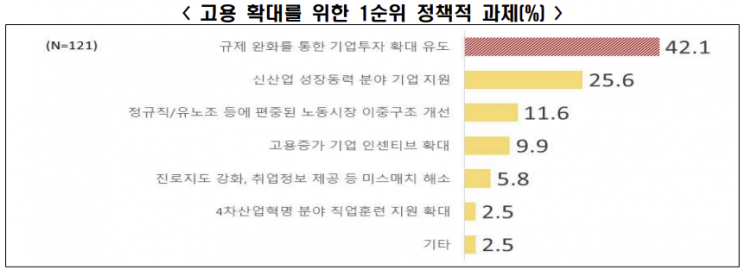
Companies identified 'expanding corporate investment through deregulation (42.1%)' as the top policy task to expand new college graduate hiring. Following this were ▲support for companies in new growth engine industries (25.6%) ▲improvement of the dual labor market structure biased toward regular workers and union members (11.6%) ▲expansion of incentives for companies that increase employment (9.9%) ▲strengthening career guidance and providing employment information to resolve mismatches (5.8%).
Choo Kwang-ho, head of the FKI Economic Headquarters, said, “With the recent surge in raw material prices and the triple-high phenomenon of high inflation, high interest rates, and high exchange rates, along with export slowdown, the possibility of an economic recession is increasing, which may negatively impact the employment market in the second half.” He added, “If the government and the National Assembly create a business-friendly environment through active policy responses such as regulatory reform, fostering new industries, and easing tax burdens, it will help companies actively create jobs.”
© The Asia Business Daily(www.asiae.co.kr). All rights reserved.



















