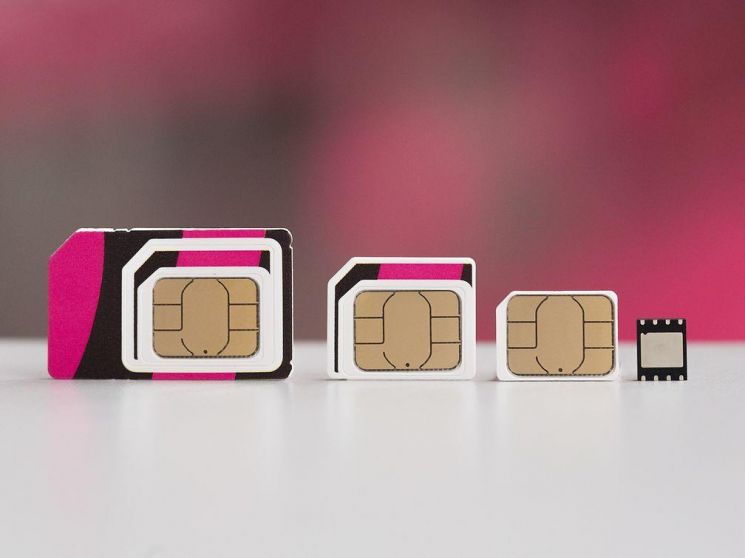
[Asia Economy Reporter Oh Su-yeon] Since the 1st of this month, the eSIM (embedded SIM) service has been commercialized. One of the strengths of eSIM is that it allows the use of two numbers on a single device. It looks similar to the existing 'two-number service,' which has deepened the dilemma for consumers considering subscribing to eSIM.
As the name suggests, eSIM is an embedded SIM. It performs the same role as a regular USIM but the chip is embedded inside the device. There is no need for physical insertion or replacement. While traditional SIM cards require waiting for delivery or visiting an offline store for activation, eSIM allows users to download the carrier profile via a QR code, making it fast and convenient. This enables tasks such as number porting, subscription, and cancellation to be handled without visiting a store.
From the user's perspective, the biggest difference brought by the introduction of eSIM is that the device can be used as a 'dual SIM.' One device can use two numbers, allowing users to separate lines according to purpose, such as work and personal use.
Before the introduction of eSIM, the three major carriers offered two-number services as an additional service. These include SK Telecom's 'Number Plus II,' KT's 'Dual Number Light,' and LG Uplus's 'Dual Number.'
When subscribing to the two-number service, users receive a virtual number in addition to their existing number, allowing them to use two phone numbers, which seems similar to eSIM.
However, there are differences in actual use. To call using the virtual number from the two-number service, users must first dial a prefix such as *281 (SK Telecom), *77 (KT), or *77# (LG Uplus) before the phone number. The same applies to text messages. Forgetting to enter the prefix can accidentally expose the original number, and having to dial the prefix every time is inconvenient.
Because it is a virtual number, the number received through the two-number service cannot be used for identity verification.
If subscribing to the two-number service means getting an additional virtual number, eSIM differs in that it provides two real numbers. Since the eSIM line is newly activated under the user's name like a USIM line, identity verification is also possible.
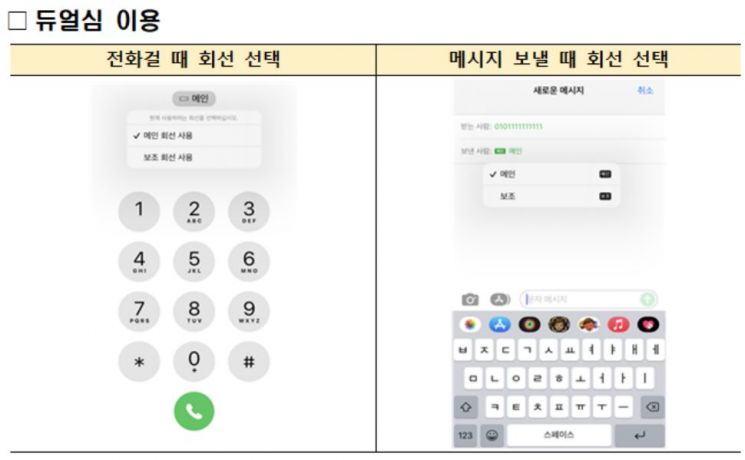
It is also convenient to use. Unlike the two-number service, there is no need to enter complicated numbers before making a call. After selecting whether to use the main or secondary line, users can dial the number as usual.
Carriers can also be separated. The two-number service is an additional service and can only be used within one carrier. However, eSIM can be subscribed to with different carriers or MVNOs. It is possible to combine the necessary plans.
In terms of price, the two-number service seems cheaper. The two-number service costs around 3,000 KRW per month, but the dual SIM plans currently offered by KT and LG Uplus cost 8,800 KRW per month. The two-number service uses the voice and text of the existing line, while subscribing to a dual SIM plan provides an additional 250MB to 1GB of data and allows sharing of calls and texts from the main line's plan.
However, if you do not insist on the three major carriers, it is different. If you use an MVNO other than the three major carriers for the eSIM line, the cost burden can be lower than the two-number service. For example, T Plus's eSIM standard plan offers 100 minutes of voice and 100 texts for 2,900 KRW per month. Plans that include data cost around 4,000 to 5,000 KRW per month, but if you do not need to use data on the eSIM line, opening a line with an MVNO seems more economical.
Meanwhile, to use eSIM, the device must have an embedded eSIM. Samsung Electronics' Galaxy devices have supported eSIM since the Galaxy Z Fold and Flip4 models released last month. iPhones have supported eSIM since the iPhone XS released in 2018.
© The Asia Business Daily(www.asiae.co.kr). All rights reserved.
![From Bar Hostess to Organ Seller to High Society... The Grotesque Con of a "Human Counterfeit" [Slate]](https://cwcontent.asiae.co.kr/asiaresize/183/2026021902243444107_1771435474.jpg)

















