Yeoncheon Residents, "Great Inconvenience for Elderly and Farmers... Guarantee of Passage Rights"
Yeoncheon-gun, "No Need for Grade Separation... Construction to Proceed After Securing Residents' Passage Rights"
Railroad Corporation, "Level Crossings Not Allowed... Grade Separation with Yeoncheon-gun Budget"
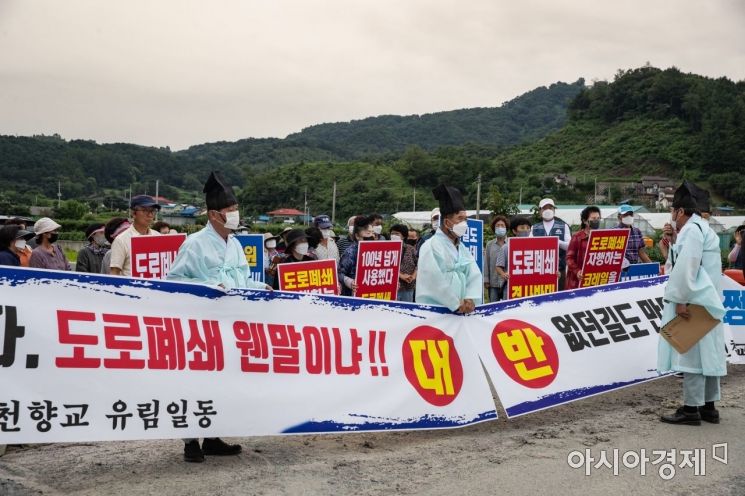 Closure of Level Crossing on Gyeongwon Line Train at Yeoncheon Section Blocks Passage, Residents Protest [Yeoncheon-gun]
[Asia Economy Reporter Ra Young-cheol] As the Korea National Railway Corporation is promoting the construction project of the Dongducheon~Yeoncheon section of the Gyeongwon Line subway, local residents are strongly opposing the closure of the Yeoncheon section railroad crossings (Gu-eup, Northern Yeoncheon) and demanding secured passageways.
Residents of Yeoncheon are appealing for the preservation of the Gu-eup and Northern Yeoncheon railroad crossings, citing the lack of alternative roads, infringement of passage rights and property rights, and inconvenience in daily life. However, the Korea National Railway Corporation insists on implementing the project as originally planned.
According to Yeoncheon County and the Railway Corporation, there are five level crossings within a 2.35 km section from Yeoncheon Station’s Yeoncheon Crossing to Gajaul Crossing on the Gyeongwon Line subway construction section. The Railway Corporation plans to completely close three of these five crossings.
Currently, during the ongoing project, the Gu-eup crossing is maintained as a temporary lane and pedestrian path, the Northern Yeoncheon crossing has its vehicle lane closed but remains open for pedestrians only, and the Southern Yeoncheon crossing has been completely closed.
In particular, the Gu-eup crossing is a main road used by more than 7,000 people daily. During farming seasons, residents of Gunnam-myeon and Jung-myeon use it most frequently for transporting agricultural machinery, and it serves as a quick passageway to other areas within Yeoncheon.
Residents have opposed the Railway Corporation and Yeoncheon County, stating, "The detour roads planned by the Railway Corporation require a long roundabout route, and most road users are elderly and farming residents, causing significant inconvenience."
They further expressed outrage, saying, "It is unacceptable to eliminate the main road, infringing on residents’ pedestrian rights, living areas, and property rights due to budget constraints and insufficient countermeasures."
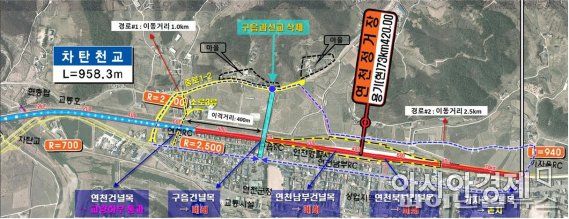
Yeoncheon-eup has been a section where Gyeongwon Line trains have operated since 1958. The current project initially planned to build a bridge over the Chatancheon crossing section, an underpass at the Apsul crossing section, and to construct new embankments using the existing line for the remaining sections.
However, Yeoncheon County, concerned that building embankments and laying tracks would divide the area into east and west centered around the railway, requested a design change to convert the crossings into urban planning roads (Class 1 middle roads) and bridges, agreeing to bear additional project costs.
According to the Railway Corporation, the Gu-eup crossing was originally designed to be constructed as a pedestrian overpass, but Yeoncheon County proposed deleting the overpass plan and instead extending the railway bridge to create a detour road underneath.
During this process, the construction cost of the Gu-eup crossing (pedestrian overpass) amounting to 7.5 billion KRW was included in the main project cost of the Dongducheon-Yeoncheon subway (approximately 530 billion KRW), resulting in the exclusion of the Gu-eup crossing construction project.
As time passed, Yeoncheon residents demanded that the Gu-eup crossing remain as a level crossing, and Yeoncheon County, citing relevant laws, stated that there is no problem even if it is not a pedestrian overpass.
According to Article 7 of the Enforcement Decree of the Railroad Crossing Improvement Promotion Act, if grade separation is difficult due to topographical conditions or is deemed unnecessary through consultation with related administrative agencies, grade separation may not be implemented.
Kim Deok-hyun, Yeoncheon County Governor, requested, "After completing the originally agreed Yeoncheon urban planning roads 1-2, secure residents’ passage rights and then proceed with construction. As a crossing measure, after the subway opens, maintain the Gu-eup crossing as a level crossing and construct a pedestrian overpass at the Northern Yeoncheon crossing with national funding to guarantee residents’ passage rights."
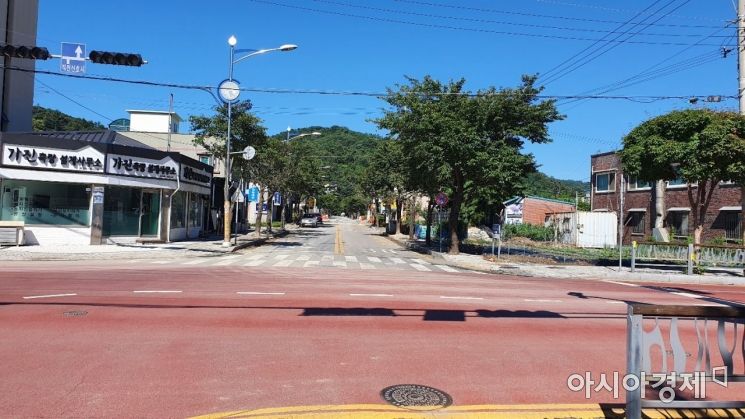
In response, the Railway Corporation, citing railway-related laws and safety, stated, "Level crossings are not allowed," and insisted, "Yeoncheon County must fully fund the construction of the Gu-eup crossing as a pedestrian overpass."
However, they left room for negotiation, saying, "If Yeoncheon County secures the budget, we will actively consider the feasibility of facilities close to the railway."
Nevertheless, it is currently difficult to continue using the Gu-eup crossing in its existing level crossing form or to construct it as a pedestrian overpass with additional budget as residents demand.
Even if national funding is requested, if the national project budget increases beyond the original plan, consultations with the Ministry of Land, Infrastructure and Transport and the Ministry of Economy and Finance are required.
Moreover, since Yeoncheon County, which has limited finances, has already invested county funds in the urban planning road and bridge project related to the national railway project, it is a significant burden to allocate additional county funds again.
Attention is focused on what solutions the Korea National Railway Corporation and Yeoncheon County will propose regarding residents’ safety and securing passage rights.
© The Asia Business Daily(www.asiae.co.kr). All rights reserved.



















