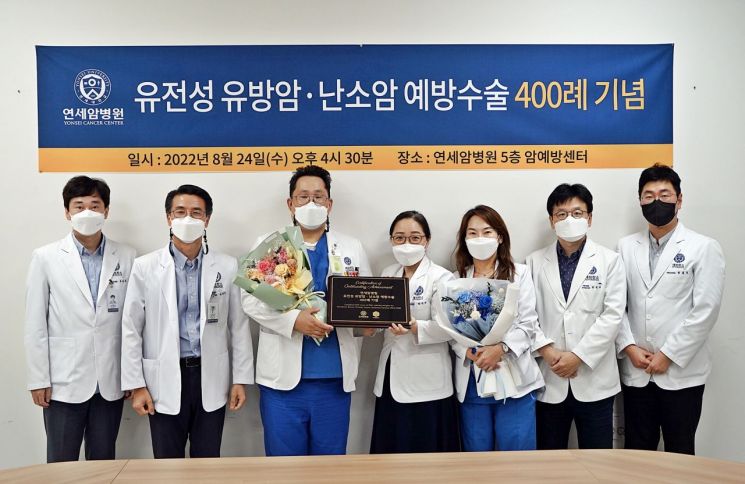
[Asia Economy Reporter Lee Gwan-ju] Yonsei Cancer Hospital recently announced on the 2nd that it has achieved 400 cases of preventive surgery for hereditary breast and ovarian cancer.
Yonsei Cancer Hospital performed 101 cases of preventive mastectomy (including contralateral mastectomy) and 299 cases of preventive salpingo-oophorectomy. Among the patients who underwent surgery, neither breast cancer nor ovarian cancer has occurred to date, and there were no serious side effects or complications such as bleeding or necrosis.
Hereditary breast cancer is caused by specific mutated genes that cause the disease to occur across generations within families, accounting for 5-10% of all breast cancer cases. The representative cause is the BRCA1 and BRCA2 gene mutations, which became widely known following the preventive mastectomy of the famous American actress Angelina Jolie. Generally, women with BRCA1 mutations have a 70% risk of developing breast cancer and a 40% risk of ovarian cancer by age 70, while those with BRCA2 mutations have an estimated 70% risk of breast cancer and 20% risk of ovarian cancer.
Hereditary breast and ovarian cancer syndrome is a condition where the risk of developing breast and ovarian cancer is more than 10 times higher compared to the general population. If mutations are confirmed through BRCA1 and BRCA2 genetic testing, cancer occurrence can be prevented through chemical prophylaxis or preventive surgery. Among these, preventive surgery of the breast and ovaries is known to be the most effective method.
Preventive surgery reduces the risk and mortality of breast and ovarian cancer. The surgeries include preventive mastectomy (preventive bilateral and preventive contralateral mastectomy) and preventive bilateral salpingo-oophorectomy. In the case of mastectomy, due to feelings of loss and fear regarding breast removal, many patients did not undergo contralateral mastectomy; however, with recent improvements in awareness, cases of preventive surgery are increasing.
The Cancer Prevention Center at Yonsei Cancer Hospital is staffed by specialized medical professionals from various departments including breast surgery, obstetrics and gynecology, gastroenterology, oncology, clinical genetics, pediatrics and adolescent medicine, and laboratory medicine. They are responsible for cancer treatment, genetic counseling, and multidisciplinary care. Especially for high-risk groups, they provide preventive treatment along with analysis of various cancer risk factors. For breast or ovarian cancer patients, specialists take detailed family histories and, if BRCA1 or BRCA2 mutations are confirmed through genetic testing, provide treatment to prevent cancer in patients and family carriers.
Park Ji-su, head of the Cancer Prevention Center at Yonsei Cancer Hospital, said, “We will continue to strive to actively prevent cancer occurrence through professional and precise cancer preventive surgeries to help high-risk hereditary cancer patients lead healthy lives.”
© The Asia Business Daily(www.asiae.co.kr). All rights reserved.

















