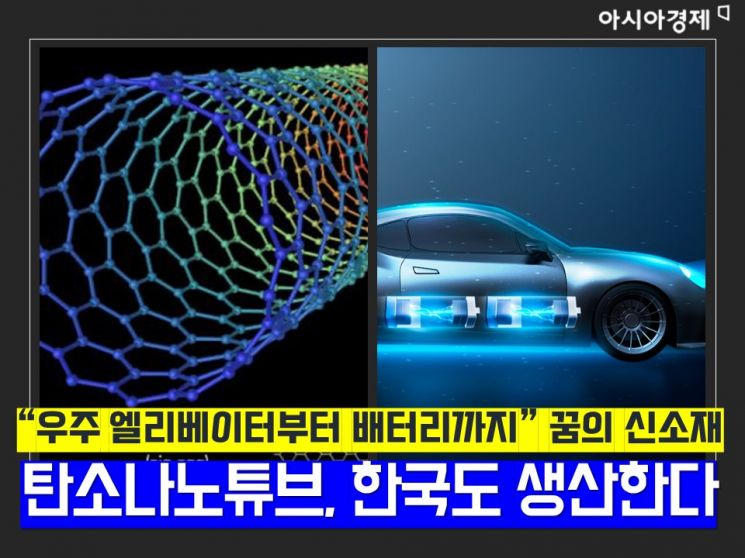
 Carbon nanotubes, which are 100 times stronger than steel and nearly 4 times lighter, are considered a key material for future industries. / Photo by Song Hyundo, Asia Economy intern reporter
[Asia Economy Reporter Lim Juhyung, Intern Reporter Song Hyundo] The domestic petrochemical industry is challenging to take the lead in the 'Carbon Nanotube' market. Large corporations such as LG Chem and SK Innovation have already begun expanding their facilities. Carbon nanotubes are considered a 'dream new material' due to their uniquely high stiffness, enabling applications not only in secondary batteries but also potentially making the construction of a 'space elevator' connecting Earth and space possible in the distant future.
On the 30th of last month, LG Chem announced plans to build a 4th carbon nanotube factory. LG had already operated its second carbon nanotube production plant last year and started construction of the 3rd plant earlier this year. They are pushing to build two factories simultaneously within just one year.
Meanwhile, SK Innovation, which has SK On as a subsidiary, invested 15 billion KRW in March to acquire a 5.45% stake in JOE, a domestic company producing carbon nanotubes. JOE has been developing carbon nanotubes since 2007 and already supplies products to several global companies, including the European automaker Volkswagen.
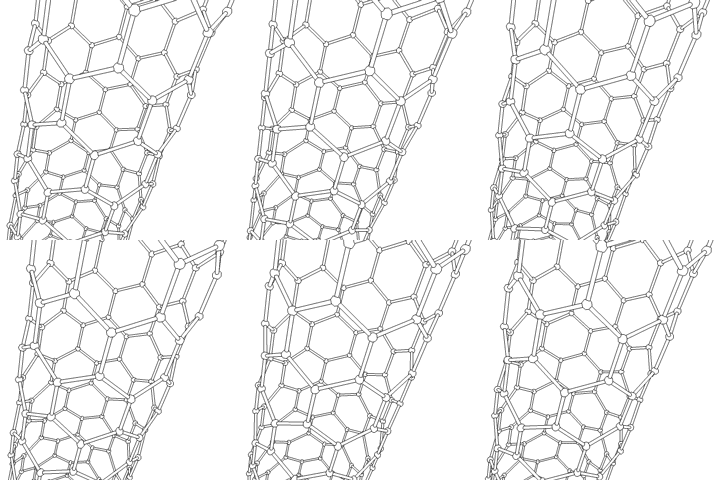 3D Animation of Carbon Nanotube Structure / Photo by Wikipedia
The reason companies are aggressively investing in carbon nanotubes is the high expectation that it is a 'core technology' that will determine the direction of future industries, from electric vehicles to the space industry. Carbon nanotubes are materials made of hexagonally arranged carbon atoms shaped into cylindrical tubes. They were first discovered in 1991 by Dr. Sumio Iijima (飯島澄男) from NEC's affiliated research institute in Japan. Their most significant feature is stiffness. They are 100 times stronger than steel but more than four times lighter. They also have excellent thermal and electrical conductivity.
Because they possess useful characteristics for use as composite materials, they were initially hailed as a 'dream new material' when discovered. However, a fatal drawback has been the difficulty of mass production. Carbon nanotubes are produced by applying heat to carbon-rich materials such as graphite, but the amount produced relative to the cost is limited, and maintaining uniform quality is challenging.
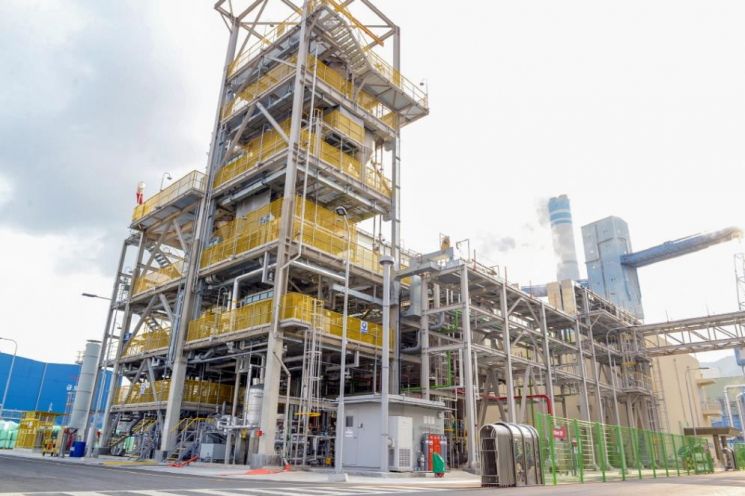 LG Chem's Yeosu carbon nanotube factory. Carbon nanotubes are gaining attention as cathode conductive materials for electric vehicle batteries. / Photo by LG Chem
For example, carbon nanotubes are already a key material in electric vehicle batteries. Typically, lithium-ion batteries consist of four main components: cathode, anode, electrolyte, and separator. Among these, carbon nanotubes can be used as conductive additives (fine powders added to facilitate the flow of electricity and electrons) in the cathode.
Currently, a carbon material called 'black carbon' is mainly used as the conductive additive in batteries. However, experts explain that the performance of carbon nanotubes surpasses existing materials. A representative from JOE's battery division stated, "The advantage of carbon nanotubes is that they can achieve better conductivity with a smaller amount than existing conductive additives," and predicted, "They will establish themselves as an essential next-generation raw material in terms of battery capacity and stability."
Carbon nanotubes are also expected to play a key role in the future space industry. A representative concept is the 'space elevator,' which proposes connecting the structure on the ground and Earth's orbit with a strong cable and transporting people or cargo similarly to a building elevator. For this idea to be realized, an extremely strong cable capable of withstanding Earth's gravity in space is required, and international researchers studying the feasibility of building a space elevator consider carbon nanotubes the most promising candidate material.
© The Asia Business Daily(www.asiae.co.kr). All rights reserved.


















