[Seoul District News] Lee Gijae, Yangcheon-gu Mayor, Proposes to Won Heeryong, Minister of Land, Infrastructure and Transport, Practical Compensation Measures Including Expansion of Noise Control Areas by Relaxing Noise Standards, Increased Realistic Electricity Fee Support, and Reduced Aircraft Operation Hours... Jung-gu's First Supplementary Budget of 23 Billion Won in the 8th Elected Term... Seongdong-gu's Advanced Smart Inclusion Policy Promoted Across East Asia
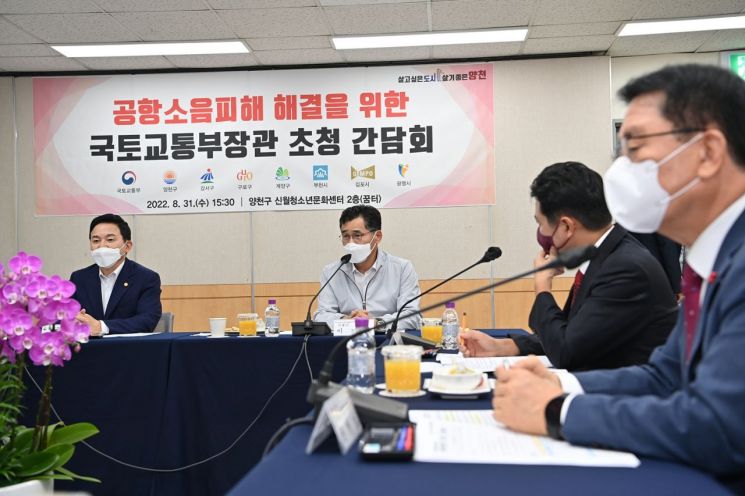
[Asia Economy Reporter Park Jong-il] Yangcheon-gu (District Mayor Lee Gi-jae) held a meeting on the afternoon of August 31 at the Sinwol Youth Culture Center with Won Hee-ryong, Minister of Land, Infrastructure and Transport, and heads of local governments near Gimpo Airport, requesting active government support to resolve noise issues from Gimpo Airport.
This meeting was arranged after Yangcheon-gu Mayor Lee Gi-jae invited Minister Won Hee-ryong to inform him that 65% of the entire noise-affected area around Gimpo Airport consists of Yangcheon-gu residents.
Attendees included Kim Tae-woo, Mayor of Gangseo-gu, Seoul; Moon Heon-il, Mayor of Guro-gu; Kim Byung-soo, Mayor of Gimpo; officials from Gyeyang-gu, Incheon; Bucheon City; and Gwangmyeong City, all local governments near Gimpo Airport. They explained the noise damage experienced by residents near the airport and requested active interest and cooperation from central government agencies.
Yangcheon-gu Mayor Lee Gi-jae requested a thorough survey of residents affected by airport noise and the establishment of realistic compensation measures, proposing ▲expansion of noise control areas through relaxation of noise standards ▲increase in electricity bill support to reflect current realities ▲reduction of aircraft operation hours ▲inclusion of adjacent areas (households) when designating noise control zones.
Minister Won Hee-ryong, after listening to the proposals, said, “The government has continuously implemented support projects such as installing soundproofing facilities and air conditioners in noise-affected areas, but it may have fallen short of residents’ expectations. We will work to find reasonable measures to alleviate residents’ suffering through sufficient consultation with related agencies such as the Ministry of Strategy and Finance and the Ministry of Environment.”
Yangcheon-gu Mayor Lee Gi-jae emphasized, “Most of the issues proposed to the Minister of Land, Infrastructure and Transport at this meeting are common concerns, so it is more important than ever for local governments near Gimpo Airport to cooperate and speak with one voice.”
After the meeting, Mayor Lee Gi-jae visited an apartment in Sinwol-dong, Yangcheon-gu, where airport noise damage is most severe, together with Minister Won Hee-ryong to inspect the aircraft noise damage and requested a thorough review of the proposals to resolve airport noise.
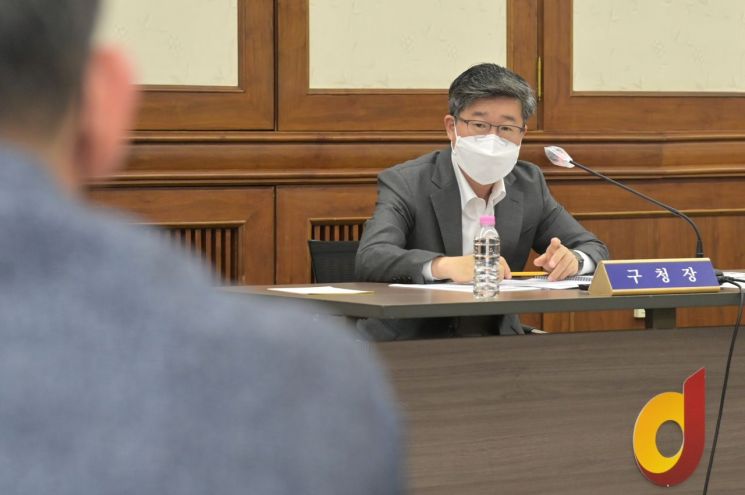
Jung-gu, Seoul (District Mayor Kim Gil-seong) announced on the 1st that it has formulated the first supplementary budget of the 8th local government term, reflecting residents’ hopes for the next four years.
The supplementary budget amounts to 23 billion KRW, and once approved, 67 projects in the second half of this year are expected to bring tangible changes to residents.
Key allocations include ▲3.4 billion KRW for urban development such as the revision of Namsan height restrictions ▲2.4 billion KRW for infrastructure expansion including the undergrounding project of Yaksu Market ▲500 million KRW for disaster safety such as support for restoring retaining walls at Namsan Town Apartments damaged by floods ▲900 million KRW for revitalizing the local economy including support for small business owners ▲3.7 billion KRW for social welfare including support for the disabled and vulnerable groups ▲1.6 billion KRW for childcare and education including childbirth encouragement subsidies ▲800 million KRW for promoting sports and culture.
The district stated that it has boldly reduced unnecessary parts of the existing 2022 budget and carefully selected only essential projects for residents to prepare a well-structured budget plan.
The budget proposal was submitted to the Jung-gu Council on the 1st and will be finalized after deliberation and approval in the plenary session in September.
An official from the district said, “These projects are directly related to residents’ basic safety and livelihood, and since they embody the earnest wishes for Jung-gu in the 8th local government term, the projects will be implemented without delay as soon as the budget passes the council.”
Kim Gil-seong, Mayor of Jung-gu, said, “This supplementary budget is a ‘Residents’ Hope Supplementary Budget’ and the first step to change Jung-gu’s future. I hope the budget will be swiftly approved with united efforts solely for the 122,000 residents of Jung-gu.”
Seongdong-gu (District Mayor Jung Won-oh) participated in the ‘11th East Asia Inclusive Cities Network Workshop’ held in Osaka, Japan, for four days starting from the 23rd of last month, presenting Seongdong-gu’s core policy case of the Smart Inclusive City and sharing it with East Asian countries.
The East Asia Inclusive Cities Network is a workshop where various experts, scholars, and activists related to housing welfare and urban studies such as housing, urban issues, poverty, and homelessness from Korea, Japan, Taiwan, and Hong Kong participate to share policies among member cities. The conference is held annually, rotating among cities.
Since 2016, Seongdong-gu has participated annually, sharing leading policies such as prevention of displacement (gentrification) and essential worker policies.
This workshop was held under the theme ‘From Divided and Vulnerable Cities to Inclusive Resilient Cities Respecting Diversity,’ covering four areas: the status and support policies for socially vulnerable groups, disaster-resilient cities and recovery, coexistence with foreign nationals, and urban policy cases from each country.
Seongdong-gu’s Moon Seong-su, Director of the Smart Inclusive City Bureau, participated as Korea’s representative in the urban policy cases sector and presented the ‘Smart Inclusive City policy case realizing the value of inclusion through smart technology as a solution to digital divide and exclusion in the digital transformation era accelerated by the COVID-19 pandemic.’
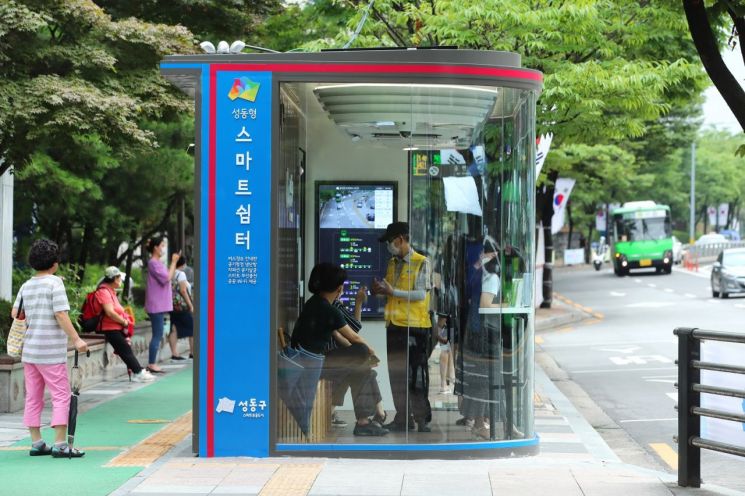
The workshop shared smart inclusive city policy cases in five areas: ▲‘Smart Sovereignty Inclusion Case’ to reduce participation gaps such as the online living lab platform Seongdong-gu Citizen Hall ▲‘Smart Education Inclusion Case’ to reduce educational gaps such as the 4th Industrial Revolution Experience Center for nurturing future talents ▲‘Smart Care Inclusion Case’ to reduce welfare gaps such as ‘Kkokkashin’ (wandering prevention shoes) and smart insoles for dementia patients and people with developmental disabilities ▲‘Smart Economic Inclusion Case’ to reduce job gaps such as the creation of smart commercial districts ▲‘Smart Safety Inclusion Case’ to reduce safety gaps such as smart shelters and smart crosswalks for transportation-vulnerable people. It also shared COVID-19 response policy cases using ICT technology such as ‘mobile electronic registry,’ ‘real-time waiting status guidance system at screening clinics,’ and drive-through urban loans, drawing active interest and positive responses from participating countries.
Since declaring the ‘Smart Inclusive City’ vision in 2018 as the first local government, Seongdong-gu has continuously developed and implemented policies for socially vulnerable groups that embrace all residents’ lives with convenient 4th Industrial Revolution technologies and enhance urban inclusiveness.
Notably, it was the first local government to establish a bureau-level organization called the ‘Smart Inclusive City Bureau,’ enact an ordinance mandating resident participation in smart inclusion policies, and received government certification as an ‘Excellent Smart City’ in 2021 for various smart policies presented at this workshop.
Seongdong-gu Mayor Jung Won-oh said, “I hope Seongdong-gu’s warm policies that develop and utilize advanced technologies not for economic ripple effects but for people, recognized as exemplary cases spreading to Seoul and the central government, will, through this workshop, extend to East Asia and the world, contributing to solutions for urban problems in the with-COVID era.”
© The Asia Business Daily(www.asiae.co.kr). All rights reserved.



















