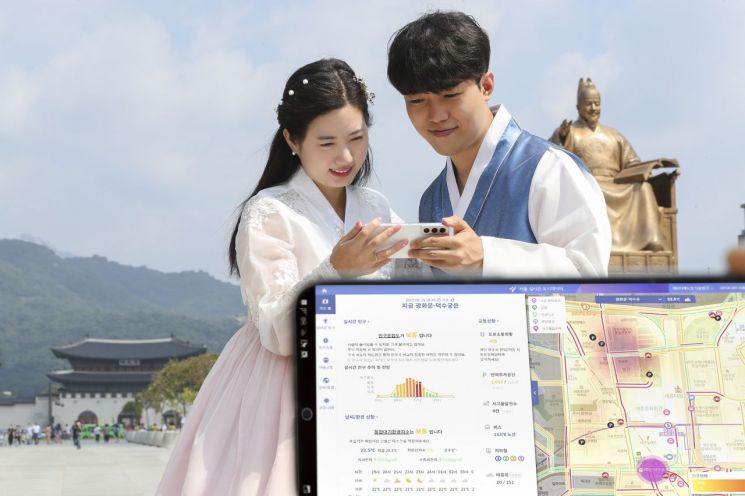
 KT employees are checking real-time on-site congestion information near Gwanghwamun, Seoul. Photo by KT
[Asia Economy Reporter Oh Su-yeon] KT announced on the 1st that it has developed ‘real-time population data’ that can verify the real-time population present in major areas (POI·Point of Interest) by utilizing big data from mobile phone base station signals, and will provide this real-time population data to Seoul City.
KT’s real-time population data is designed to estimate the population present in a specific area at the current time by aggregating and processing big data of mobile phone signals collected over 5 minutes from base stations in major areas. By utilizing this, local governments can check the congestion level of populations at key locations in real time, enabling rapid and proactive policy formulation and response system establishment.
For example, it can be used to reduce the possibility of mass infections by real-time monitoring and preemptive quarantine measures in areas with high congestion in preparation for the resurgence of COVID-19. It can also be used to inspect facilities and allocate personnel and equipment by integrating real-time weather information and population congestion data by location during weather disasters such as heavy rain or heavy snow.
KT provides real-time population data for 50 locations within Seoul, including tourist attractions, Hangang Park, and major commercial districts. Seoul City will fuse this real-time population data with public data in transportation and environmental sectors to develop and open the world’s first ‘Seoul Real-Time Urban Data,’ which integrates real-time data from public (transportation, environment) and private (telecommunications) sectors. Through this, Seoul plans to establish a ‘data-driven daily quarantine safety response system.’
Seoul City will open the data via an application programming interface (API) on the Seoul Open Data Plaza and provide real-time field information services by adding population prediction information based on a real-time population prediction AI model developed together with AI specialist company ‘WhiteScan.’ Additionally, by the second half of this year, Seoul plans to visualize and provide real-time urban data to citizens through the Seoul tourism website ‘Visit Seoul.’
Choi Jun-gi, Head of KT AI/Big Data Business Division, said, “We will expand the scope of real-time population data utilization to disasters, safety, environment, transportation, and security to contribute to improving citizens’ safety and quality of life.”
© The Asia Business Daily(www.asiae.co.kr). All rights reserved.

















