'European Environmental Geoscience Research and Education Center' Research Team
Discovers Tributary Enabling Construction
Through Plant Pollen Fossils
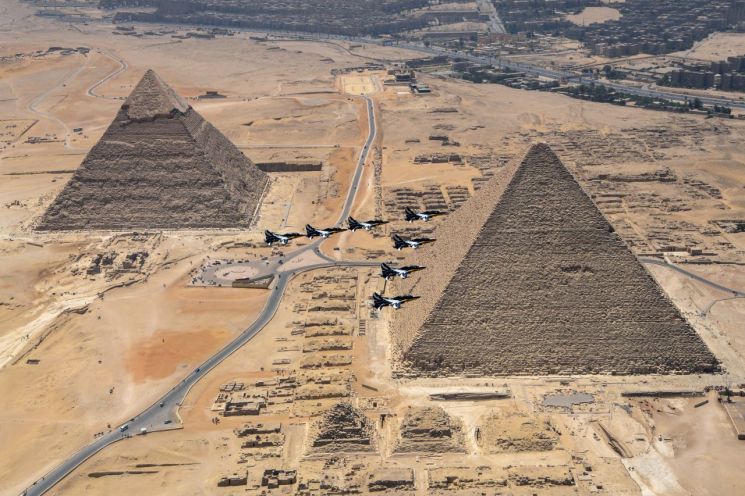 The Air Force Special Flight Team Black Eagles participated in the Pyramid Airshow 2022, flying over the pyramids near Cairo, Egypt. [Image source=Yonhap News]
[Asia Economy Reporter Kim Jung-wan] Evidence that could resolve questions about the transportation methods of the large stones used in the pyramids, one of the Seven Wonders of the Ancient World, has been secured.
According to recent reports by The New York Times (NYT) and others, an international research team led by environmental geographer Hader Seisha from the French 'European Center for Research and Education in Environmental Geosciences (CEREGE)' announced yesterday in the U.S. journal 'Proceedings of the National Academy of Sciences (PNAS)' the discovery of traces of a Nile River tributary through pollen fossils found in sediment layers drilled around the Giza Pyramids in northern Egypt.
Until now, how the massive stones used in pyramid construction were transported has been considered a mystery. Among them, the largest pyramid, King Khufu's Pyramid, stands 147 meters tall with a base length of 230 meters. Over 2-ton large stones such as limestone and granite, totaling about 2.3 million pieces, were used in its construction. Previously, scholars hypothesized that the Nile River was used for transporting pyramid materials and that waterways might have been dug to the construction site, but this had not been proven.
The research team analyzed pollen fossils to identify traces of a Nile tributary flowing near the Giza Pyramids and concluded that large stones were likely transported via this waterway. The river, named the 'Khufu Tributary' after King Khufu, the second pharaoh of Egypt's Fourth Dynasty, is claimed to have maintained sufficient water levels to transport materials from the Nile's main stream about 7 kilometers away to the pyramid construction site.
The team drilled five sites along the presumed Khufu Tributary over several years, collecting sediment samples spanning thousands of years. By analyzing pollen grains in the samples, they identified 61 plant species including ferns and palm trees. These plants provided clues to environmental changes over approximately 8,000 years. Pollen from bulrushes and papyrus indicated waterside environments, while pollen from drought-resistant plants indicated areas far from rivers, helping to pinpoint the location of the Khufu Tributary.
The team analyzed that during 2686?2160 BCE, when the Khufu, Khafre, and Menkaure pyramids were built, the Khufu Tributary maintained about 40% water level, sufficient for material transport and without flood risk, making it suitable for pyramid construction.
From around 1350 BCE, water levels gradually dropped over centuries, making material transport impossible and leading to the end of pyramid construction. By around 332 BCE, when Alexander the Great conquered Egypt, the tributary had dried up and was converted into the pyramid necropolis, the research team explained.
Researcher Seisha told the NYT that revealing how Giza's natural environment was utilized for pyramid construction helps solve some of the many mysteries surrounding ancient architecture, stating, "Knowing more about the environment can unlock the puzzles surrounding pyramid construction."
© The Asia Business Daily(www.asiae.co.kr). All rights reserved.

















