Starting next year, a 1.3 million KRW increase... 2.05 million KRW by 2025
Up to 300,000 KRW government support for Naeiljunbi Savings
Private First Class monthly salary 1.7 million KRW, Second Lieutenant 1.75 million KRW
Soldiers' monthly pay surpasses officers' after 3 years
Annual budget needed 5.1 trillion KRW... 9.3% of defense budget
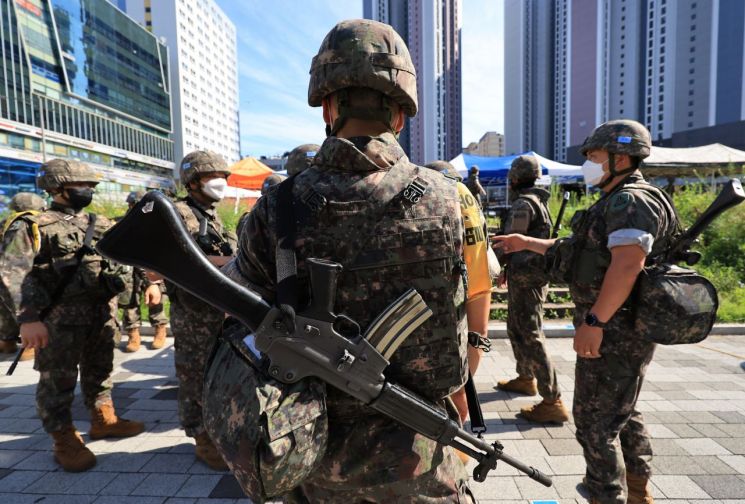 Soldiers of the Army's 56th Division shared training orders before moving to conduct reconnaissance and surveillance operations during the 2022 Eulji Exercise held on the afternoon of the 23rd at Lotte Mall Eunpyeong in Eunpyeong-gu, Seoul. [Image source=Yonhap News]
[Asia Economy Intern Reporter Kim Gunchan] Starting next year, the monthly salary for a sergeant will be increased to 1.3 million KRW. It is planned to be gradually raised to 2.05 million KRW by 2025. Concerns have been raised that a 'military salary inversion' phenomenon may occur, as the starting salary for both non-commissioned officers and officers does not reach 2 million KRW at step 1.
The government included plans to raise soldier salaries in the 2023 defense budget announced on the 30th. According to the budget, the sergeant's monthly salary, which is 676,100 KRW this year, will increase by 323,900 KRW next year to reach 1 million KRW. The government subsidy for the Soldier Tomorrow Preparation Savings, which helps soldiers build assets, will rise from a maximum of 141,000 KRW per month to 300,000 KRW. Effectively, the sergeant's monthly salary will become 1.3 million KRW (1 million KRW salary + 300,000 KRW subsidy).
The corporal's salary will increase from 610,200 KRW to 800,000 KRW, the private first class from 552,100 KRW to 680,000 KRW, and the private from 511,000 KRW to 600,000 KRW. With this raise, soldiers who pay the maximum personal contribution and are discharged by December next year will be able to save approximately 11.97 million KRW.
The government plans to gradually increase the combined amount of salary and Soldier Tomorrow Preparation Savings to 1.65 million KRW (1.25 million KRW salary + 400,000 KRW subsidy) in 2024 and 2.05 million KRW (1.5 million KRW salary + 550,000 KRW subsidy) in 2025, based on the sergeant level. The Ministry of National Defense stated that the increase in soldier salaries was set higher for higher ranks considering factors such as service experience, proficiency, role importance, and motivation for promotion.
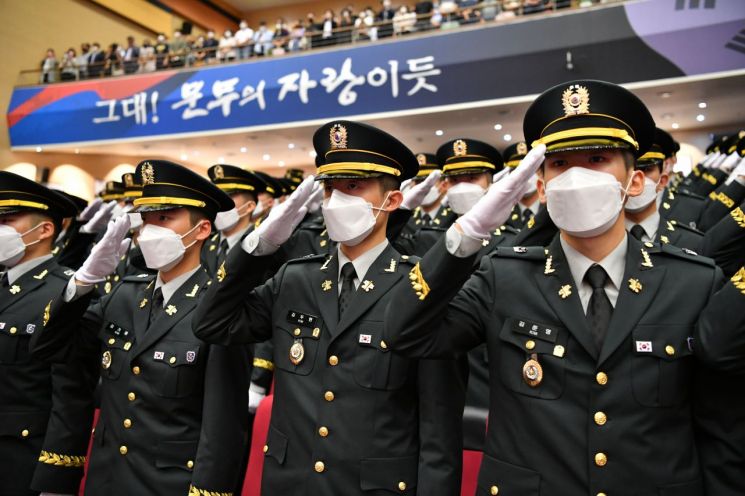 New officers are saluting at the '67th Bachelor Officer and 43rd Non-Commissioned Officer Integrated Commissioning Ceremony' held on June 24 at the Army Cadet Military School in Goesan, Chungbuk.
 [Image source=Yonhap News]
As the increase in soldier salaries becomes a reality, concerns have emerged that a 'military salary inversion' phenomenon may occur, where non-commissioned officers receive less pay than soldiers. Currently, the starting salary for both new non-commissioned officers and officers at step 1 does not reach 2 million KRW.
According to the 2022 military salary table announced by the Ministry of Personnel Management, the salary for a sergeant at step 1 is 1,705,400 KRW per month, and for a staff sergeant at step 1, it is 1,791,100 KRW. The salary for a second lieutenant at step 1 is 1,755,500 KRW, and for a first lieutenant at step 1, it is 1,920,900 KRW. If the salaries of officers are not increased, soldier salaries will surpass officer salaries in three years.
There are also concerns that the increase in soldier salaries will further reduce the recruitment rate of officers. In recent years, the number of applicants for non-commissioned officers and officers has already been significantly declining. According to the '2022 National Assembly Inspection Issue Analysis' by the National Assembly Research Service, the number of recruits falling short of the target for each military branch's non-commissioned officer recruitment was 12,200 in 2017, 14,300 in 2018, 8,100 in 2019, 10,400 in 2020, and 9,700 in 2021.
The situation is similar for officer recruitment rates. According to the Ministry of National Defense, the competition rate for this year's Army Reserve Officers' Training Corps (ROTC) candidates, which started in March and ended in May, was 2.4 to 1. This is nearly half the number of applicants compared to 2015 (4.5 to 1).
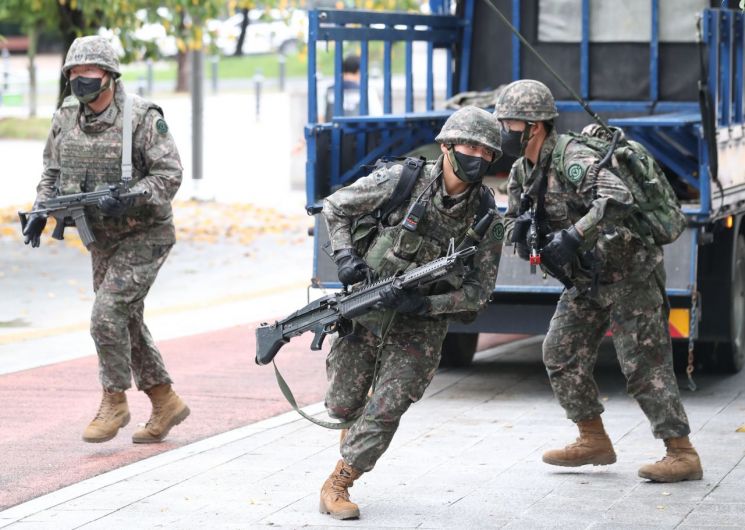 Soldiers from the Army's 50th Division and other participants are conducting realistic training during the 2022 Eulji Exercise counter-terrorism drill held on the 24th at Daegu Subway Line 2 Daegongwon Station.
 [Image source=Yonhap News]
Regarding the increase in officer salaries, the budget is expected to expand inevitably. This year, the total personnel expenses for soldiers, including the Soldier Tomorrow Preparation Savings, amount to 2.524 trillion KRW, which will rise to 3.4869 trillion KRW next year. To implement the plan to raise soldier salaries to 2 million KRW in three years, an annual budget of 5.1 trillion KRW is required. This corresponds to 9.3% of this year's defense budget of 54.6112 trillion KRW. If officer salaries are also increased, it is expected that an additional massive budget of 8 to 10 trillion KRW per year will be needed.
Meanwhile, the government announced on the 30th in the 2023 defense budget that the short-term service incentive pay, which is paid as a lump sum to officers, will be increased by 50%. The plan is to raise it from 6 million KRW to 9 million KRW for officers and from 5 million KRW to 7.5 million KRW for non-commissioned officers.
© The Asia Business Daily(www.asiae.co.kr). All rights reserved.



















