Domestic Battery Industry Receives Love Calls Ahead of Inflation Reduction Act Implementation
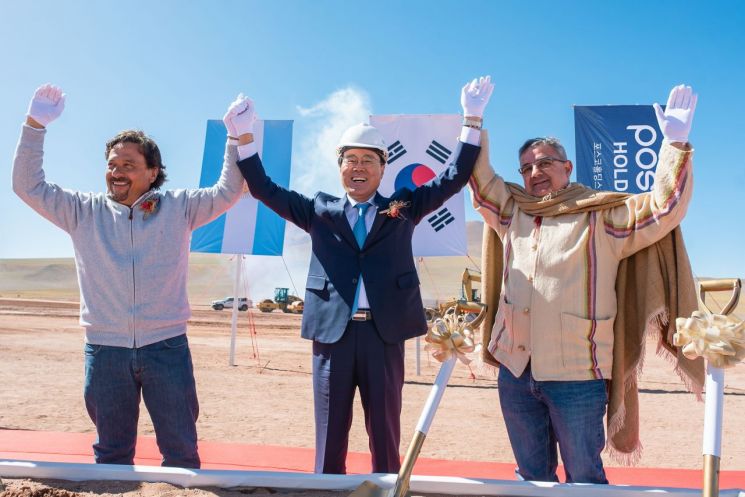 Chairman Choi Jung-woo of POSCO Group and the governors of Salta Province and Catamarca Province in Argentina are taking a commemorative photo after completing the groundbreaking ceremony for the first phase of brine lithium in Argentina this March.
 [Image source=Yonhap News]
As the United States' Inflation Reduction Act (IRA) is set to take effect, local governments in North America are actively courting the domestic battery industry. In the month the Inflation Reduction Act passed the U.S. Congress, governors and economic ministers from three North American states visited Korea to conduct "battery sales" promotions.
According to POSCO Holdings on the 31st, Choi Jeong-woo, chairman of the POSCO Group, met with Jason Kenney, governor of Alberta, Canada, and his delegation who visited Korea on the 29th, and had extensive discussions on resource development. Although no concrete investment plans or cooperation agreements were finalized, Governor Kenney explained the value of lithium brine deposits (lakes with inorganic salt content of 500 mg per liter or more) in Alberta and discussed potential collaboration.
Alberta, Canada, is one of the major lithium production regions in North America. Due to the enactment of the U.S. IRA, starting next year, electric vehicles must be assembled in North America and meet mineral and component ratio requirements for batteries to qualify for U.S. subsidies. Accordingly, the value of minerals such as lithium, nickel, and cobalt that can be sourced locally in North America is expected to rise. As securing supply chains across the entire value chain?from battery materials to cells and finished vehicles?becomes increasingly important, key officials from various state governments are visiting Korea directly to attract investment.
Alberta, in particular, has abundant lithium brine reserves where POSCO has developed eco-friendly extraction technology. According to the Korea Trade-Investment Promotion Agency, as of 2020, Canada's lithium reserves amounted to 15.16 million tons in lithium carbonate equivalent (LCE), with economically minable reserves estimated at around 2.8 million tons. Of these, 44% of lithium is stored in brine, with most of the brine lithium reserves concentrated in Alberta.
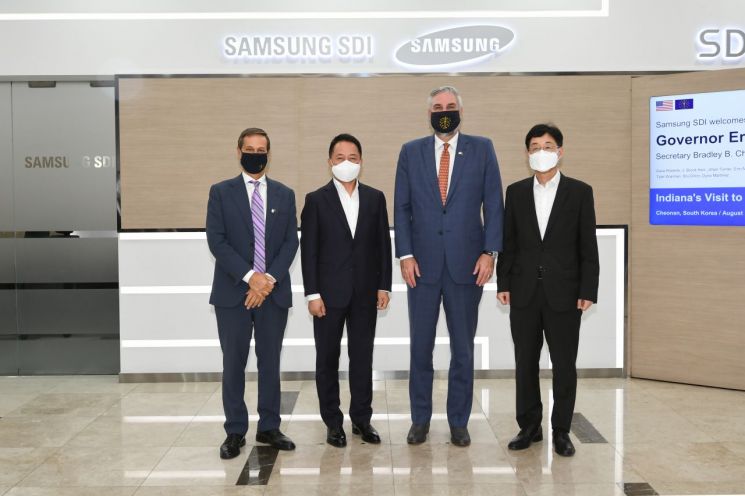 Choi Yoon-ho, President and CEO of Samsung SDI, is meeting with a delegation led by the Governor of Indiana, USA, and taking a commemorative photo at the Cheonan plant on the 25th of this month. From left to right: Bradley Chambers, Indiana Secretary of Commerce; Choi Yoon-ho, President and CEO; Eric Holcomb, Governor of Indiana; Park Jin, Head of Samsung SDI's Medium and Large Battery Division. Photo by Samsung SDI
Since starting lithium production technology development in 2010, POSCO has developed eco-friendly lithium extraction technologies from both brine and ore. POSCO's brine lithium production technology uses less brine and freshwater compared to other technologies, recycles most of the by-products during the process, and boasts high productivity. Commercialization is also within sight. In March of this year, construction began on a brine lithium plant based on the Hombre Muerto brine lake located in the highlands of Salta Province, Argentina, which is expected to produce 25,000 tons annually by 2024 (enough for about 600,000 electric vehicles).
Choi Yoon-ho, CEO of Samsung SDI, also met with Eric Holcomb, governor of Indiana, and Bradley Chambers, Indiana Secretary of Commerce, who visited Korea, on the 25th at the Cheonan plant in Chungnam. In May this year, Samsung SDI announced a joint venture with North American automaker Stellantis to produce electric vehicle batteries in Kokomo, Indiana.
Pat Wilson, Secretary of the Georgia Department of Economic Development, recently visited Korea and met with key executives including Chung Eui-sun, chairman of Hyundai Motor Group. Wilson toured Hyundai Motor's headquarters located in Yangjae-dong, Seocho-gu, Seoul, and discussed specific matters with officials. Hyundai Motor had earlier decided to establish its first dedicated electric vehicle plant in Georgia, aiming for completion in 2025, with construction scheduled to begin in the first half of next year.
© The Asia Business Daily(www.asiae.co.kr). All rights reserved.


















