No. 1 on Netflix Top 10 in the third week of August
Available in a total of 31 languages
"Kayak," "deed," "elle," and more
Dubbed version set for release next month
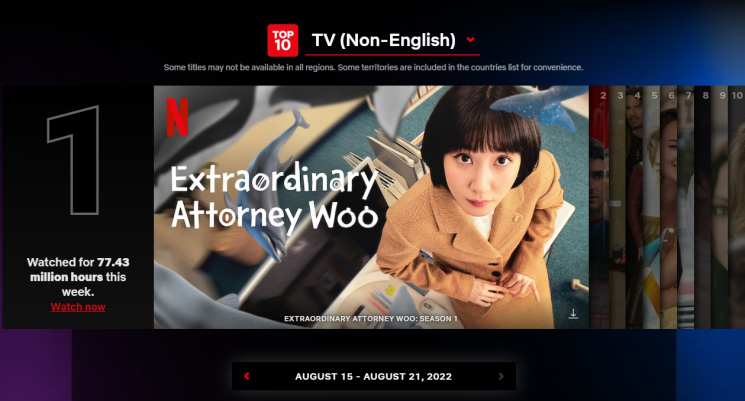 Woo Young Woo ranked first in the "Netflix Top 10" during the third week of August. In the non-English drama category, it held the number one spot for viewing hours for four consecutive weeks.
 Photo by Netflix
[Asia Economy, Intern Reporter Kim Goonchan] The ENA drama "Extraordinary Attorney Woo" (Woo Young Woo) has found success overseas as well. Analysts attribute this to subtitles that were carefully crafted to consider the nuances of each country's language, as well as the power of translations that preserved the flavor of the original dialogue.
Woo Young Woo, which concluded on August 18, has gained significant popularity abroad. According to Netflix's official website on August 30, Woo Young Woo ranked first in the "Netflix Top 10" during the third week of August. In the non-English drama category, it held the number one spot for viewing hours for four consecutive weeks. With 77.43 million viewing hours, it far outpaced the Mexican crime series "High Heat," which came in second with 27.68 million hours. This marks the sixth time Woo Young Woo has topped the viewing hours chart.
As Woo Young Woo's popularity has surged overseas, Netflix has expanded its subtitle offerings for the show. As of August 30, Woo Young Woo is available in a total of 31 languages, including English, Japanese, Spanish, and Portuguese. When the series was first released on Netflix, it was translated into 10 languages. As its global popularity grew, subtitle services were gradually expanded to countries in Asia, Europe, and South America.
Experts believe that Woo Young Woo's success abroad can be attributed to subtitles that were meticulously crafted to reflect the linguistic nuances of each country. The power of translations that preserved the unique flavor of the original dialogue is also seen as a key factor.
A prime example of this is the translation of the drama's title. The English title for Woo Young Woo is "Extraordinary Attorney Woo." Instead of directly translating "이상한" as "weird" or "strange," it was rendered as "extraordinary," which conveys a sense of being remarkable or exceptional.
 Woo Youngwoo's self-introduction was translated in the English subtitles as "Kayak," "deed," "rotator," "noon," and "racecar." Photo by ENA
A representative example of translation that preserves the flavor of the original dialogue is Woo Young Woo's self-introduction. In the show, Woo Young Woo introduces herself by listing words that are palindromes-words that read the same forwards and backwards. She says, "My name is Woo Young Woo, whether you read it forwards or backwards. Goose, tomato, Swiss, Indian, shooting star, Woo Young Woo... Yeoksam station?"
This self-introduction was translated into each language using palindromic words appropriate for that language. In the English subtitles, it became "Kayak," "deed," "rotator," "noon," and "racecar." For "Yeoksam station," since there was no suitable replacement, it was left as "Yeoksam station." In the upcoming dubbed version, it will be translated as "Civic" (a Japanese car brand).
Additionally, in the Japanese subtitles, words like "キツツキ" (woodpecker), "こねこ" (kitten), and "みなみ" (south) were used. In the Spanish subtitles, "arenera" (sandbox) and "somos" (we are) were selected, while the French subtitles used words like "radar," "elle" (she), and "ressasser" (to repeat).
Wordplay in the drama was also translated to capture its nuance. For example, when the character Mr. Kim introduces himself on a blind date by saying, "I'm Kim Min-sik-i-ramjwi" (a pun combining his name with "squirrel" in Korean), it was translated as "I'm Kim Min-sickly prickly," combining the similar-sounding English words "sickly" and "prickly."
In the line, "If you eat a banana, will you fall for me?" the pun on "fall for me" was translated as "will you find me a-peeling?"-a play on the word "peeling" (as in peeling a banana) and "appealing."
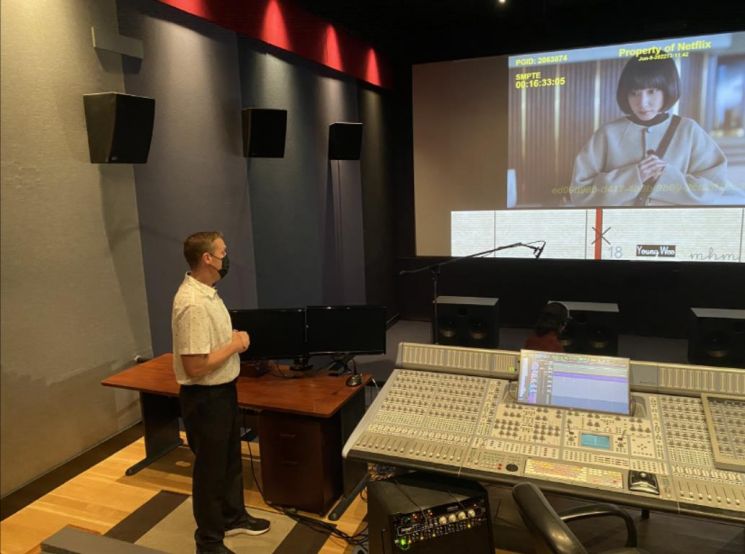 The dubbing director of Netflix is explaining the English dubbing work of Woo Youngwoo on the 23rd (local time).
 [Image source=Yonhap News]
Experts point out that as Korean content garners more attention overseas, subtitles and translations have become increasingly important. Cultural critic Jung Deok-hyun explained, "Even if something is universally understood in Korea, there are aspects that may not be understood abroad. The role of translation is to bridge that gap." He added, "Translation occupies a much more important position than in the past, and it is directly related to the success or failure of content."
Next month, a dubbed version of Woo Young Woo will also be released. Netflix is currently producing dubbed versions in English, Japanese, Hindi, Thai, Portuguese, and Spanish.
The dubbed versions aim to capture subtle nuances that cannot be conveyed through simple translation alone. Min Kyungseo, a consultant who provided Korean language advice for the dubbing process, said, "I provide guidance on the context and details of Korean lines in the show, such as the significance of switching from formal to informal speech. I also explained to the dubbing team that in Korea, the term 'oppa' is used by women to refer to their boyfriends."
Ezra Weisz, the Netflix dubbing director involved in the project, stated, "We respect Korean original content and aim to capture the nuances of the original actors' performances. We will create dubbed versions that make it seem as if the voice actors are engaging in natural conversation."
© The Asia Business Daily(www.asiae.co.kr). All rights reserved.



















