Powell, US Fed Chair, Signals Rate Hike Until Confidence Is Gained
Foreign Exchange Authorities Seem Unwilling to Defend Exchange Rate... Favorable for Chinese Exporters
[Asia Economy Senior Reporter Cho Young-shin] The value of the Chinese yuan is plummeting.
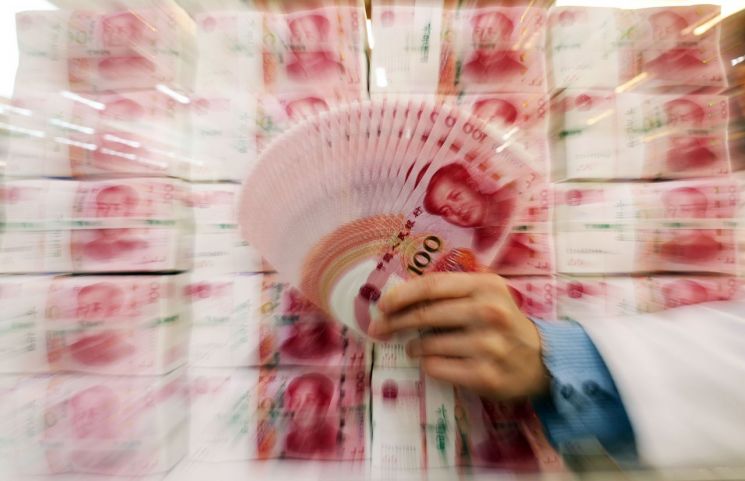
On the 29th, the People's Bank of China, the central bank, announced the yuan's reference exchange rate against the dollar at 6.8698 yuan (midpoint), up 0.212 yuan from the previous trading day. This is the lowest level since August 28, 2020. During the day (at 11:28 a.m. Beijing time), the yuan was traded at 6.9161 yuan per dollar.
If the current trend continues, there is a forecast that the yuan could again break through the 7-yuan-per-dollar level, a phenomenon known as "Po-chi (破七)".
The yuan has only risen to the 7-yuan-per-dollar level during the global financial crisis in 2008, in August 2019 amid the US-China trade war, and in April and May 2020 after rebounding from negative growth due to COVID-19. An increase in the dollar-yuan exchange rate means the yuan's value has fallen.
The continuous spread of COVID-19 in China, economic recovery slowdown, ongoing Russia-Ukraine war, and US inflation concerns are cited as causes for the yuan's depreciation.
Among these, the US interest rate hike policy is analyzed to have the greatest impact.
Jerome Powell, Chair of the US Federal Reserve (Fed), stated in his Jackson Hole speech on the 26th (local time) that the Fed will continue to raise interest rates until it is confident that inflation is under control, which is generally seen as influencing the yuan exchange rate. Powell's remarks are interpreted as suggesting that further rate hikes may occur next month.
Accordingly, some analyses suggest that whether the yuan exchange rate rises further depends on the will of Chinese financial authorities. In the onshore Chinese market, the yuan trades within a 2% range above or below the announced midpoint exchange rate. Considering the recent speed of yuan depreciation, it appears that Chinese financial authorities have a low willingness to manage the exchange rate.
Although some foreign media reported that Chinese financial authorities warned banks last week against selling yuan, the strength of the warning is unclear. From the perspective of the Chinese economy struggling with recession, a rising yuan exchange rate helps exports and other sectors.
Guangda Securities of China forecasts that the yuan's depreciation will not continue long-term and expects that industries such as petrochemicals, textiles, home appliances, telecommunications equipment, and automobiles could benefit from exchange rate fluctuations.
© The Asia Business Daily(www.asiae.co.kr). All rights reserved.