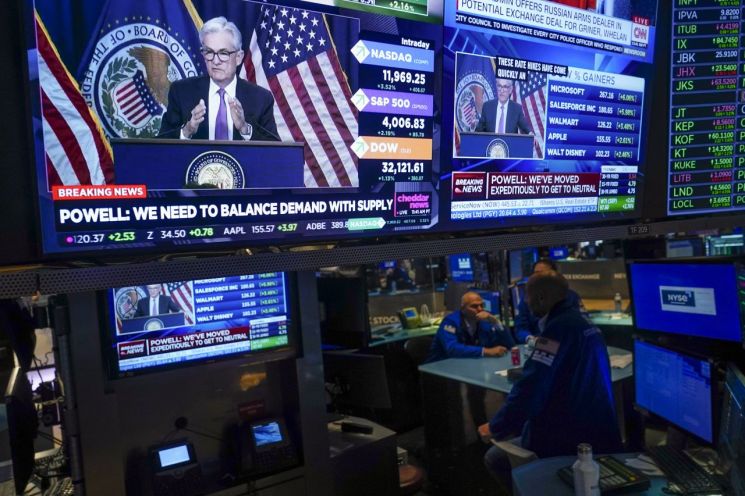
[Asia Economy Reporter Kim Bo-kyung] The United States and Europe emphasized the need to maintain high interest rates to curb inflation at the Jackson Hole meeting. Meanwhile, Japan stated that the inflation rate will soon decline and that it will maintain its monetary easing stance.
On the 27th (local time), Loretta Mester, President of the Federal Reserve Bank of Cleveland, said in an interview with foreign media held in Jackson Hole, Wyoming, that the U.S. Federal Reserve (Fed) is expected to raise the benchmark interest rate to slightly above 4% by early next year.
Given that the current U.S. benchmark interest rate is at 2.25?2.5%, this implies that a total additional rate hike of more than 1.5 percentage points is necessary.
President Mester predicted that this level of interest rates would be maintained throughout 2023, stating, "I do not expect the benchmark interest rate to decrease next year."
Regarding whether the Federal Open Market Committee (FOMC) will take a third consecutive 'giant step' (a 0.75 percentage point rate hike) or switch to a 'big step' (a 0.5 percentage point rate hike) at next month's regular meeting, Mester said the decision will be based on inflation indicators.

On the second day of the meeting, Isabel Schnabel, a member of the European Central Bank (ECB) Executive Board, also spoke, emphasizing, "We need to raise interest rates," and added, "Even if we enter a recession, we have almost no other choice but to continue on the path of (monetary policy) normalization."
In particular, Schnabel warned that central banks should not immediately stop monetary tightening at the first sign that inflationary pressures have eased.
She expressed concern that long-term inflation expectations could become entrenched well above the inflation target for an extended period, urging, "Central banks must act strongly."
In contrast, Haruhiko Kuroda, Governor of the Bank of Japan, took an opposing stance, saying, "We have no choice but to continue monetary easing," differing from the U.S. and Europe.
He forecasted, "Miraculously, our current inflation rate is 2.4%, most of which has been triggered by rising international commodity prices such as energy and food," and predicted, "The inflation rate will approach 2% or 3% by the end of this year and will further decline toward 1.5% next year."
© The Asia Business Daily(www.asiae.co.kr). All rights reserved.


















