 Japanese media evaluated that their citizens' English proficiency lags behind neighboring Asian countries. The photo is not related to any specific expression in the article. [Image source=Pixabay]
[Asia Economy Reporter Hwang Sumi] Japanese media have evaluated that their citizens' English proficiency lags behind neighboring Asian countries. As the influence of English increases in the international community, voices are emerging calling for changes in English education methods within Japan.
Recently, Newsweek Japan reported that as the number of English speakers increases in the era of globalization, the English proficiency of Asian countries is improving compared to the past.
First, it cited the average TOEFL iBT scores by country, a representative test measuring English skills. According to the media, the global average TOEFL iBT score rose from 79 in 2006 to 87 in 2020.
In particular, Asian countries showed annual improvements in English proficiency. Looking at the average scores by country in 2020, South Korea (86), China (87), and Taiwan (85) were at levels similar to the global average. However, Japan scored 73, relatively low compared to other Asian countries. This represents a difference of more than 10 points from the average score.
The media analyzed that this reflects the characteristic of Japanese people being cautious about speaking English. Because they feel embarrassed to use English imperfectly, an atmosphere has formed where only those who can speak it perfectly feel able to use English. Additionally, so-called 'Japlish,' which is far from native pronunciation, is cited as one of the reasons hindering English proficiency improvement. Japlish is a portmanteau of Japan and English, referring to Japanese-style English not commonly used in English-speaking countries.
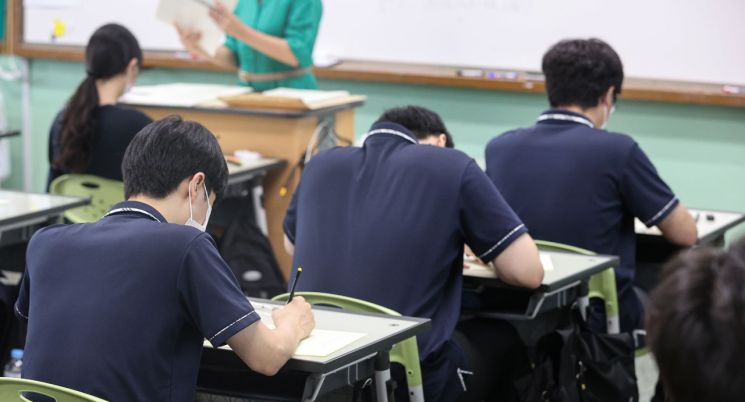 High school seniors took a mock exam on the morning of the 6th of last month at Ogeum High School in Songpa-gu, Seoul. [Image source=Yonhap News]
Furthermore, the media emphasized the need to change Japan's English education methods and mentioned South Korea's education. The media analyzed, "South Korea began English education reform in 1997 and raised its goals," adding, "English education starts from the first grade of elementary school, increasing study time and content sophistication, resulting in more students proficient in English."
It continued, "South Korean middle school English textbooks are more than three times thicker than those in Japan," explaining, "This means South Korean middle school students cover three years' worth of study in one year compared to Japanese students." It also emphasized, "South Korea's English classes focus on practical use, using books and texts written exclusively by native speakers rather than unnatural, grammar-centered English," adding, "Practical conversation instruction at a high level is being conducted compared to Japan."
It further added, "Twenty years ago, South Korea was known to be poor at English like Japan, but now it has become a country proficient in English comparable to Hong Kong in Asia."
Meanwhile, in Japan, the number of companies designating English as the official in-house language is increasing. A representative example is Rakuten Group, a comprehensive internet service company in Japan, which began conducting all workplace operations in English from 2012. All tasks, from various documents to meetings, are conducted in English.
Earlier, in 2015, automobile company Honda also announced it would use English as the official in-house language. Cosmetics company Shiseido declared in 2018 that it would adopt English as the official language for about 2,500 employees working at its global headquarters and Shiseido Japan. Since overseas sales account for more than half of total sales, it was judged that English communication became inevitable to respond to the purchasing demand of Japanese tourists and overseas internet shopping malls.
© The Asia Business Daily(www.asiae.co.kr). All rights reserved.

![Clutching a Stolen Dior Bag, Saying "I Hate Being Poor but Real"... The Grotesque Con of a "Human Knockoff" [Slate]](https://cwcontent.asiae.co.kr/asiaresize/183/2026021902243444107_1771435474.jpg)















