Ongoing Impact of Russia-Ukraine War
Increased LPG Demand as Expensive Natural Gas Replaced
Seasonal Factors and Supply-Demand Improvement Expected in Q4
Concerns Over Reduced Operating Rates at Petrochemical Plants
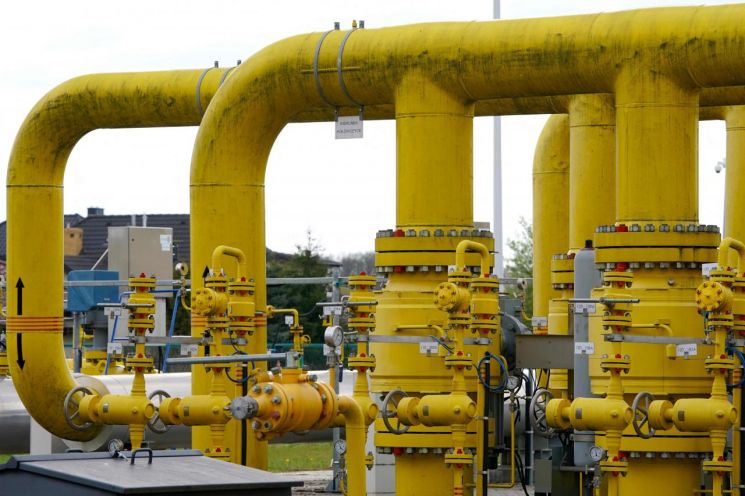 On April 28th, a gas pipeline at the natural gas relay station in Lembelszyce near Warsaw, the capital of Poland. On this day, Russia completely cut off gas supplies to Poland and Bulgaria, members of the European Union (EU) and the North Atlantic Treaty Organization (NATO), who have heavily relied on Russian natural gas. [Image source=Yonhap News]
[Asia Economy Reporter Choi Seoyoon] As liquefied natural gas (LNG) prices hit a 14-year high, expectations are growing for a recovery in demand for liquefied petroleum gas (LPG) as a substitute for expensive natural gas. LPG sales, which surged in the first quarter due to the outbreak of the Russia-Ukraine war, have slowed down in the second and third quarters. In the fourth quarter, LPG sales are expected to improve due to seasonal peak factors and better supply and demand conditions. However, petrochemical companies reducing their operating rates due to economic downturns remain a concern for domestic LPG importers such as SK Gas.
According to the Korea National Oil Corporation’s petroleum information site Petronet on the 28th, domestic LPG consumption in the first half of this year was 68.446 million barrels, an increase of 11.3% compared to the same period last year. An industry official said, "Demand for LPG, a substitute for natural gas, began to increase in the first quarter due to the sharp rise in natural gas prices," adding, "In the second quarter, sales declined due to seasonal domestic demand reduction and a slowdown in the petrochemical sector."
Natural gas prices have been volatile as Russia, which accounts for about half of Europe’s natural gas imports, drastically reduced gas supply. Natural gas prices in Europe have surged more than tenfold compared to a year ago. As Europe started importing the shortfall of natural gas from the United States, natural gas prices in the U.S. have also soared. Recently, the U.S. natural gas Henry Hub futures price reached $9.329 per million BTU (British Thermal Units), the highest since August 2008. Natural gas prices peaked in January this year, dropped to the lowest point of the year in April, and have been rising again since June.
When natural gas prices rise, sales of LPG, which can substitute natural gas, increase. SK Gas, the market leader in domestic LPG, saw industrial supply increase by 90,000 tons from January to March this year due to the rise in natural gas prices. Supported by this, its operating profit in the first quarter rose 181% year-on-year to 105.7 billion won.
However, due to increased demand and the overall rise in energy prices, LPG prices also rose, causing LPG sales to decline in the second quarter. The propane (residential use) price of E1, the second-largest domestic operator, was 1,465.8 won as of this month, up 33% from 1,094.8 won in the same period last year, and butane prices increased by 15% during the same period. An E1 official said, "International LPG prices have continued to rise following the increase in crude oil prices, but we minimized the price hike considering consumer burden relief," adding, "Since natural gas prices have risen so much, LPG prices remain competitive."
LPG demand is expected to increase in the second half of the year due to rising natural gas prices driven by heating demand in winter. Accordingly, the government is pushing a plan to blend LPG into natural gas starting in October to prevent supply and demand deterioration caused by the sharp rise in natural gas prices. To expand LPG blending, the government is also preparing to revise natural gas supply regulations. The plan even includes compensation for losses incurred due to blending.
A gas industry official said, "We expect sales to recover in the fourth quarter due to seasonal factors after the third quarter," but added, "It is concerning that petrochemical companies, which are industrial customers, have sharply reduced plant operations due to the recent economic downturn." The operating rates of the top three domestic chemical companies?LG Chem, Lotte Chemical, and Kumho Petrochemical?fell by about 5-10% in the first half of this year compared to a year ago. According to Leaders Index, a corporate analysis research institute, the inventory assets of 26 petrochemical companies in the first half of this year increased by 71% from the first half of last year to 28.3531 trillion won.
© The Asia Business Daily(www.asiae.co.kr). All rights reserved.

















