"Time is short, public and private sectors must respond together"
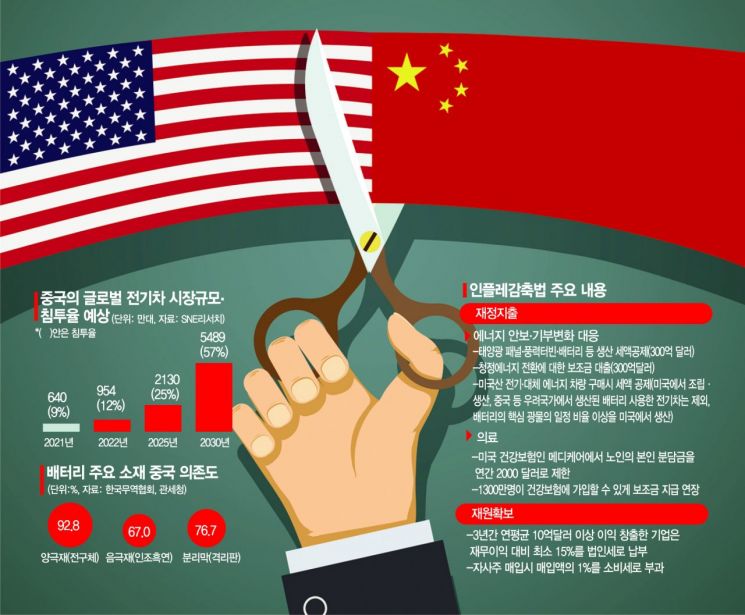
[Asia Economy Reporter Kiho Sung] Industry and experts are urging that the public and private sectors actively respond together to the enactment of the U.S. Inflation Reduction Act (IRA). Although the bill has passed, the enforcement decrees and regulations have yet to be established, so it is essential to incorporate our opinions as much as possible. Along with this, it is advised that domestic policies such as reforming electric vehicle subsidy programs and temporary corporate tax reductions be implemented to protect companies that may suffer damage.
According to the automotive industry on the 27th, Minister Lee Chang-yang of the Ministry of Trade, Industry and Energy chaired an urgent meeting on the 25th with related companies in automobiles, batteries, and semiconductors to discuss responses related to the U.S. Inflation Reduction Act.
According to the Korea Automobile Industry Association, due to the Inflation Reduction Act, Korean-made electric vehicles, which rank second in market share in the U.S. electric vehicle market, are not eligible for subsidy benefits, raising concerns about an annual export disruption of approximately 100,000 electric vehicles arithmetically. Furthermore, with a decrease in domestic production volume, not only the finished car industry but also the 13,000 domestic parts suppliers facing difficulties due to the transition from internal combustion engine vehicles to electric vehicles could face even greater challenges.
The industry holds the position that our government must actively voice its opinions to the U.S. administration and legislature. An official who attended the meeting said, "The government should raise objections as this violates the national treatment principle of the Korea-U.S. Free Trade Agreement (FTA) and the most-favored-nation principle of the World Trade Organization (WTO)." He added, "Especially, products manufactured in FTA partner countries like us should be recognized as having the same status as those produced in North America."
Experts point out that since the law has just been passed, it is more important than ever for our government to communicate its opinions. Professor Kim Pil-soo of Daelim University’s Department of Automotive Engineering emphasized, "What has currently passed is the parent law, and the enforcement decrees and regulations are being drafted. Therefore, it is crucial to strongly convey opinions without missing the timing."
On the 25th, the Korea Automobile Industry Association also issued a statement raising four major issues: ▲ violation of WTO subsidy regulations ▲ breach of the national treatment principle under the Korea-U.S. FTA ▲ violation of the vision of the Indo-Pacific Economic Framework (IPEF), which the U.S. is promoting for supply chain cooperation ▲ and contradiction to the spirit of strengthening the Korea-U.S. economic security alliance emphasized during President Biden’s visit to Korea this year. They requested the U.S. Congress and government to provide tax benefits equal to those for North American-made electric vehicles for electric vehicles produced in Korea, an FTA partner country and economic security ally.
There was also an opinion that government support is urgently needed to protect domestic industries. In the statement, the association requested that our National Assembly and government strengthen existing negotiation efforts for amending the U.S. law and enhance outreach activities to the U.S. Additionally, domestically, they called for measures such as improving the electric vehicle subsidy system, temporary corporate tax reductions for electric vehicle exporters, and support for electric vehicle export subsidies.
There are also calls to prepare for changes in the U.S. after the midterm elections scheduled for November this year. Researcher Lee Hang-gu of the Korea Automotive Research Institute advised, "Currently, the law requires batteries to be produced in North America, but depending on the midterm election results, the scope could expand further. If the North American production requirement extends to automotive parts and tires, it would inevitably cause significant damage to domestic industries, so preparations must begin now."
Chairman Chung Man-ki of the association stated, "The U.S. Inflation Reduction Act could shrink domestic electric vehicle production and negatively impact future vehicle competitiveness and jobs, so active joint responses from the public and private sectors are urgently needed." He emphasized, "It is necessary to improve the domestic subsidy system that provides about 50% of electric bus subsidies to Chinese-made products, as well as the zero-emission vehicle supply target system, which is being distorted into a policy promoting electric vehicle imports due to excessive focus on achieving electric vehicle supply goals."
© The Asia Business Daily(www.asiae.co.kr). All rights reserved.

















