Local Governments File Lawsuit to Ban Nuclear Plant Restart
Ruling Coalition Party Gongmyeong Emphasizes a Society Without Nuclear Power
Lack of Persuasive Grounds Due to Decline in Nuclear Power Economic Strength
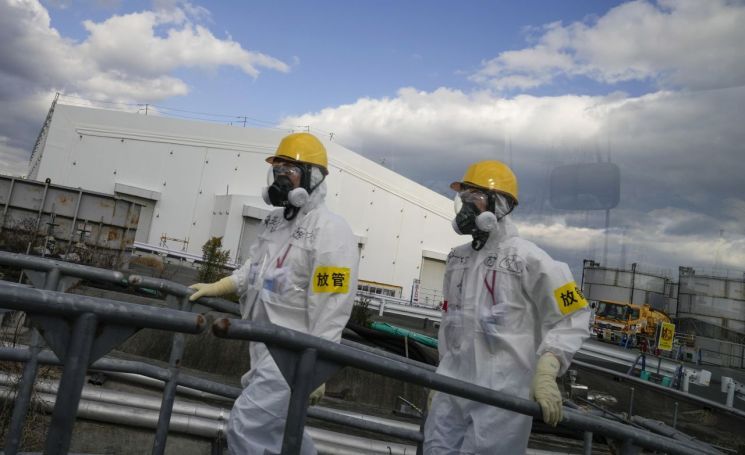 Workers wearing protective suits are passing by the Advanced Liquid Processing System (ALPS), a contaminated water treatment facility, at the Fukushima Daiichi Nuclear Power Plant in Omae, Fukushima Prefecture, Japan. Meanwhile, the Japanese government has officially approved the plan to discharge contaminated water generated at the Fukushima Daiichi Nuclear Power Plant into the ocean.
 [Image source=Yonhap News]
[Asia Economy Reporter Lee Ji-eun] Japanese Prime Minister Fumio Kishida has ordered the consideration of constructing new nuclear power plants and restarting existing ones to ensure a stable power supply, but it is expected that a difficult process will follow before the plans can be implemented. Foreign media in Japan predict that persuading local governments will become an obstacle to advancing nuclear power policies.
On the 25th, Nihon Keizai reported that the government must obtain the consent of local governments that have safety agreements with power plants in order to restart nuclear reactors. Although these safety agreements have no legal binding force, local governments are granted several rights through them, including prior consent rights, demands for measures, and rights to participate in inspections. Local governments effectively manage safety issues through these agreements, making it impossible to restart nuclear reactors by obtaining consent from power companies alone.
Furthermore, some local governments are currently strongly opposing the restart of nuclear power plants by filing lawsuits against them. Last year, 244 residents from Ibaraki Prefecture and Tokyo filed a petition with the Mito District Court to prohibit the restart of the Tokai No. 2 Nuclear Power Plant, citing the lack of evacuation plans for municipalities surrounding the plant.
Under current law, nuclear power plants must prepare evacuation plans for municipalities within 30 km of the plant, but Ibaraki Prefecture, where Tokai No. 2 Nuclear Power Plant is located, has not established proper evacuation plans. Currently, the restart of Tokai No. 2 Nuclear Power Plant has been banned by a ruling from the Mito District Court.
In addition, the Kashiwazaki-Kariwa Nuclear Power Plant in Niigata Prefecture is also effectively shut down due to insufficient protection of nuclear materials and other reasons. Residents of Niigata Prefecture have long opposed the government's use of reprocessed nuclear fuel at Kashiwazaki-Kariwa Nuclear Power Plant. Moreover, debates among residents regarding the safety of the fuel used at the plant have continued.
Nihon Keizai stated, "All these nuclear power plants have passed the screening of the Japan Nuclear Regulation Authority," but added, "It is unlikely that local governments will agree to the restart of the nuclear power plants."
Political opposition is another hurdle that must be overcome. The coalition partner Komeito Party has set a goal of achieving a society that does not rely on nuclear power in the upcoming July House of Councillors election. The party also maintains a cautious stance on the construction of new nuclear power plants.
Since the Great East Japan Earthquake in 2011, Komeito has shown differences with the Liberal Democratic Party regarding the operation of nuclear power plants. Komeito lawmaker Takeuchi Yuzuru expressed opposition to Prime Minister Kishida’s recent nuclear policy, stating, "Restoring public trust in nuclear power is a priority."
There is also the issue of economic viability that must be addressed. In Japan, concerns have been raised that nuclear power is less economically competitive compared to eco-friendly energy sources such as solar power. According to statistics on power generation costs to be incurred by 2030, released by the Ministry of Economy, Trade and Industry, the cost of solar power generation is lower than that of nuclear power.
Nihon Keizai noted, "Considering construction and decommissioning costs, the economic advantage of nuclear power has also faded," and added, "Even if the government pushes for construction, it is unclear whether power companies will invest, so the government needs to explain in detail the basis for promoting new nuclear power plants."
© The Asia Business Daily(www.asiae.co.kr). All rights reserved.
![Clutching a Stolen Dior Bag, Saying "I Hate Being Poor but Real"... The Grotesque Con of a "Human Knockoff" [Slate]](https://cwcontent.asiae.co.kr/asiaresize/183/2026021902243444107_1771435474.jpg)
















