Choi Joo-sun, President of Samsung Display, Delivers Keynote at 'IMID 2022'
Samsung and LG Display Develop OLED for Metaverse AR and MR Devices
Apple, Meta, and Samsung Electronics to Launch MR Glasses
[Asia Economy Reporter Han Yeju] "Samsung Display is preparing 'micro organic light-emitting diode (OLED)' in response to market demands. If we provide clearer customer value through definite technological solutions, the (micro OLED) market will open." (24th, Choi Juseon, President of Samsung Display)
To access the metaverse, hardware such as virtual reality (VR) and augmented reality (AR) devices is essential. The core of VR and AR devices is undoubtedly the display. Only high-performance displays can enhance visual comfort and fast operation speed, thereby increasing concentration on the virtual world. The 'market demand' mentioned by President Choi refers precisely to this aspect. As demand for IT devices such as TVs, laptops, and smartphones shrinks, the display industry is turning its attention to the metaverse device market.
According to the industry on the 25th, President Choi delivered a keynote speech titled "The Display Industry Changing through Disruptive Innovation" at the opening ceremony of IMID (International Meeting on Information Display) 2022 held at BEXCO, Busan, the previous day. He presented micro OLED as one of the specific goals to lead the self-emissive display market and achieve annual sales of 50 billion dollars.
President Choi stated, "To advance micro displays, the light source must shift from organic to inorganic materials, and the backplane must expand from glass to wafers. This will bring about a technological paradigm shift where displays evolve into semiconductors," adding, "VR and AR present a great opportunity for the display industry to expand the value chain and converge with other industries."
Micro OLED refers to a technology that deposits OLED elements on a silicon wafer, a semiconductor material, instead of the conventional glass substrate. Because silicon is used as the substrate, it is also called OLEDoS (OLED on Silicon). Currently, companies such as Japan's Sony and China's BOE are producing micro OLEDs in small quantities.
It is especially expected to be used in AR and MR glasses, drawing attention as the next-generation OLED display. AR and MR glasses require high resolution on small screens due to the short distance between the screen and the eyes. Unlike existing OLEDs with 300?400 PPI, micro OLED requires 3000?4000 PPI for this reason. Existing panel technologies such as liquid crystal displays (LCDs) can cause dizziness for users, so advanced display technologies like micro OLED are necessary.
Currently, the two major domestic display companies, Samsung Display and LG Display, are fully committed to establishing micro OLED production lines with the goal of mass production in 2024.
Samsung Display officially announced the development of micro OLED during its Q2 earnings conference call this year, and LG Display has recently begun preparations for mass production by ordering deposition equipment for micro OLED. In May, LG Display also unveiled a 0.42-inch micro OLED for AR glasses at the Society for Information Display (SID) conference held in San Jose, California, USA. This product realized an ultra-high resolution of 3500 PPI (pixels per inch), about ten times that of existing OLEDs, attracting significant industry attention.
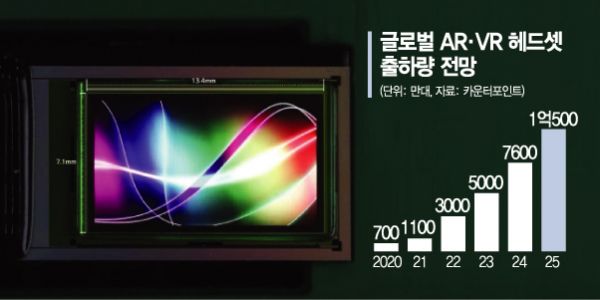
For domestic companies that decided to withdraw from the LCD business due to the influx of low-priced Chinese products, the expansion of the display panel market driven by increased shipments of VR and AR devices is expected to be a new opportunity. The AR and VR device market is currently in its early stages and is expected to expand significantly with the launch of Apple's AR headset as a turning point. Currently, most big tech companies such as Meta and Google are developing AR and VR devices, and Samsung Electronics recently entered this market by recruiting Executive Director Yoon Garam, formerly of Meta subsidiary Oculus VR, as head of the Samsung Research VR Lab.
Display market research firm DSCC forecasted that annual sales of displays for AR and VR devices will increase from $778 million (about 1.0137 trillion KRW) this year to $9.3 billion (about 12.1179 trillion KRW) by 2027. This means the market size will grow more than 12 times in five years.
© The Asia Business Daily(www.asiae.co.kr). All rights reserved.

















