 Some shared electric scooter operators are aiming for popularization through the integration of the 'public transportation transfer system,' but there are still issues that need to be resolved. / Photo by Song Hyundo, Asia Economy intern reporter
[Asia Economy Intern Reporter Song Hyundo] Some companies operating shared 'Personal Mobility (PM)' services such as electric kickboards are aiming for growth momentum as early as next year by integrating with public transportation transfer systems. However, as PM-related accidents surge, regulations are tightening, and citizens are complaining about the inconvenience caused by kickboards left anywhere, presenting significant challenges to be resolved.
The most active PM transportation mode introduced in Korea is shared kickboards. Shared kickboard companies began their business in earnest around 2017. The growth rate of the business is also steep. According to data released by the 'Electric Kickboard Council,' the number of shared kickboards operated by 13 leading domestic PM sharing companies increased more than fivefold from 17,130 units in 2019 to 91,028 units last year, two years later.
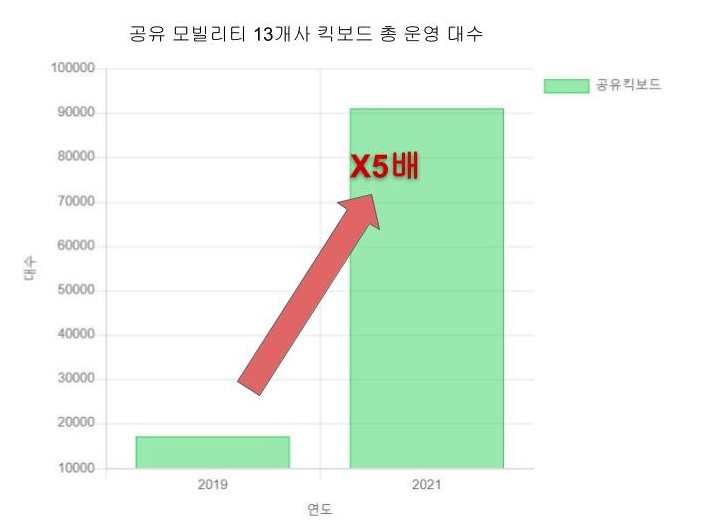 From 2019 to 2021, the number of scooters owned by domestic shared mobility operators increased more than fivefold. Source: Electric Scooter Council under Korea Startup Forum / Photo by Asia Economy DB
Some companies are promoting the integration of shared kickboards into the public transportation transfer system to strengthen growth momentum. For example, companies like 'Gicooter' and 'SsingSsing' formed a council on March 3 and signed a memorandum of understanding (MOU) with the transportation card settlement company Locomobility to add shared kickboards to public transportation transfer discount benefits. Accordingly, the introduction of a transfer system between public transportation and shared kickboards is expected to be fully implemented as early as next year. The industry expects that the 'integration into public transportation' of shared kickboards will further activate citizens' use of PM.
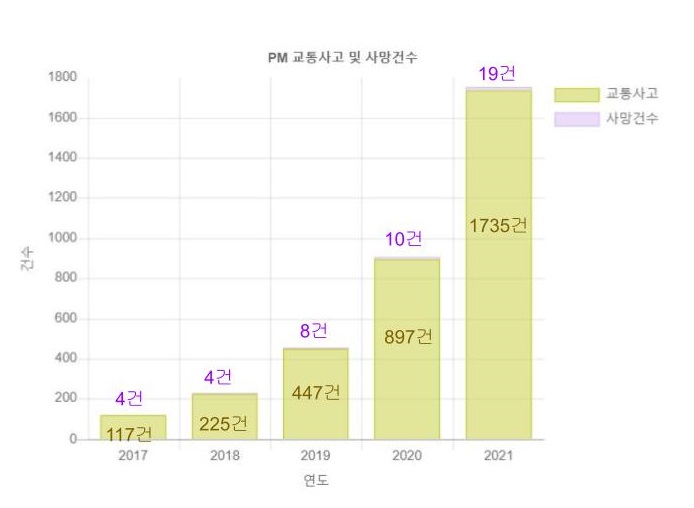 The number of traffic accidents involving Personal Mobility Devices (PM) has sharply increased from 2017 to last year. Source: Korea Road Traffic Authority / Photo by Asia Economy DB
However, some voices argue that considering various obstacles surrounding kickboards, full integration into the public transportation system is premature. Since the revision of the Road Traffic Act took effect in May last year, shared kickboard users are required to have a license and wear helmets. In particular, the helmet mandate is the biggest reason users hesitate to use kickboards. Most shared kickboard rides last only 3 to 5 minutes for short distances, making it inconvenient to carry a helmet just for a short ride. Some companies have placed helmets at rental stations, but due to high rates of damage and loss, expanding this service is difficult.
At the same time, it is difficult to call for deregulation because related traffic accidents are sharply increasing. According to the Road Traffic Authority, PM-related traffic accidents totaled 117 cases with 4 deaths in 2017, but four years later, last year, traffic accidents rose dramatically to 1,735 cases with 19 deaths.

Insufficient device management is also a challenge to be addressed. Many citizens complain that some users do not return kickboards to designated parking spaces but leave them illegally on the streets. In response, some local governments, such as Jeonju City in Jeollabuk-do Province, have established complaint channels to report the locations of abandoned kickboards and are conducting collection and towing operations.
Overseas, the approach is to manage the total number of kickboards. For example, Paris, France, authorized three shared kickboard companies through a business license bidding process in 2019, allowing each company to operate up to 5,000 kickboards. They also established evaluation criteria for balanced distribution, kickboard maintenance and recycling, and collection policies to oversee the overall management. Other major cities abroad, such as London in the UK, New York and Washington DC in the US, and Oslo in Norway, have set similar standards.
As a result, Western metropolitan cities like London, Paris, and New York have about 3,000 to 17,500 kickboards deployed respectively, enabling systematic management through collaboration between the city and private operators. This contrasts with Korea, where about 55,000 kickboards were deployed last year by as many as 14 operating companies competing in the market.
© The Asia Business Daily(www.asiae.co.kr). All rights reserved.
![Clutching a Stolen Dior Bag, Saying "I Hate Being Poor but Real"... The Grotesque Con of a "Human Knockoff" [Slate]](https://cwcontent.asiae.co.kr/asiaresize/183/2026021902243444107_1771435474.jpg)












