Ministry of Science and ICT "292.9 Billion KRW Project Budget Passes Preliminary Feasibility Study"
Operations Start in 2024, Unit 5 Already Unable to Meet Demand
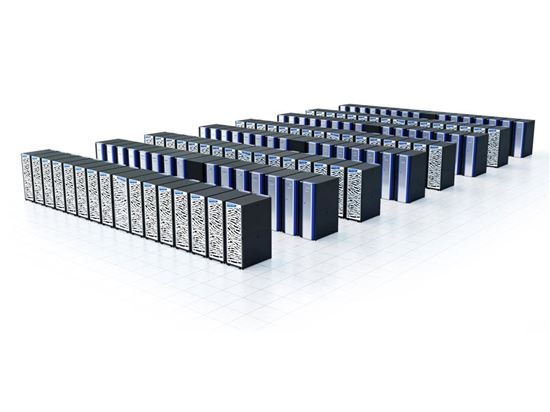 ▲Perspective view of Supercomputer No. 5.
 [Photo by KISTI]
[Asia Economy Reporter Kim Bong-su] The government will invest 300 billion KRW to newly install the 6th national ultra-high-speed supercomputer with performance ranked in the world’s top 10.
The Ministry of Science and ICT announced on the 22nd that the preliminary feasibility study for the project "Advancement of National Flagship Ultra-High-Performance Computing Infrastructure" to build and operate the 6th national ultra-high-performance computer (supercomputer) has passed.
The government plans to build a supercomputer with a theoretical performance of over 600 petaflops (1PF = 1,000 trillion calculations per second) by 2028, investing a total of 292.9 billion KRW. This includes hardware (HW) system and infrastructure construction, system software (SW) and development tool establishment and operational support for optimal use of ultra-high-performance computing. The infrastructure aims to support solving domestic scientific challenges and creating new industries based on the 4th Industrial Revolution.
Since the 1980s, the government has recognized supercomputers as social overhead capital supporting innovation across science, technology, economy, and society, and has introduced them accordingly. Starting with the 1st system in 1998, the 2nd in 1993, the 3rd in 2001, the 4th in 2008, and the 5th in 2018 were each established. The most recently built 5th system (Nurion) has had an average usage rate of 77% and a maximum of 90.1% over the past year (March 2021 to June 2022), indicating an overload state. Consequently, the project support rate (the ratio of selected projects to applied projects) was only about 51% as of last year.
Considering the operational efficiency aspects such as the speed of computational performance development and durability, the government has been promoting the construction of the new system (6th) since overseas cases typically replace ultra-high-performance computing resources every 4 to 5 years.
The Ministry of Science and ICT and the Korea Institute of Science and Technology Information (KISTI) plan to start official services for the 6th system from 2024. A Ministry official stated, "Through the establishment of the 6th system, it will be possible to improve research and development efficiency and overcome limitations based on ultra-high-performance computing, enabling timely acquisition of ultra-gap technologies in national strategic fields and accelerating scientific and technological innovation capabilities." The official added, "We will carry out preliminary procedures such as basic planning, infrastructure, and system design, and expand utilization by continuously supporting promising research in strategic fields that can only be performed through ultra-high-performance computing."
© The Asia Business Daily(www.asiae.co.kr). All rights reserved.
!["The Woman Who Threw Herself into the Water Clutching a Stolen Dior Bag"...A Grotesque Success Story That Shakes the Korean Psyche [Slate]](https://cwcontent.asiae.co.kr/asiaresize/183/2026021902243444107_1771435474.jpg)















